
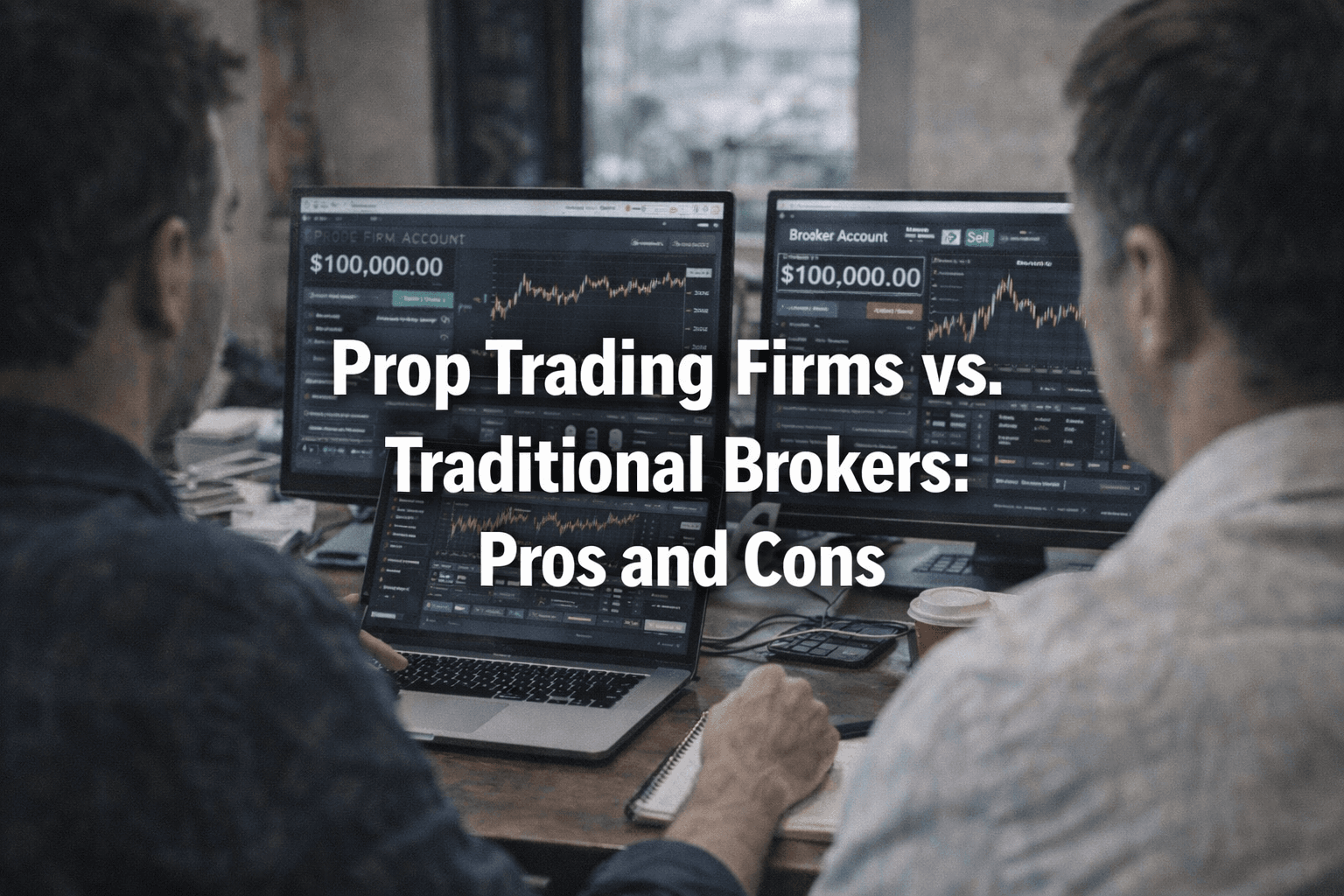
It’s true that if you read online lately about trading, you’ve seen a lot of conversation about prop trading vs. traditional backers or brokers, and which one is better for your needs. For many traders just beginning or getting to know their surroundings, it’s a complicated issue because both prop trading and traditional brokers offer opportunities to trade. What is more, both promise you access to the global markets and professional-level tools.
However, how prop firms and traditional brokers operate is very different, and because of this, your trading journey, risk level, and psychology can be very different as well. Let me break them down so you can easily see the key similarities and differences.
What is a Prop Trading Firm?
A prop trading firm (also called a proprietary trading firm) provides traders with access to the firm’s funds rather than requiring them to use their own capital. Prop trading firms typically require traders to demonstrate that they know how to trade responsibly and generate profits consistently by passing a challenge or evaluation phase. After successfully completing the challenge phase, the firm grants the trader access to the funds and will split the profits with them. Most traders see this as the biggest advantage of trading with a prop trading firm. This is because you do not need a large personal account to trade a full volume.
Although prop trading firms may sound simple, they can actually be quite complicated. The majority of prop firms will have various rules governing your trading, including maximum daily loss limits, profit targets, and limits on how long you can trade. While a prop trading firm can offer you the ability to trade with more buying power, they require you to be responsible and able to withstand pressure.
What is a Traditional Broker?
A traditional broker is what most traders think of when they think of brokerage services. You open an account, deposit your own funds, and trade directly in the markets. Any profits you earn belong entirely to you, and likewise, any losses are fully your responsibility.
In most jurisdictions, brokerage firms operate under well-established regulatory frameworks. These regulations are designed to protect clients, enforce transparent business practices, and establish clear operational standards governing how brokers and traders interact.
Traditional brokers do not provide traders with capital from the company. Instead, your trading activity is determined by the amount of money you deposit into your account, the leverage limits set by local regulatory authorities, and your personal risk tolerance. This structure gives traders full control over their trading decisions while placing full responsibility for risk management on the individual.
What is the Difference Between Prop Firms and Brokers?
The most obvious difference between prop firms and brokers is who supplies the capital for trading. Generally speaking, prop firms use their capital for trading, while brokers require you to supply your capital. There are other important distinctions between the two forms of trading; for example, brokers typically operate under a recognised financial authority to provide customer protection, whereas in some jurisdictions, prop firms are not required to be supervised by such an authority.
Another factor to consider is the terms under which traders may use their capital: profit firms versus brokerage companies. Prop firms usually impose profit benchmarks, consistency rules, and limits on losses they can incur to close out a trader’s position. Brokers, however, typically do not limit how traders trade, provided they adhere to the trading platform's guidelines.
Advantages of Trading through Prop Firms
For individuals who are comfortable with their trading strategies, access to greater capital will enable them to generate substantial profits even on modest percentage returns. Most prop firms have evidence of a structured risk-management system to ensure their traders maintain discipline. Psychologically speaking, prop firms can be psychologically beneficial to a trader because they aren’t putting their own funds at risk. Prop firms can also provide aspiring traders with an easier way to become full-time traders, bypassing the traditional steps.
Disadvantages of Prop Trading Firms
Unfortunately, these advantages come with some disadvantages. The majority of the “prop” trading firms require you to take a “paid for” evaluation, and many a trader has failed more than once, so the expenses can begin to add up quickly. Additionally, the rules are oftentimes stringent, which can limit traders who would like to explore and/or hold extended trades or trade during times of high volatility.
Profit sharing is another disadvantage to prop-trading firms; even if one is doing very well at trading, one has to share one's profits with the prop firm. Every prop firm is slightly different, so you could end up delayed or unhappy if you don’t choose the right one.
Advantages of Traditional Brokers
Traditional brokers have one significant advantage: total independence. A trader can trade their own money using their own strategies without having to worry about any imposed limits or artificial rules from a broker. A trader keeps 100% of their profits. With most reputable, regulated brokers, you also get additional protections, such as transparency, fund protection, and a clearly defined legal framework.
Furthermore, traditional brokers usually offer a diverse range of market offerings; these can include Forex, Stocks, Commodities, Indices, Crypto, and much more. This variety allows traders, long-term investors, or anyone who likes to have 100% control over their accounts to take advantage of the many opportunities that arise.
Disadvantages of Traditional Brokers
However, using a traditional broker means that your money is always at risk. If you have a smaller account, returns may appear slow to materialise, and emotional stress can be especially high because you are trading your own money. In fact, depending on where you are, some traders may have limited leverage, which limits buying power.
The other thing you need to consider when using a traditional broker is discipline. Traders may become over-leveraged, over-trade, or mishandle their losses if they have no outside rules to govern their actions. In fact, the freedom that a traditional broker provides could ultimately impede a trader’s ability to trade profitably.
Comparison Table: Prop Firms vs Traditional Brokers
Feature | Prop Trading Firms | Traditional Brokers |
Trading Capital | Firm’s capital | Your own capital |
Regulation | Often limited or indirect | Usually regulated |
Risk | Firm bears main loss risk | You bear full risk |
Profit Share | Profits shared with firm | You keep 100% of profits |
Trading Rules | Strict rules, challenges | Flexible, fewer restrictions |
Emotional Pressure | Lower financial stress | Higher personal financial risk |
Accessibility | Requires evaluation | Open account and trade |
Long-Term Suitability | Good for scaling quickly | Better for independence & stability |
Who is Right For a Prop Firm?
If you have conviction in your strategy, are disciplined with your trades, and would like to trade large amounts without risking your own capital, then a prop trading firm could be beneficial. Traders who thrive in structured environments and those who prefer to work with performance systems that track performance levels will also find prop trading firms favorable.
Who is Right For a Traditional Broker?
A traditional broker may be a better fit if you prefer to have control, flexibility, and full ownership of your profits. For example, a trader looking to build a long-term portfolio or someone who wants to trade without having to follow all the trading rules most prop firms impose would benefit greatly from using a traditional broker.
Final Thought: Which Is Better?
There is no single "winner" in the "Prop Trading Firm vs. Traditional Broker" debate. The best option for you will depend on your trading style, experience, current level of knowledge, and, most importantly, what matters most to you as a trader (i.e., access to large capital quickly versus regulation, freedom from all trading restrictions, and the right to keep all profits). Understanding yourself clearly as a trader will lead you to discover which option you are best suited for.