
Sélectionnez votre langue préférée
Les changements de langue seront appliqués immédiatement
Sélectionnez votre langue préférée
Les changements de langue seront appliqués immédiatement
The Relationship Between Margin and Leverage
"Find out how leverage magnifies opportunity as well as risk, how margin works as collateral, and how you can manage both effectively and safely."
Équipe Wikilix
Équipe de Contenu Éducatif
Imagine this: you open a trading platform, fund it with a respectable $1,000, and instantly you're able to control a position worth $100,000. It feels like financial wizardry—but it's not. It's merely leverage and margin.
Because these two concepts are at the core of modern trading, they are also responsible for many of the misunderstandings, losses, and blown accounts that exist today. Knowing the relationship between margin and leverage is not a vanity detail; it's now a necessity for survival and success in the marketplace.
Margin is thought of as a cost or fee—it's neither. It is collateral–a portion of your account balance that your broker will hold so that you can keep a transaction open.
For example:
• Without leverage, if you were to trade one standard lot (in forex, that's $100,000), you would need $100,000 cash.
• With 1:100 leverage, you would only need $1,000 cash as margin.
So in this example, margin is like a security deposit that you put down to "borrow" extra buying power from your broker.
Leverage is the process by which traders can control substantial positions with relatively small amounts of their capital. It is represented as a ratio—1:10, 1:50, or 1:500—that tells you how many times bigger your position size can be relative to your margin, or collateral amount. For example:
• Leverage 1:10 → For every $1 margin, you trade a $10 position.
• Leverage 1:100 → For every $1 margin, you trade a $100 position.
Leverage amplifies opportunity - but it also amplifies risk.
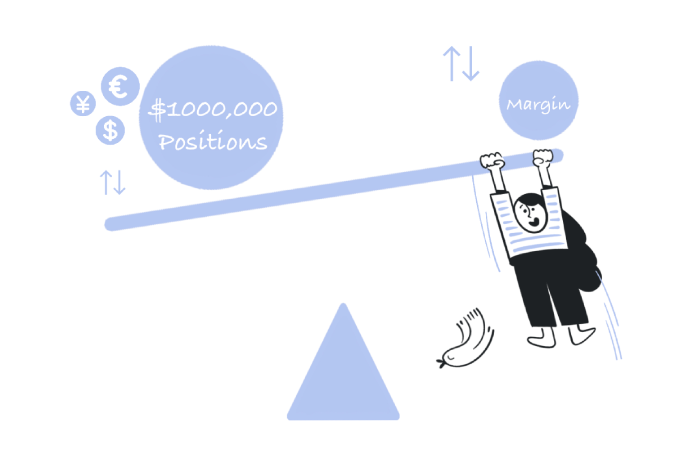
Margin and leverage are two sides of the same coin. The relationship is as follows:
Required Margin = Trade Size ÷ Leverage
Example:
• Trade Size = $100,000
• Leverage = 1:100
• Required Margin = $100,000 ÷ 100 = $1,000
This illustrates how leverage directly affects how much margin will be required—higher leverage → lower margin.
On the surface, high leverage looks very attractive, as it allows you to open prominent positions with limited capital. However, the danger is quite clear: a small move against your position can deplete your account very quickly.
• At 1:500 leverage, a 0.2% move against you means you have a 100% loss on your margin.
• At 1:20 leverage, you have significantly more space, but the upfront margin is larger.
For this reason, many regulators (like ESMA in Europe) restrict leverage for retail traders to protect them from devastating losses.
When open losses become too large, your equity (balance + floating P/L) falls enough compared to your used margin. If it falls below a broker's level:
• Margin Call: a warning that you no longer have enough free margin to open new positions.• Stop-Out: If the losses get deeper and deeper, your broker will automatically close trades to ensure that your equity does not become negative.
This illustrates a direct relationship: the reckless use of leverage reduces equity, which in turn further lowers the margin level, ultimately leading to stop-outs.
Let's say you deposit $2000 and are trading 1:100 leverage
• You place a $100,000 position (equity required of $1,000 margin).
• You have the market moves against you at only 2%. So you have lost $2,000.
• Account equity is now $0. You are out of business.
Now imagine this with 1:20 leverage.
• Required margin = $5,000 (so you could not even make this trade with a $2,000 account).
• That restriction has prevented you from blowing up your account.
This illustrates how leverage determines the rate at which the margin can be depleted.
Leverage is not inherently a bad thing. Quite the opposite, professional traders use leverage to:
• Diversify positions: Less capital has to be in each position, allowing you to spread your risk across several assets.
• Increase efficiency: Allows capital not to be locked into a single trade for the entire duration of the trade.
• Increase investment return: With the correct risk parameters, leverage can improve return without increasing stated risk.
The key takeaway is balance: use leverage smartly, and it can become a great tool. Misuse it, and the explosives can go off at any time.
1. "Margin is a cost." Wrong! Margin is collateral—not an expense.
2. "High leverage guarantees higher profitability." False—high leverage brings high risk with it!
3. "Margin calls only happen to beginning traders." False—even experienced traders can get margin calls when they don't respect risk management.
4. "Leverage is risky all the time." Not always—if you are careful, then leverage is a valuable tool.
• Keep Position Sizes Small: For every trade, never risk more than 1-2% of your equity into the trade overall.
• Always Use Stop-Loss Orders: Always know risk before entering the trade.
• Maintain Healthy Free Margin: It is seen more often than you think that traders push margin levels close to 100%.
• Leverage Matters: Many professionals will only use effective leverage of 1:5 or less on bulk trading, even if their brokers offer 1:500.
• Monitor Margin Level Daily: Monitor it like your trading account's heartbeat.
Margin and leverage are relevant to every market:
• Stock Trading: Brokers may offer 2:1 or 4:1 leverage.
• Futures & Commodities: Exchanges have strict margin rules.
• Crypto Trading: Platforms may offer incredible leverage (up to 1:100), with a considerable amount of risk.
The principle is always the same: margin = collateral, leverage = multiplier.
Emotional highs and lows arise from trading with leverage. A couple of quick wins might convince traders to increase lot sizes without proper thinking. Fast losses can lead to fear or revenge trades. This emotional roller coaster leads to poor decision-making.
Successful traders remain mechanical with the leverage and margin as pure tools and not emotional sources. They respect the math and are disciplined.
The margin and leverage relationship is a foundational element of modern trading, where margin is your collateral, and leverage multiplies your cash flow. When used correctly, the power of margin and leverage creates profit opportunities, but misuse can quickly lead to losses.
When used correctly, leverage can optimize your efficiency and freedom with your capital. When misused or mismanaged, you force margin calls and stop-outs. The key is to find balance: respect margin, manage risk through position sizing, and respect your margin.
In the end, the most crucial thing in trading is to survive before thriving. By mastering the margin and leverage relationship, you will not only protect your account but also put yourself in a position for growth within your trading in the market.
Continuez à développer vos connaissances avec notre parcours d'apprentissage structuré. Chaque section s'appuie sur la précédente.
C'est la première section
Vous êtes au début de votre parcours!
C'est la dernière section
Vous avez terminé ce cours!
12 min
Temps de lecture
Débutant
Difficulté