

Digital vs Paper Trading Journals – Which to Choose
Digital vs Paper Trading Journals – Which to Choose
"Discover the pros and cons of digital vs paper trading journals and find out which is best for your trading style. Learn how each option can help you track performance and improve your strategy."
Wikilix Team
Educational Content Team
9 min
Reading time
Intermediate
Difficulty
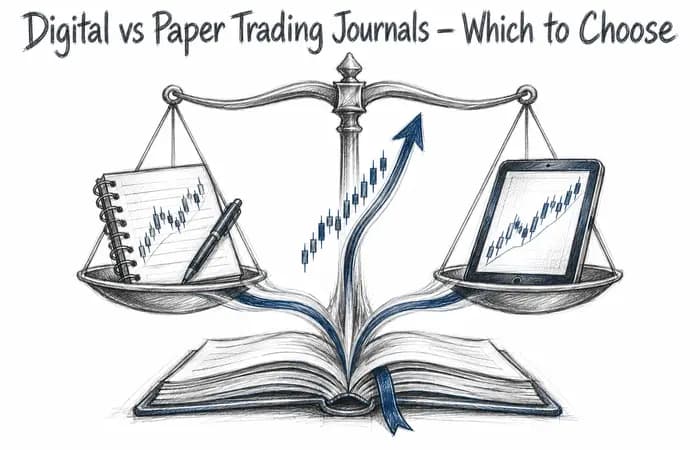
If you’ve committed to keeping a trading journal, kudos—you’ve taken one of the smartest actions you can take to become a better trader. Then the question becomes: Should you do it old school with a notebook? Or go with technology and keep a digital journal? Each has its benefits, and the choice is purely about who you are as a person, your habits, and your goals. Let’s talk about both to help you decide which one works best for you.
Why Use a Journal in the First Place
Before comparing the two, let’s make sure to remember why have a journal in the first place. Trading is fast and full of emotions. A journal allows you to slow down, think back on what you have been doing, and recognize trends or patterns that you might not have recognized on your own. Writing on paper, or typing on the screen, journals turn the random and arbitrary and non-systematized trade, into something improved through learning from the experience.

Paper Journals: Basic and Personal
Hand writing has a certain power. A paper journal does not require batteries, and it does not require software and do not require the internet, it is simply always there, useful. Most traders that I know write down their thoughts about their trading, and writing by hand requires more thought than typing, therefore causing you to think deeper.
For example, “I entered because I did not want to miss out,” stays with you as a sentence when you write by hand, has a much greater and memorable impression when it is handwritten. Paper journals also have that sense of privacy, and accessibility, you can literally open up a book and "just begin."
Paper journals have their disadvantages.Calculating performance metrics, organizing data or searching for specific trades can certainly be tedious. If you trade often, flipping through pages to pull insights from the past is going to slow you down.
Digital Journals: Fast and Efficient
On the other hand, digital journals—like spreadsheets, apps, or any trading platform that has built-in logging capabilities—will allow you to journal quickly and efficiently; type in numbers, see win rates, and create a chart showing your performance over a period of time.
For example, if you want to find out your average reward-to-risk ratio on your last 50 trades, a spreadsheet (or other digital tool) would calculate that for you in seconds. Digital tools also allow you to take screenshots of charts easily, categorize trades (if desired), and quickly search past entries.
The downside to using a digital journal? It loses some of the personal touch. It is so easy to type a quick note without fully reflecting on it. Plus, if you're not very disciplined about logging your trades, you can't expect any of the digital platforms to log them for you!
Here is a simple layout of the two vehicles for journaling:
Feature | Paper Journal | Digital Journal |
|---|---|---|
Reflection | Deeper, more personal | Quick, but sometimes rushed |
Organization | Limited, manual | Strong, automated |
Calculations | Manual effort | Automatic and fast |
Accessibility | Always available | Dependent on device/software |
Visuals (charts/screenshots) | Difficult | Easy to attach and analyze |
There are clear benefits for each option—you only need to find the style that works for you.
Which one is right for you?
If you are a trader that places a high value on reflection, enjoys that a journaling process slows your thoughts down, and does not trade frequently, a paper journal is probably best. It will connect you to your thinking so you can journal in a more mindful manner.
If you are a trader that is data-driven needs to account for numbers and performance metrics when ultimately making the decision to execute a trade or if you have many trades per week, digital is probably better. Digital will save you more time and provide you with clearer analytics in which to base your own trade decision-making.
And, you don't have to choose either/or. Many traders often use both the paper notebook to take notes on emotions and reflections with a second spreadsheet to note the numbers and stats. If you have both vehicles you will have the best of both worlds.
The Habit of Journaling is the Most Important
At the end of the day, the choice between either paper vs. digital matters less than the habit of journaling is what matters. Take a look at your own trades, review, look for patterns or consistency, to make necessary adjustments. It doesn't matter if you flip through a notebook or scroll through an excel sheet, just be consistent.

Final Thoughts
In the end, both paper or digital doesn't make a difference to your learning as long as you are actively using it. A journal is your own personal coach that provides a reflection system for you to reinforce lessons learned from the past for your own development moving forward. Begin with whichever engagement is the easiest to be consistent with and adjust your journaling as you develop in your trading journey.
If you are looking for more tips for journaling, building habits of effective journaling, and useful and practical tools to make your trading journey easier, check the Learn section on Wikilix! It was put together for this purpose—helping traders develop smarter, with consistency and confidence through the next trade.
Frequently asked questions
Answers to the questions readers ask most about this lesson.
Comments & Reviews
0 entries
Nothing on the record yet
Be the first to share what happened.
What's Next?
Keep building your knowledge with our structured learning path. Each section builds upon the previous one.