

Choosing the Right Timeframe for Your Strategy
Choosing the Right Timeframe for Your Strategy
"Learn how to choose the right timeframe for your trading strategy. Understand how different timeframes affect risk, profit potential, and your overall trading style."
Wikilix Team
Educational Content Team
16 min
Reading time
Intermediate
Difficulty
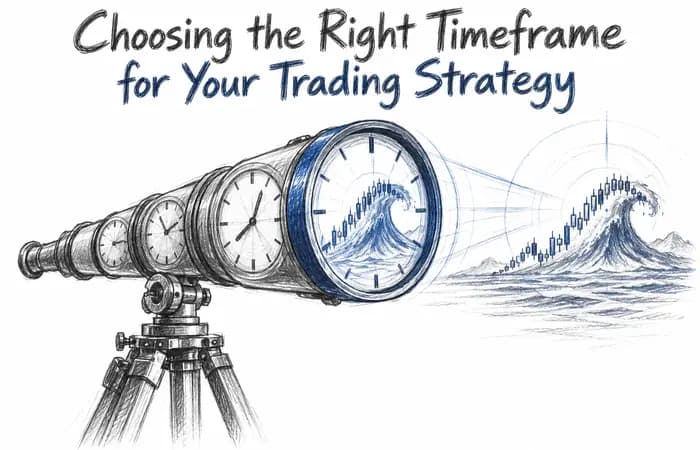
If you've ever thought about how two traders can view the same chart and come to significantly different conclusions, part of the answer lies in the Timeframe. One trader sees a substantial uptrend on the daily chart while the other trader sees a short-term pullback on the 15-minute chart. Both traders can be correct, but their strategies, objectives, and outcomes may differ significantly.
Choosing the right Timeframe to use is one of the most crucial trading decisions you will make. The Timeframe impacts how you analyze the market, how often you trade, how long you keep an acquisition in place, and even how emotionally taxing trading can be. This article will help you discover your Timeframe, goals, strategy, and personality, enabling you to trade with confidence and consistency.
What does Timeframe mean?
A timeframe in trading determines the length of time each candlestick or bar represents on your chart. If you have a 1-hour chart, which displays a price movement for each hour, you will see one candle per hour. A daily chart condenses price movement for the entire day into a single candle.
Different timeframes reach different views.
• Short-term (1m -15m): Perfect for scalpers looking for quick, small profits.
• Medium-term (1H-4H) traders use the harmonizing of being active with conducting some analysis of their trades throughout one trading day.
• Long-term (Daily- Weekly), the position trader or long-term investor screen will pay more attention to the significant price trends that take more time to develop.
The goal isn't to determine which Timeframe is "best"; it's to find the one that fits your trading style, level of patience, and daily schedule.

Step One: Have the Timeframe line up with your Trading Goals
Always keep your goals in mind before opening your charts.
If you are in the market to take a few quick profits and don't mind sitting in front of your screen for a short period, then your Timeframe is likely to be something shorter, such as 5 or 15 minutes. However, if you are hoping to grow your wealth slowly over time and hold down a forty-hour-a-week job, then a timeframe of daily, weekly, or even 4-hour candlesticks would suit you best.
Questions to ask yourself:
• What would be the most time I could realistically commit to trading each day?
• Am I more suited for quick decision-making or waiting patiently for a really good setup?
• Would I prefer many quick gains or a few larger moves?
The more precise your goals, the easier it will be to pick the correct time frame.
Step Two: Find the Timeframe that Fits your Personality
Every trader is different in their emotional tolerance. Some traders excel in fast-paced action and can outlast the market because they thrive on rapid movement, while others perform better with slow, calculated moves.
• If you suffer from impatience or get bored easily, shorter timeframes like 1-minute and 5-minute may help keep you engaged; however, this will also require a lot of focus and discipline.
• If you are more patient and methodical by nature, then higher timeframes, such as 4-hour and daily, help you to reduce "noise" and prevent any two emotions from overtrading.
• If you are analytical by nature and like looking at data, medium timeframes such as 1-hour are often a good compromise between detail and view.
Trading success is largely about self-knowledge, rather than market knowledge. The best Timeframe comes naturally. It will not feel forced.
Step Three: Understand the Trade-Offs of Each Timeframe
Each timeframe comes with its own advantages and disadvantages. Recognizing them helps set realistic expectations.
Timeframe | Pros | Cons |
|---|---|---|
Short-Term (1m – 15m) | More opportunities, faster results | High stress, higher transaction costs, noise-heavy |
Medium-Term (1H – 4H) | Balanced pace, manageable risk | Requires part-time commitment |
Long-Term (Daily – Weekly) | Less stress, fewer decisions, strong trends | Fewer trades, slower profits |
There’s no perfect choice — only trade-offs. What matters is finding the balance that lets you stay consistent without emotional burnout.
Step Four: Analyze Multiple Timeframes for Additional Context
Once you have selected your timeframe, professional futures traders frequently analyze multiple timeframes to confirm their signals. For example, a swing trader may identify the primary trend on the daily chart, look for entries on the four-hour chart, and then potentially fine-tune their timing on the one-hour chart.
Meanwhile, a day trader may check the one-hour chart for direction, then use a five-minute chart for entry. Being able to account for multiple timeframes widens your view, allowing you to see up to 50% of your trade opportunities while simultaneously reducing the risk of trading against the primary trend and identifying potential short-term trade opportunities. Think of it like using a map and a compass - one allows you to see your plan (the map), and the other guides your next steps (the compass).
Step Five: Consider Market Volatility and Liquidity
Different timeframes are impacted differently based on market conditions. First, in a volatile environment, short-term charts can become very erratic with false breakouts followed by whipsaws. Conversely, in a slow market or alternative ranging period, using longer (larger) timeframe charts can help to filter out market noise and focus on potential directions that offer meaning.
Second, you should also consider the liquidity in the market, or the ease of entering and exiting a position. Highly liquid markets, such as major forex pairs, facilitate easier execution of shorter-term trades. In contrast, less liquid asset classes and assets may be reserved for higher timeframes due to the increased difficulty of execution.

Step Six: Testing, Tracking, and Development
Determining the appropriate timeframe is not a single decision — it is a timeline of persistence and respect. You might begin with trading on a 15-minute chart and quickly find that your preferences lie with the 1-hour or the daily chart. There is nothing wrong with that.
Now, here are some things to consider when refining your choice:
1. Backtest your strategies on various timeframes, and based on your backtesting, find out which timeframe suits them best.
2. Keep a trading journal where you keep track of which timeframe feels most comfortable, and which timeframe offers the clearest signals and best performance.
3. Make a slow transition — do not change timeframes in short amounts of time or based on simple together results.
As with anything, consistency is found through repetition; so after you find a timeframe that suits your rhythm, stick with it and master that timeframe.
Common Mistakes When Selecting a Timeframe
Even experienced traders often make this mistake when working on their edge and within their chosen timeframe. Here are some mistakes to avoid:
• Jumping back and forth between timeframes too often: leads to confusion and simply inconsistency in signals.
• Selecting a timeframe that does not fit your lifestyle: If you cannot monitor positions during your days of work, day trading on short-term charts will be frustrating.
• Not considering higher timeframe analysis: trading on small timeframes of charts leads to only seeing the small picture, and not the big picture based on the existing higher timeframe.
• Do not backtest strategies on multiple timeframes before committing: test the strategy before live trading.
Consider this: trading as an overall does not depend on the timeframe as much as it depends on you and how consistently you apply it.
Conclusion
There is no ongoing discussion, nor is there a correct answer to the question "What is the best timeframe to use when trading?" The best timeframe is the one that allows you to trade consistently, comfortably, and with confidence, knowing you can implement and continue the strategy.
The premise is simple. Your trading system should fit you, not the other way around. Some thrive on the fast rhythm of 5-minute charts, while others prefer the calm of daily market analysis. The deal is that your chosen timeframe will fit your trading style and your ability to stay disciplined, and most importantly, remain objective and somewhat emotionally comfortable with the processing chosen while monitoring potential trades or even entered trades.
Trading enables you to "zoom in and out" of the market. As with a camera, you can zoom in too much and miss the big picture; conversely, zoom out and lose the details of the one pictured. The skill, once again, is finding the option that allows you to see the market clearly. When this finally occurs, the pieces will start to fit together, beginning with your entries.
Frequently asked questions
Answers to the questions readers ask most about this lesson.
Comments & Reviews
0 entries
Nothing on the record yet
Be the first to share what happened.
What's Next?
Keep building your knowledge with our structured learning path. Each section builds upon the previous one.