

Common Mistakes When Building Your First System
Common Mistakes When Building Your First System
"Avoid costly beginner mistakes when building your first trading system. Learn the most common errors new traders make and how to design a system that truly works."
Wikilix Team
Educational Content Team
15 min
Reading time
Intermediate
Difficulty
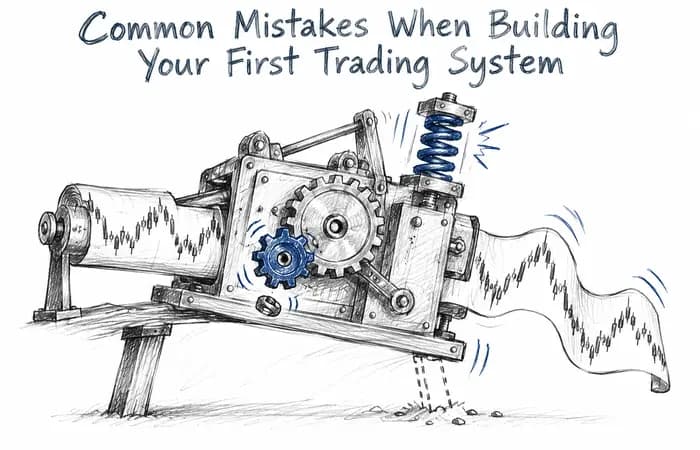
Each trader aspires to develop the perfect trading system, one that consistently produces winning trades, limits risk, and has the potential to generate profits almost automatically. However, upon closer examination, most first attempts do not pan out as expected. Systems that appear great on paper often unravel, and once live trading occurs, the systems become abundantly flawed.
Most of the time, the reason is that trading systems do work, but new traders often develop them incorrectly. They repeat the same easily avoidable mistakes time and again, which inhibits their success and confidence, not to mention the monetary costs.
If you are developing your first system, I would like to help you avoid some of the most common mistakes.
Mistake 1: Rodeoing without a clear goal
Many beginners start diving into charts and indicators without declaring what they want to accomplish with the system. Are you trying to take advantage of short-term, easy, quick profits or sit on longer time frames to capture longer-term trends? Are you wanting to trade frequently or have a higher probability setup?
Without having a clear goal, you are likely to mix strategies, thus creating confusion.
How do we fix this?
• Determine your style of trading (scalping, swing, or position).
• Define measurable goals – like "I am looking for a 3:1 reward-to-risk ratio" and/or "I will execute two setups a week".
You develop a trading system to serve you, not the other way around!

Mistake 2: Overcomplicating your system
A typical beginner believes that the more indicators we add, the more accurate we will be. In fact, for us, "more" will kill any clarity you might have had. Depending on five indicators, three filters, and two rules for confirmation in your system, you'll find yourself in a confused state, waiting to be overwhelmed — and you'll hesitate before taking action.
The Truth: Simple systems are easier to adhere to, easier to adjust, and less prone to errors.
How to Fix It:
• Focus on two or three essential building blocks, such as trend, your entry trigger, and how you'll manage risk.
• Only use indicators to add value and not unnecessarily add redundancy.
• Consistency beats complexity.
Mistake 3: Ignoring Risk Management
Even a winning system can become a loser without proper risk controls. Newer traders often focus exclusively on entries and ignore their risk on every trade.
They believe, "If I only find the perfect setup, I won't need to set a stop-loss." The market has no investment in your conviction.
How to Fix It:
• Risk only 1–2% of your account in a single trade.
• Always utilize a stop-loss and stick to your pre-established parameters.
• Backtest your strategy with reasonable-sized positions.
The name of the game is not figuring out the future, but handling what happens when you're wrong.
Mistake 4: Not Backtesting Properly
Many traders skip altogether and say the system "looks good" on the recent charts. If you don't backtest, you are just randomly guessing, not validating.
How to Fix It:
• Utilize historical data to gauge how your system performs on several hundred trades.
• Record the crucial metrics - win rate, profit factor, drawdown, and expectancy.
• Test your system with trending, ranging, volatile, and quiet market conditions. A backtested trading process provides you with a degree of confidence, as it has demonstrated how the system performs during challenging periods.
Mistake 5: Curve Fitting (Over-Optimization)
After backtesting, some traders attempt to "perfect" the system by adjusting every parameter to achieve the highest historical performance. This is curve fitting, which is a pitfall. When you find over-optimized past performance, you have created fragility for the future.
How to correct:
Optimize for robustness, not perfection.
If slight changes in the parameters ruin performance, the system is too fragile.
Use walk-forward testing, which uses the optimized system on data it has never seen before.
A proper system will be robust enough to perform satisfactorily in multiple markets and time frames—not simply for one backtest.
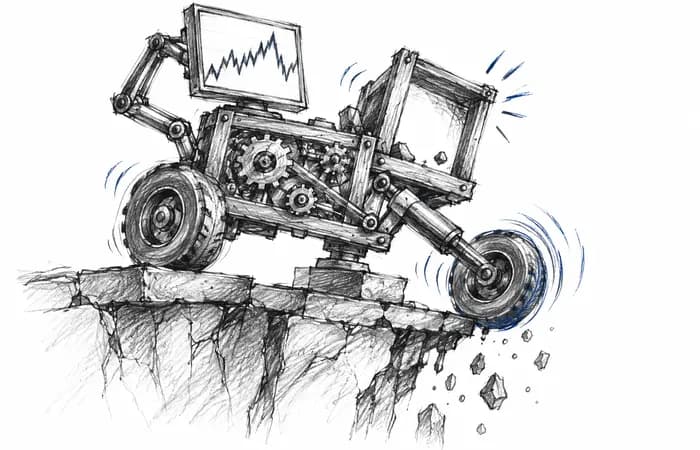
Mistake 6: Forgetting Market Regime
A trading system may work like a charm in a trending market, but in a sideways market, it may fail. New traders often forget that market regimes change, and the system trader must adapt to the changing market regime.
How to correct:
Understand the type of market your system would perform the best in (trend, range, or volatile).
Implement filters (like MAs or ADX) to confirm the changing market regime.
Review your performance quarterly and adjust rules as the regime evolves. Does it trend, or does it move sideways?
Markets change - you must also. Mistake #7: Failing to Maintain a Record of Outcomes or Journal
When a new trader creates a system, they often stop tracking the performance entirely. They say every system "just works." Without data, you cannot improve.
How to Fix It
• Hold a trading journal for every trade you take: entry, exit, reasoning, and outcome.
• Examine for trends -- were losses due to bad trades or emotional mistakes?
• Keep updating this information to adjust your system.
A system without a real-time feedback loop is like driving without a dashboard -- you really cannot tell if something is wrong.
Mistake 7: Allowing Emotions to Guide Following Rules
Even the best system breaks down if you cannot follow it. Fear and greed are your constant adversaries -- they will drive you to close trades too soon, chase trades, and break your rules.
How to Fix It
• Treat your trading system like a business plan.
• Fully mechanical (not emotional), follow your rules.
• Begin with smaller position sizes until you have complete confidence in your system.
Discipline is what converts your trading plan to a trading system.
Mistake 8: Wanting to Win All of the Time
Many first-time creators want to be profitable quickly. They may test their system for a week, lose a few trades, and then declare it "broken." Sound systems do not just win, win, win.
How to Fix It
• Focus on consistent results over time -- not how it performed after the first week -- which is a very short timeframe.
• Focus on results over dozens/hundreds of trades -- not just the last few trades.
• Remember, trading is a probabilities game -- it's okay not to win every trade.
Patience and data-driven thinking are what take traders from beginners to professionals.
Mistake 9: You Rely on Just Copying A System
The very first thing any trader wants to do is copy someone else's system -- especially if they say (or a friend says) it is a "proven" system or systems. If you do not understand how or why it works, how can you know what to do when your system stops working?
How to Fix It
• Be sure to examine the logic behind every rule before you use it.
• Customize systems for your style, risk tolerance, and how much time you have to apply the system process.
• Do not unthinkingly follow a system -- either personalize it or do not bother using it at all.
You do not become a successful trader by copying someone else's system -- you become successful by adapting a personal system.
Conclusion
Building your first trading system is exciting -- and yes, there will be mistakes because it is all still very new to you -- but awareness is power. If you can identify common mistakes and avoid them, you will create a real opportunity for something sustainable.
A successful trading system does not need to be perfect -- it only needs to be clear and consistent with your goals. Try it. Trust it. Improve it over time.
Just remember -- every single successful trading professional started with their "first trading system." The only difference is that they learned from their mistakes and developed mastery from the experience.
Do not strive for perfection -- aim for intelligence, and intelligence will evolve as you do. That is the foundation for successful trading.
Frequently asked questions
Answers to the questions readers ask most about this lesson.
Comments & Reviews
0 entries
Nothing on the record yet
Be the first to share what happened.
What's Next?
Keep building your knowledge with our structured learning path. Each section builds upon the previous one.