

What is a Mechanical Trading System?
What is a Mechanical Trading System?
"Tired of emotional trading? A mechanical trading system could be the answer. Find out how rule-based strategies can bring discipline, consistency, and confidence to your trades."
Wikilix Team
Educational Content Team
17 min
Reading time
Intermediate
Difficulty
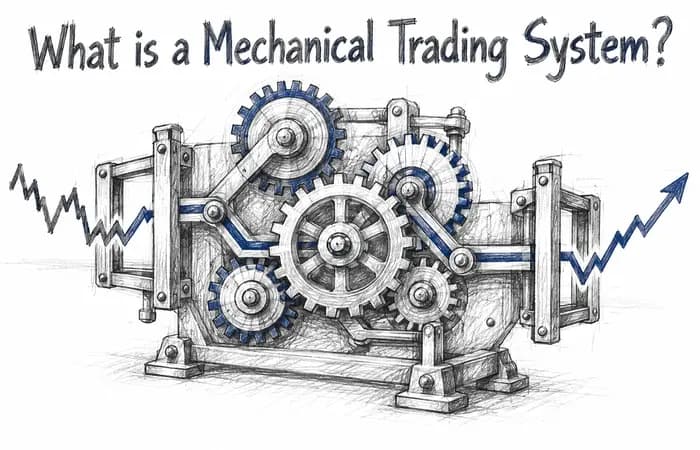
Envision trading the markets free from fear, hesitation, or second-guessing about your decision-making. Each entry and exit is a function of a rule; your decision-making is uniform day after day, regardless of how the market behaves. This is the promise of mechanical trading — a systematic approach that replaces an emotional component with a logical, rule-based decision-making approach.
In a world often plagued by emotional baggage that disrupts the decision-making process of seasoned traders, mechanical systems have become the vehicle of choice and the backbone of every trader seeking a disciplined, consistent, and outcomes-based approach to decision-making. But what is a mechanical trading system? How does this decision-making process work? And, more importantly, are mechanical trading systems the true "Holy Grail" to long-term trading success?
What is a Mechanical Trading System?
A mechanical trading system is a predetermined set of rules that tells you when you're going to buy, when you're going to sell, and how much capital the trade represents. Every decision (entry and exit, as well as all position sizes) is tied to and based on objective criteria rather than emotional judgment or your "gut feeling."
In a different sense, it is trading in autopilot mode, fueled by logic rather than impulses. Some traders just handle that execution as humans, while others rely on software to execute the rules.
The primary goal is to be consistent, but with a mechanical system, the decision-making process responds uniformly to market signals, enabling you to eliminate the number one contributor to inconsistency: human psychology.
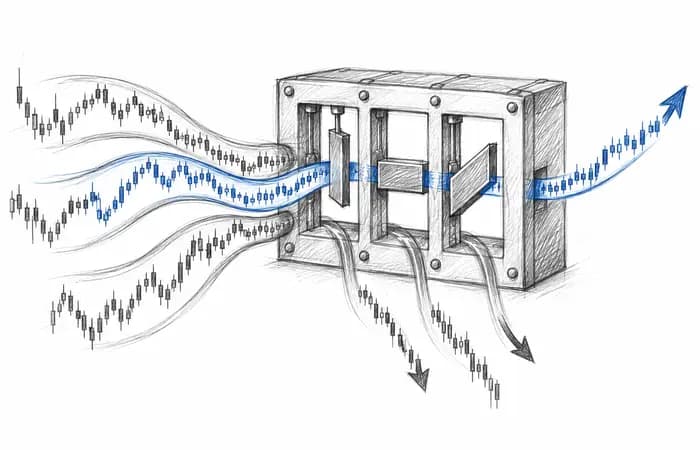
Why Do Traders Use Mechanical Systems?
The reason most traders lose money is not that they had a bad idea; rather, it is that they could not execute on that idea consistently due to fear, greed, impatience, self-doubt, or any other emotional charge in the moment. Potentially, you open a trade and, after a week or so, you have become profitable, only to do something irrational that ruins potentially weeks of work in one click. Mechanical trading systems remove that emotional noise. They simplify and objectively make decisions in an environment defined by clear, testable rules.
Here are a few reasons traders adopt that philosophy:
• Discipline: Every move is meant to be in accordance with logic.
• Saving Time: Once the system is established, it requires little to no supervision.
• Stress Reduction: Traders won't have to "guess" what to do.
• Backtesting: Rules can be run against data to validate performance before risking real capital.
In short, mechanical systems provide structure in a world of uncertainty.
Core Components of a Mechanical Trading System
A successful trading system doesn't emerge by accident. It is constructed using a few essential components.
1. Market and Timeframe Specification
Decide ahead of Time what market you want to trade, i.e., forex, stocks, futures, crypto, etc., and what timeframe (daily, hourly, etc).
2. Entry Rules
Determine what will trigger your trade to be executed, i.e., a moving average crossover, breakout above resistance, or momentum signal.
3. Exit Rules
Establish when you will exit a trade, either to take profit or to cut your losses. Exits are as crucial as entries!
4. Position sizing
Decide what size of your capital will be risked on each trade, which will help control for profit potential, as well as drawdowns.
5. Risk management
Incorporate a stop-loss and take-profit level. A mechanical system should be able to protect against a catastrophic loss.
6. Performance levels
Measure win rates, risk-to-reward ratios, maximum drawdowns, etc., to analyze the reliability of the system.
When all of these components work in harmony, you have a structured, habitual, and repeatable process — not merely a strategy, but a system.
The Development of Mechanical Systems
The development of a mechanical trading system typically consists of a step-by-step approach:
1. Idea Generation - To start, you begin with an idea. For example, "I believe that trends persist after a breakout."
2. Rule Definition - You take that belief and create specific and measurable rules for it.
3. Backtesting - You take those rules and apply them to historical data to see how they perform.
4. Optimization - You adjust the parameters to optimize for even better results, but are careful not to overfit.
5. Forward Testing - You test the system live and/or on data that has not been seen to see if results are consistent.
6. Live Trading - You take the system and trade it with real capital, preferably in small sizes at first.
Successful traders approach this method in the same way that a scientist runs an experiment - hypothesis, test, revise, test again.

Benefits of a Mechanical Trading System
✅ Emotion-Free Decision Making
A mechanical trading system enables traders to take actions based on predefined rules, which avoids the emotional rollercoaster that can lead to inconsistent behavior.
✅ Consistent
Since the same conditions lead to the same actions, a mechanical trading process generates consistent actions, which in turn help produce consistent and reliable long-term performance.
✅ Accountable
You can track your system's performance, identify areas for improvement, and view its strengths and weaknesses in your account.
✅ Saves Time
Mechanical systems can trade multiple markets simultaneously, automatically, while you sleep.
✅ Flexibility:
After it is developed, a mechanical system can be customized to work with different assets or different time periods with simple modifications.
Disadvantages and Limitations
No system is perfect - mechanical trading has its drawbacks, too.
❌ Over-Optimizing (Curve Fitting): A system may backtest extremely well but turn out poorly in a live market because it was "tweaked" too closely to the data, or it was over-optimized based on the data.
❌ Lack of Flexibility: Markets are changing. A rule that worked two years ago may not be effective in today's volatile market.
❌ False Confidence: Some traders may become too reliant on automation and forget that they need to observe performance and intervene if necessary.
❌ Issues with Technology: Automated systems depend on feeds and connectivity - a single dropped signal could lead to unexpected losses.
While mechanical systems help eliminate emotion, risk is still present. The critical thing to do is monitor the systems and evolve them appropriately.
Mechanical vs. Discretionary Trading
To further explain the concept of mechanical trading, it can be beneficial to compare it to its opposite: discretionary trading.
• Mechanical Trading: A rules-based approach where the trading process is systematic and repeatable and is based on specific criteria.
• Discretionary Trading: Not rules-based and is based on the trader's judgement and interpretation of the market, there is more Flexibility and subjectivity in this approach.
Many seasoned traders blend both approaches - using a mechanical trading system to provide structure, but reserve the discretion for the context. For example, as an experienced trader, I tend to avoid automated trading around significant news events, in which case I exercise discretion to take or not take the trade.
Real World Example (Basic)
Let's say that we wanted to simplify the example:
• Entry Rule: Buy when the 50-day moving average crosses over the 200-day moving average.
• Exit Rule: Sell when the 50-day moving average crosses under the 200-day moving average.
• Stop-Loss: 2% below the price we bought.
This is a simple trend-following mechanical system; it doesn't care about news or opinions, it just reacts to the data. Although a simple premise, variations of this method of a mechanical system have been in use for decades because they remove the guesswork and adhere to the logic of the market.
Conclusion
A mechanical trading system is not magic - it's just a framework for discipline. A mechanical trading system helps traders develop a profitable situation, follow the data with objective decisions, and reduce the "noise" of our emotions interfering with decision-making. But like any other great, productive tool, it requires frequent assessment and possibly even some alterations over Time, and most of all trust in the system and process.
The best traders are not those with the best or flashiest systems; they are those traders who have systems that make sense to them, understand their strengths and weaknesses, do what they say they will do, and execute flawlessly.
By either developing or fine-tuning your own mechanical trading system, you're replacing randomness with structured approaches—and your emotions with confidence.
When you eliminate impulse trading and say you are trading by design, you stop guessing and start operating like a professional.
Frequently asked questions
Answers to the questions readers ask most about this lesson.
Comments & Reviews
0 entries
Nothing on the record yet
Be the first to share what happened.
What's Next?
Keep building your knowledge with our structured learning path. Each section builds upon the previous one.