

Understanding Reward-to-Risk Ratio and How to Improve It
Understanding Reward-to-Risk Ratio and How to Improve It
"Learn what the reward-to-risk ratio is, why it matters in trading, and proven ways to improve it. Master risk management to boost your profitability and trading confidence"
Wikilix Team
Educational Content Team
10 min
Reading time
Advanced
Difficulty
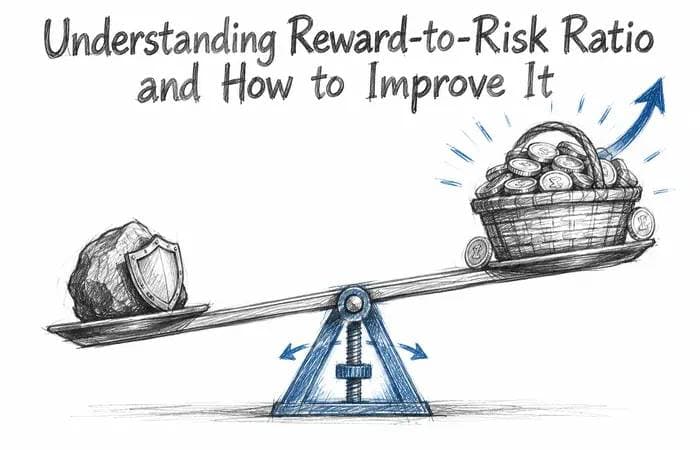
If you have been trading for any time, it is likely you have heard the term "reward-to-risk ratio." While it can sound technical, it is a fairly simple concept in trading, and it can be quite powerful in its nature. Simply put, the r:r ratio will tell you whether it is worth it to take a trade. The difference between knowing it, or even better enhancing your r:r, could be said to be the difference between surviving, or consistently growing your account.
What is reward-to-risk ratio?
The reward-to-risk ratio, or when writing it "R:R", is just comparing how much you stand to gain if the trade worked out for you, versus how much you would be willing to lose if it did not work out for you.
In a very simple example, for a trade you risk $100 (this is your risk amount) trying to make $300 (potential gain). Your reward-to-risk ratio would be 3:1. Basically, this just means, you are risking $1 to try and make $3.
Also, to clarify quickly, here is a simple table:

Risk (Potential Loss) | Reward (Potential Gain) | R:R Ratio |
|---|---|---|
$50 | $100 | 2:1 |
$100 | $300 | 3:1 |
$200 | $200 | 1:1 |
So as shown the higher the ratio percentage, the more profit you are looking to achieve vs your risk amount. The point in stating this, is that you would set your focus up to achieve a risk amount for trade that would give you a decent upside ratio.
The Importance:
Many traders focus only on their win rate (trades they are right on). Truth is, you can be wrong more times than right and still be profitable (as long as your r:r is good), let’s look at an example.
Hypothetically:
Let’s say you win 4 trades out of 10, all with a 3:1 r:r.The losing trades detracted $100 each = $600 lost.
The winning trades made you $300 each = $1,200 gained.
With a win rate of only 40%, you would still be profitable. This is the power in how you build your reward-to-risk.
Common Errors Made By Traders
One of the common mistakes is turning that ratio upside down - risking more than you stand to gain = risking $300 to make $100. In the short term, you might succeed - but it is not a long term solution.
Another mistake is not utilizing stop-losses. If you do not have a risk level, there is nowhere to calculate the reward-to-risk ratio at all. Your just sailing into trades blind, and inevitably will end up with blown accounts.
How to Increase Your Reward-to-Risk Ratio
Increasing your reward-to-risk ratio is not based around being overly aggressive, it is based around being strategic about it. Here are two ways to do this:
Tighter Stop Loss Placement
Instead of placing a wider stop "just in case," you learn to find logical levels where your trade idea is proven wrong. Such as under a strong support zone or above a respected resistance line. So, a tighter stop losses on a trade will allow you to risk less by keeping your potential reward the same, and just like that your R:R improves.

Letting Winners Run
Too many traders cut profits short as they think losing gains will occur. When the market has more space to run in your direction. Allowing trades to run bigger wins can be achieved by scaling out of a trade or using a trailing stop to entered - if you are able you than risk even less to still target wins coupled with an effective trading strategy.
An Example
Lets say you have a GBP/USD trade. You notice a strong break out and enter at 1.2600. You have a stop loss set at 1.2570, This is a 30 pips risk. You have a tgt at 1.2660 this is 60 pips potential. This would be a 2:1 ratio.
If the trade works, you win twice your risk vs lost in value. If it does not work, you have applied a loss cap of value. Do that several times over dozens of trades, and if the ratio is adapted properly, math is on your side whether every trade is perfect.
Shift Your Mentality
Many traders chase being "right"- but trading is not about being right every move in the market. This is about managing outcomes. Reward to risk helps you to get a better, more objective picture of the whole trade. instead of obsessing over trades, you can start to see in terms of probability and consistency.
Over time these shifts in mentality lessen stress to allow discipline in one trading endeavor, outside of waiting for the right trade to arrive. Instead of pondering "will I win this trade?" It can become "is this trade good and offers a ratio that is decent and makes sense to follow through in the long run."
Conclusion
The reward-to-risk ratio, in trading is essentially equal to a compass. The R: R ratio, even if you do not need to pay attention to it specifically, keeps you pointed in the proper direction. If you aim for good R:R ratios, the math will end up favoring you -- your profits will eventually outweigh your losses over time.
Most importantly you are not required complicated math, just to remain disciplined and plan.
If you want to learn more about strategies and to begin mapping your trades smarter and improving consistency, head to the Learn section of Wikilix. You will find practical tools and insights toward improving your trading journey step by step.
Frequently asked questions
Answers to the questions readers ask most about this lesson.
Comments & Reviews
0 entries
Nothing on the record yet
Be the first to share what happened.
What's Next?
Keep building your knowledge with our structured learning path. Each section builds upon the previous one.