

Turning Failures into Long-Term Trading Lessons
Turning Failures into Long-Term Trading Lessons
"Learn how to turn trading failures into long-term lessons. Discover strategies to analyze mistakes, grow your skills, and build lasting success in trading."
Wikilix Team
Educational Content Team
12 min
Reading time
Advanced
Difficulty
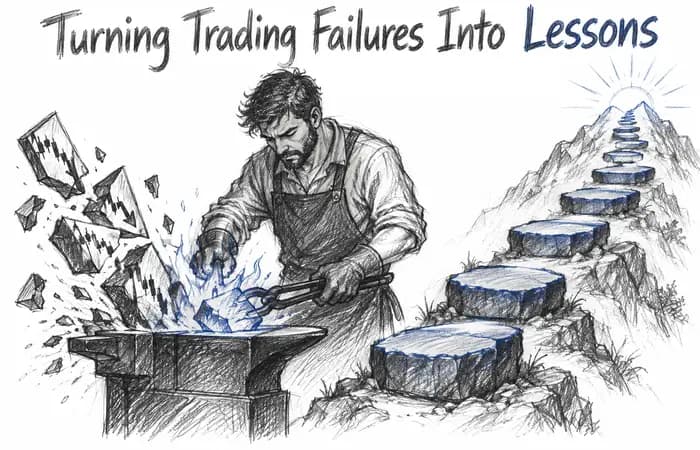
Each trader has a failure story to tell. This can be an account that was blown, a trade that got out of control or a trade that they wish they could have back. A failure can be crushing, especially after dedicating time, energy, and money to practicing your craft. But here is the reality, failure is not the contrary of success in trading, it is part of the process.
The traders that are able to survive long enough to become consistent are not the "never failed" traders. They are the traders that took the failures and lessons and grew from those experiences.
Why Failure Hurts in Trading
Losing money is personal. When a trade goes bad, most traders think... "I must not be cut out for this." But here is the reality: even the most seasoned traders lose money. The market does not give you a prize for perfection: it rewards persistence.
The mindset is the difference. Beginners focus only on failure, while professional and experienced traders view it as feedback. Once you own the original loss in trading and reframe losing as just data and not a statement about the trader, all mistakes become profit and performance improving opportunities.

The Market Doesn't Care
One of the hardest realities to accept in trading is that the market does not care about you. The market does not care about your hopes and dreams, market analysis at 3am or gut feel about a trade. The market doesn't even care if you decide to take a trade. Many times the market will fail before a reliably trade setup that preceeded it. This is perfectly normal.
Accepting this fact may even feel liberating.If you aren't taking failure personally, you can stop punishing yourself and start the process of examining what the market just told you.
Common Errors and Their Lessons
Most traders make similar mistakes, particularly in the early days. Each has a lesson hidden inside:
Failure | Lesson to Learn |
|---|---|
Risking too much on one trade | Protect capital first—it’s your lifeline. |
Ignoring stop losses | Discipline is more important than hope. |
Overtrading after a loss | Emotional trading leads to poor decisions. |
Chasing the market | Patience usually pays more than impulse. |
You may feel pain from the mistakes, but that pain won't last. The lessons, when practiced, might last forever.
A Story To Relate
A simple story involves two traders starting with the same balance. One trader rushed in trying to less than a week after opening his trading accounts, an over-leveraged position, and let his emotions drive the decision. After about 2 weeks, the entire trading account was nearly emptied.
The other trader experiences losses as well, but viewed each loss as a learning opportunity. This trader documented how they got into the position, how they risk managed during the trade, and how he felt throughout the process. He continued to journal his journey through each loss, while feeling confident that he modified risk rules, continued position sizing, and behavior. A year later, that trader did not become a millionaire, but he did grow his account and skills.
What’s the lesson? It is not about not failing; it is how you respond to failure when it comes.
Turning Losses Into Lessons
So how do you actually learn from your mistakes instead of repeating them?
Keep a journal of your trades. To the best of your ability write down the reason for entering the trade, then document how the trade was managed to closure, including feelings. This will help you in identifying patterns over time.
When reviewing, be un-emotional on the review. Don’t simply ask “How much did I lose?” Scrutinize each mistake by asking “What caused it?” then explore “What will I do differently next time?”
One mistake does not define you; continuing to repeat the mistake without studying it does. If you approach trading like a craft, and by not getting discouraged by mistakes or losses, you turn what could be considered losses or collapses into stepping stones.
Building Emotional Resilience
Trading failures are often less about the numbers but more about how we felt. It was fear, it was greed, it was frustration to revenge trading and ultimately interfere with our trading plan entirely.
With this perspective in mind, the most important characteristic to develop is resilience, or the ability to bounce back from failure. Resilience is like a muscle, the more you practice being ok with small failures, calm, the better you will become when your future challenges to your resilience come. What once seemed large or insurmountable will over time seem like just another rational step in the process.

Keeping Things In Perspective
Zoom out for a minute and remind yourself of this conversation. One trading experience does not shape your entire trading career. Review performance throughout the entire timeframe you have been trading.
In terms of general scope, the experiences you review should not be experiences that would cause you to quit. When you zoom out, generally experiences aren’t staged as ‘setbacks’, but rather like milestones; milestones that prompted you or caused you to try again. Whether the market was teaching you discipline, risk tolerances, patience, or opportunities.
Final Thoughts
Failure is expected in trading, but does not have to be destructive. Each failure taught you a lesson on risk, discipline, or patience. If you view failure as feedback and a ‘new opening’ you will learn to start to permit each failure to grow yourself and grow your abilities and become a more accountable trader and individual.
And do remember, trading is not about failing.... it is about leaning in on failure, and using the failure as feedback toward your goal of education for evidenced success.
If you feel ready to continually sharpen your mind and convert your failures into growth then visit the Learn section within Wikilix... you will find resources to help you grow into a solid disciplined, confident trader that eventually will fail, but each time will see evidence failure is not an ending, as every failure is the beginning of your continued growth.
Frequently asked questions
Answers to the questions readers ask most about this lesson.
Comments & Reviews
0 entries
Nothing on the record yet
Be the first to share what happened.
What's Next?
Keep building your knowledge with our structured learning path. Each section builds upon the previous one.