

Using Leverage Safely – The 2% Risk Rule Explained
Using Leverage Safely – The 2% Risk Rule Explained
"Learn how to use leverage safely with the 2% risk rule. Discover proven strategies to protect your capital, reduce losses, and trade with confidence."
Wikilix Team
Educational Content Team
10 min
Reading time
Advanced
Difficulty
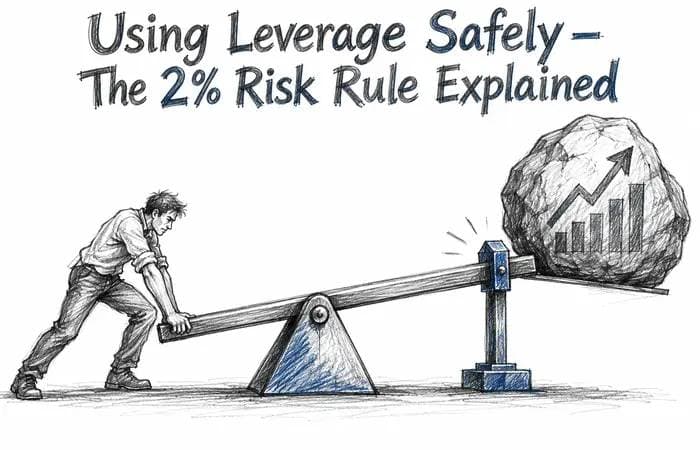
One of the most significant benefits of the Forex market is leverage. As a trader, you can use a relatively small amount of money to control positions that are much larger. This can increase profits exponentially but can also add to losses as well. Using leverage improperly is like driving down a highway with no brakes. By taking advantage of leverage in a sensible manner, it can be a powerful educator.
This is where the 2% rule comes in. The 2% rule is a simple guideline for using leverage and protecting your capital while still being able to grow.
What Is the 2% Rule?
The 2% rule means that you will never risk more than 2% of your account balance on one trade. That does not mean that you cannot use leverage; however, it does mean that if your trade goes against you, your losses are limited.

If you have a $5,000 account, 2% is $100. $100 is your maximum loss on a single trade. Even if you have leverage of 1:10 or 1:100, the key is to make sure your position size is calculated so that if the trade goes against you or your stop loss hits, your losses will never be greater than $100.
Why This Is Important
The reason many new traders blow up their accounts isn't because they are always wrong about market direction; more often than not, it is because they risk too much. After having one or two bad trades with oversized position sizes, a trader can give back weeks of positive progress.
The 2% rule creates a cushion or safety net, allowing you to weather a string of losing trades without taking down your account.Remember, the first rule of a trader is not to make money, but to protect the money that they have already made.
A Real Simple Example.
Let's assume that we have two traders and both have a $10,000 trading account.
Trader A is going to risk 10% on their trades. Based on the premise of losing 3 trades, Trader A will have a trading account of $7,000. Now, Trader A has to earn 43% be to breakeven on their trade.
Trader B will risk only 2% per trade. Assuming Trader B loses 3 trades, Trader B will have an account balance of $9,400. Trader B would need to only earn 6.4% to be breakeven.

This example underscores the importance of limiting your risk to small defined amounts for long-term viability.
What does Leverage have to do With It?
Leverage has no bearing on the 2% rule-- it only factors in the size of the position. I encourage you to think of leverage as a tool instead of a shortcut. You can always employ a larger leverage position, just abide by the limits of your risk investing plan.
For example, If I am trading EUR/USD with a 50 pip stop-loss, and my account size allows me to risk $100, then I can properly account for my lot size to remain within the 2% risk. Leverage will allow you to open the position, but your stop-loss will keep your risk capped at your loss.
Why is This Important?
Risking less protects more than just your trading account; it protects your mind too. Fear and panic come when we risk too much.Traders often second-guess, exit trades too quickly, or hold on to losing trades for too long.
However, when you establish that the maximum downside on a trade is 2%, you are able to think rationally. You stop worrying about every pip, and you trade with a sense of assurance. Ironically enough, this calm and relaxed state of mind may eventually lead to better results than the 2% rule itself.
Mistakes to Avoid
Even when adopting the 2% risk management strategy, traders still make mistakes. Common mistakes include:
1. Moving stop losses further away to avoid a loss. Once you change the original stop loss, the risk is no longer 2%.
2. Stacking correlated trades (ex. purchasing EUR/USD and GBP/USD at the same time) and doubling or tripling exposure without even realizing it.
3. Risking more after a loss in an effort to "make it back quickly", which results in bigger drawdowns than originally predicted.
The important point here is discipline. The 2% risk management strategy only works if you have discipline.
Creating Consistency
The great thing about the 2% risk management rule is that it's boring. And boring is a great place to be. Instead of swinging for the fences every trade, you are creating a solid, sustainable, level of trading. Over time, your edge in the market has plenty of room to play out without one trade ruining everything.
Think of it in a professional sport. Champions aren't champions because they "go all in" every time. They are champions because they are consistent, manage their energy, and have the opportunity to compete and take advantage of any opportunity that comes their way.
Final Thought
Leverage is powerful, but without discipline, it can be dangerous. The 2% risk management strategy provides an easy, (real) way to use leverage safely while protecting your account from unnecessary and unwanted risks. It also frees you up to think about the long game of survival in the market rather than short-term excitement.
If you are interested in discovering more ways to enhance your trading discipline and apply risk management strategies to real life, check out the Learn section on Wikilix. The section is full of resources designed to help you grow incrementally and trade confidently.
Frequently asked questions
Answers to the questions readers ask most about this lesson.
Comments & Reviews
0 entries
Nothing on the record yet
Be the first to share what happened.
What's Next?
Keep building your knowledge with our structured learning path. Each section builds upon the previous one.