

Testing & Optimizing Your Trading System
Testing & Optimizing Your Trading System
"Is your trading system truly working? Find out how to test, refine, and optimize your strategy to maximize profits and minimize risk with proven methods."
Wikilix Team
Educational Content Team
13 min
Reading time
Intermediate
Difficulty
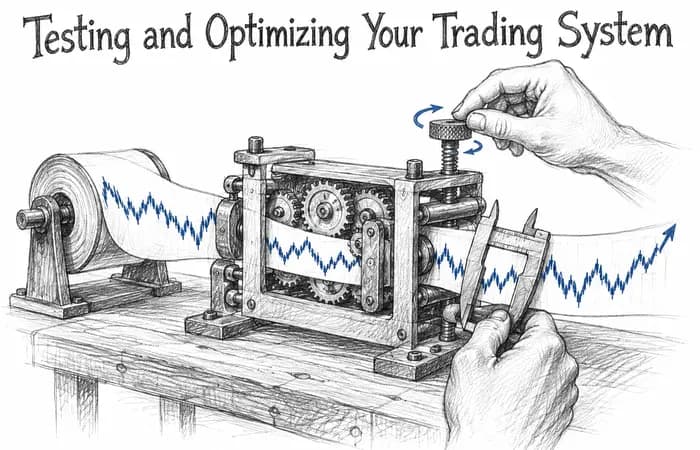
Many traders believe they've developed a "winning" trading system — until the market humbles them. The difference between a consistently winning trader and a trader who hopes to win comes down to a tested and optimized system rather than just a good idea.
Testing a trading strategy is similar to doing a stress test on an airplane before it flies you anywhere — you want to know if the aircraft can handle turbulence before you are trusting that airplane with your money. Optimization involves streamlining the trading system to be more reliable and efficient, while maintaining simplicity.
In this article, we will discuss how to test and optimize your trading system, basing it on evidence rather than hope. You can then implement strategies with confidence and consistency.
Why Testing Your Trading System Is Important
Creating a trading system without testing it is like driving with your eyes closed — it is just a matter of time before luck runs out.
By testing, you will:
• Establish if this is a strategy that has positive expectancy.
• Establish the strengths and weaknesses of the strategy.
• Establish if the strategy fits your risk tolerance and trading style as a trader.
• Establish trust and discipline in the process.
Even a good idea can turn into a disaster without proper testing. You can take any simple idea and test it sufficiently to obtain a reliable, profit-generating trading system.
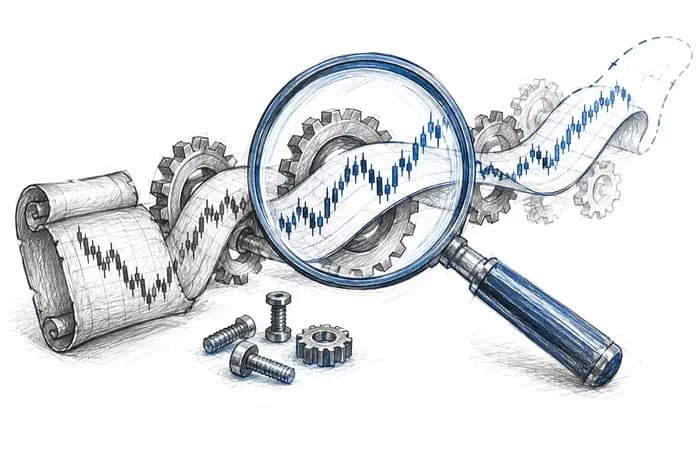
Types of Testing: Backtesting vs. Forward Testing
To validate your trading system, you want to see how the strategy performs both historically and in real-time. Backtesting
Backtesting is the process of executing your trading rules using actual price data to assess how your system would have performed historically.
• It is efficient; it can take mere minutes to apply a system to several years' worth of trading data.
• It describes how your strategy reacts under different market conditions.
Backtesting is not foolproof, however - many things can change with market evolution, and past performance is no guarantee of future success.
Forward Testing (Paper Trading)
Forward testing, or demo trading, means that you are executing a strategy in real-time market conditions, without the risk of losing real money.
• Forward testing can provide reassurance that your system is still performing well with current market dynamics.
• Forward testing gives you a chance to evaluate emotional discipline, execution timing, and realistic trade management using quantity.
It is probably best to employ both approaches — backtest to eliminate poor ideas, then forward test to assess the reliability of your system in real market conditions.
How to Backtest Your System
Step 1: Define Clear Rules
You cannot test what you cannot measure. Therefore, you must define your system clearly in all aspects.
• Entry and exit signals
• Stop-loss and take-profit levels
• Position size risk per trade
• Market and timeframe
Step 2: Obtain Data of Adequate Quality
Use clean and reliable data from reputable third-party sources. If the historical data contains minor errors or if candles are missing, your results can be significantly skewed.
Step 3: Execute the Backtest
Most platforms, such as MetaTrader, TradingView, or NinjaTrader, will allow you to backtest automatically. With some time, traders can backtest a system over a larger data sample - at least several months to years' worth of data.
Step 4: Evaluate the Core Metrics
Emphasize some metrics and quantifying movement to see the consistency of your system:
• Win rate – The proportion of profitable trades,
• Profit factor – The total profit divided by the total loss. (Aim for > 1.5).
• Max drawdown – How much an account declined from a peak to a low (ensures risk is maintained).
• Expectancy – The average amount the trader expects to win or lose on each trade.
Step 5: Evaluate the Market Environment
Do not get caught up in numbers. Evaluate when the system does best (i.e., trending, overranging, or volatile)
This will help you when optimizing the system the next time.

The Dangers of Overfitting
One of the biggest pitfalls that arises from optimizing a system is the concept of overfitting. That is the fine-tuning of the system against the past data to the point where it performs poorly in the future.
This is similar to preparing for an individual race by memorizing the course; while it is a great thing to do for that event, it is almost useless afterwards.
Typically, you may be overfitting your system if there are:
• Too many entries or indicators,
• Too high win rates in the backtest,
• Poor forward test results,
Keeping your system logical and straightforward is the solution. Your rule should not just research the historical results of the chart, but instead explain the logic behind the market in the first place.
How to Optimize a Trading System
Optimization is not about saying that your system is "perfect." The goal is to find a trade-off between performance and stability.
1.7. Observing and Evaluating Live Performance
Having gone live with your system, your work should not stop; this is just the start. You should have a journal of your trading activity that records, at a minimum:
• Entry & Exit times and points
• Market conditions
• Profit or loss
• Any emotional/execution issues
Over time, as you evaluate what you think is your system, you will be able to see whether your system is performing as expected or if some combination of tuning is required. Many professional traders would refer to this as a continuous feedback loop: test → optimize → implement → review → refine.
The Impact of Psychology on Testing and Optimization
You can have the best-tested trading system, but it won't work if you break the rules. That is why psychological discipline is an integral part of your optimization process.
You should ask yourself:
• Am I able to stay in my system after losing three in a row?
• Do I have confidence in my backtested outcomes to keep from second-guessing?
• Am I able to avoid changing the settings of trades while I am actually doing them?
A trading system is only as strong as the trader who is trading it. You can achieve consistency in math, but you can have even more consistency in the mindset that drives trading.
Responsible Mistakes to Avoid
There are several mistakes that most traders make when it comes to testing and optimization:
• Testing too small a data set: Do not beat yourself up; all your findings are probably incorrect.
• Not thinking about transaction costs: Commissions, executions, and spreads can- and probably will- erode the profitability you gain.
• Only going for optimization and not thinking about drawdown, risk, or emotional perseverance.
• Changing your systems too quickly. Give a thing time to prove itself, once you have implemented it.
Keeping these things in mind/accounting for them will keep your process scientific rather than emotional.
Conclusion
Testing and optimizing your system is not a simple one-time exercise; it is an ongoing, continuous process. This is how you take raw ideas and turn them into solid, reliable ideas.
If you conduct the structured test, you will discover the real performance of your system. If you optimize it with thought, you will tighten performance without destroying the inherent logic and premise of your system... And if you do both testing and optimization, you have accomplished something more than the Holy Grail — you have built confidence.
When you know what the strengths, weaknesses, and probabilities of your system outcomes are, you will have transformed trading from a guessing game to a business, and then you can start moving forward.
Frequently asked questions
Answers to the questions readers ask most about this lesson.
Comments & Reviews
0 entries
Nothing on the record yet
Be the first to share what happened.
What's Next?
Keep building your knowledge with our structured learning path. Each section builds upon the previous one.