

Why Discipline Matters More Than Profit Goals
Why Discipline Matters More Than Profit Goals
" "Find out why discipline matters more than profit goals in trading. Discover how consistency, self-control, and disciplined strategies can lead to sustainable long-term success"
Wikilix Team
Educational Content Team
10 min
Reading time
Advanced
Difficulty

Every trader dreams of profits. This is perfectly common—we enter the markets because we want to grow our money. But when we pursue "profits," this often leads traders into one of the oldest traps in Forex which is the search for the "Holy Grail" system. The belief that there is a system that exists that wins almost all trades, and will continue to produce "unlimited" profits each time. The reality is this does not exist!! Even worse, chasing profits can often be more harmful than good.
The traders that are involved in the business for a long time understand something that many new traders do not—discipline is far more important than any profit goal. Without discipline, it does not matter what is the best profits strategy. A trader with some discipline, consistent thought, and patience, using any simple average system can become profitable overtime.
The Illusion of the Holy Grail
If you can picture this: a new trader has lost a series of trades, becomes frustrated, and immediately begins looking for another system. Maybe they buy a wildly expensive indicator, subscribe to a new signal service, or even try to mimic a Youtube channel “way to trade.” When that failed, they move on to another. This cycle goes on and on.
The end result is they spend more time looking for systems than they do learning how to trade!! They think the system is the problem, when for the most part the real problem is their lack of consistency and discipline.Why Discipline is More Important than Profit Goals
It's not hard to say something like "I want to make $1,000 a month." The problem is that profit goals push traders to force trades, take risks, and do other dumb stuff that breaks their rules. Discipline holds a trader focused.
A disciplined trader thinks about it this way, "I will take only trades that fit the system, even if I am not taking as many trades." A disciplined trader is not looking for each trade to make money or expect to "chase money". In fact, money often follows discipline.

Let’s compare:
Mindset | Likely Outcome |
|---|---|
Profit-Driven: “I must hit $500 this week.” | Overtrading, emotional decisions, higher risk of losses. |
Discipline-Driven: “I’ll only trade when my setup appears.” | Fewer trades, more consistency, gradual growth. |
Real Trading is a Game of Probabilities
Trading forex is not about certainty, it is about probabilities. A trader relies on their edge 100% of the time but has losing trades sometimes too, a disciplined trader accepts that. When they have a losing trade, there are no thoughts of panic or frustration, they just move on with the next trade, based on the premise that the edge plays out over many trades.
Let's say you are flipping a weighted coin that is heads 60% of the time. You may take a streak of tails in a row but if you remain disciplined and flip the coin, the math will generally work out for you in the long run, just like trading.
Discipline Creates Confidence
There is another hidden advantage of trading with discipline, which is confidence. If you are taking trades based on your plan, day in and day out, you will develop trust in yourself. You begin to think, "well, if the trade does lose, it still was the right trade." This takes away unnecessary stress and allows you to trade without the noise of fear or excitement.
Without the discipline, every trade feels personal.You question your abilities, shift to new systems, and fall into self-pity. But when you show up each day, you become disciplined enough to realize that losing is part of the game and not evidence that you have failed.
The Long Road vs. The Shortcut
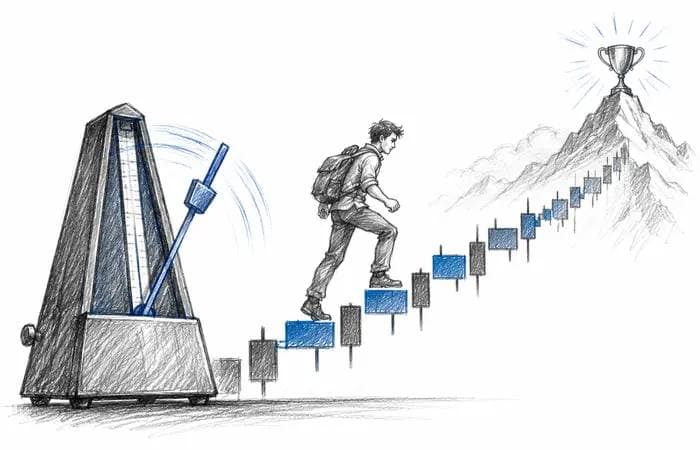
Many traders want trading to be a shortcut to riches. They imagine that they will have results in weeks, but trading is a long road. Discipline is what keeps you walking that road even when it seems slow.
Take athletes asparadigm: They do not suddenly become championship athletes overnight. They have to train every day, eat right, follow routines, sometimes for years. Traders are no different. Discipline is your training program—it may not indicate excitement at the moment, but it’ll get you results.
How To Build Discipline in Trading
Building discipline in trading does not mean you have to be perfect the first day. It’s about building small habits and making them consistent:
Have a plan: Write down what your entry rules are, risk per trade, and exit conditions.
Journal your trades: Which trades looked good? Which trades didn’t?
Set limits: You pick how many trades you are going to take for the day and/or week.
These habitual changes may sound simple and common-sensical, but they are powerful. A few of them, perhaps all of them, will begin to form the structure that protects you from chasing the “Holy Grail.”
In closing
Chasing the “perfect” strategy is a trap that keeps traders stuck. What separates a professional from a novice is not the system, it’s the discipline they apply to their trading. Profit may be a goal to aspire to, but discipline is what keeps you going.
If you want trading to stop being a chase and become a craft, shift your mindset. Rather than ask, “What strategy will make me rich,” ask, “How can I better stick to my rules today?” This is growth.
If you have an interest in learning more about developing discipline and avoiding traps in trading, check out the Learn section in Wikilix. piece by piece, you will come to find that the “Holy Grail” is not the strategy, it is the trader.
Frequently asked questions
Answers to the questions readers ask most about this lesson.
Comments & Reviews
0 entries
Nothing on the record yet
Be the first to share what happened.
What's Next?
Keep building your knowledge with our structured learning path. Each section builds upon the previous one.