
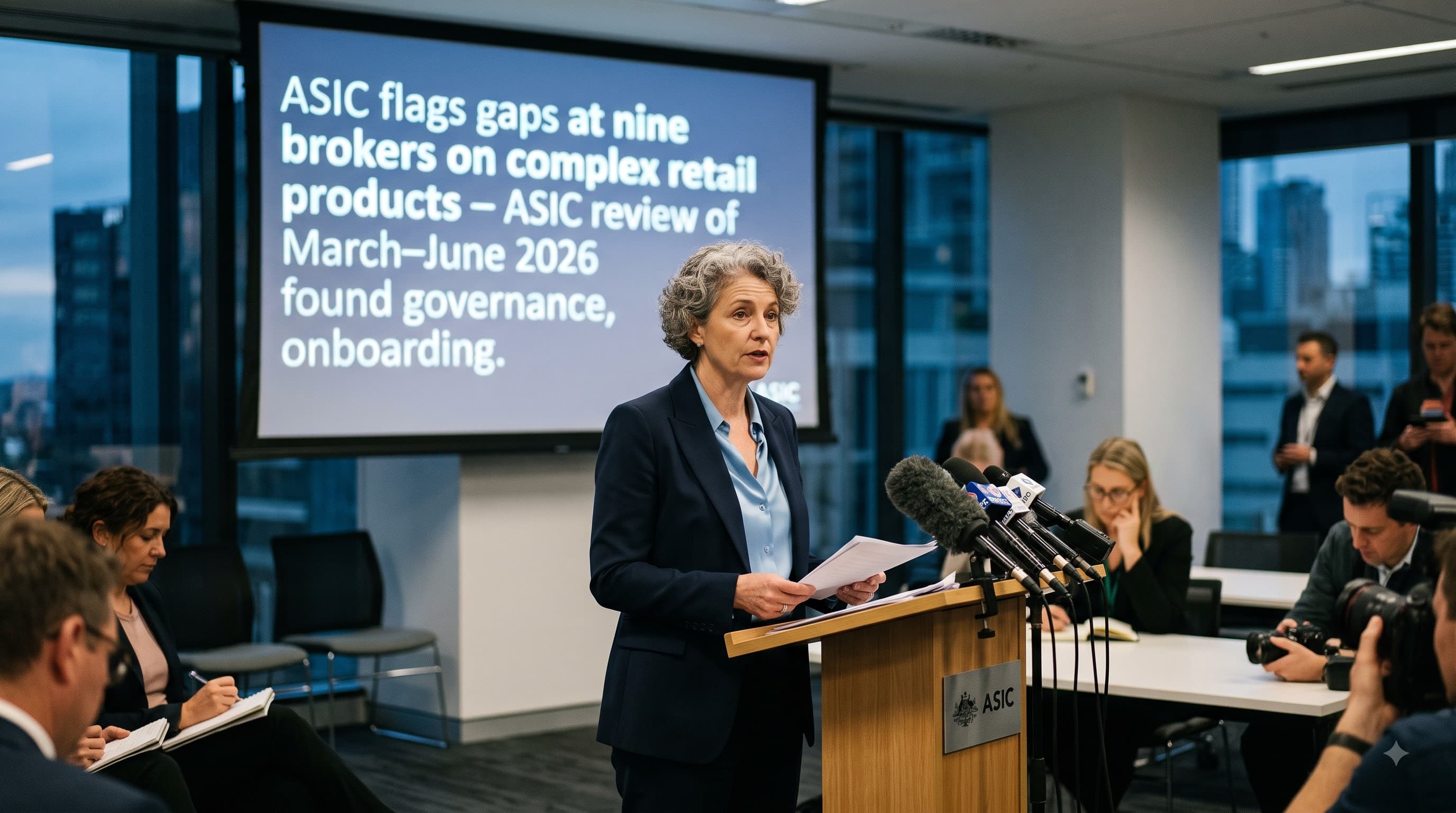
The Australian Securities and Investments Commission (ASIC) has identified product governance, onboarding and disclosure deficiencies at nine online brokers following a review of complex and high-risk products sold to retail investors.
The surveillance, conducted between March and June 2026, focused on short-dated exchange-traded options (ETOs), futures and fractional shares offered to retail clients. The nine entities reviewed were Interactive Brokers Australia Pty Ltd, Moomoo Securities Australia Ltd, Sharesies Australia Limited, Stakeshop AFSL Pty Ltd, tastytrade Australia Pty Ltd, Tiger Brokers (AU) Pty Limited, Totality Wealth Limited, Trading 212 AU Pty Ltd, and Webull Securities (Australia) Pty Ltd.
Findings on governance, onboarding and disclosure
ASIC reported three main areas of concern. First, it found deficiencies in target market determinations (TMDs), including insufficient detail on how products met the likely objectives, financial situations and needs of clients. Second, it identified onboarding shortcomings, such as limited tailoring of questions to individual client circumstances and repeated or unlimited attempts for clients to pass onboarding questionnaires. Third, the review highlighted unclear client disclosure that did not adequately explain the risks and costs associated with fractional trading.
ASIC Commissioner Simone Constant said entities offering complex or high-risk products must ensure distribution is aligned with the appropriate target market throughout the client relationship, stating that while the products are complex, the responsibilities remain straightforward.
Industry responses and regulatory context
Following ASIC’s review, five of the entities improved their compliance practices. This included two brokers that ceased onboarding options clients while remediation work is undertaken. One entity has exited the Australian market since the review. ASIC is continuing to address concerns with some providers and is considering further regulatory or enforcement action.
The review also noted that some providers used fee-free or discounted trading, cash vouchers or airline reward points as incentives. ASIC stated that such incentives can distract investors from underlying investment risks and may encourage impulsive trading decisions.
In outlining the broader risk context, ASIC referred to outcomes for Australian retail investors in complex derivatives markets. It noted that 68% of Australian retail contracts for difference (CFD) investors lost money in the 2024 financial year, with aggregate losses exceeding AU$458 million, including AU$73 million in fees. Derivatives cases accounted for about 37% of ASIC’s AU$830 million civil penalty total in the 2025-26 financial year.
ASIC indicated that it will continue its focus on the distribution of complex and high-risk products to retail clients and on ensuring that governance, onboarding and disclosure practices meet regulatory expectations.