
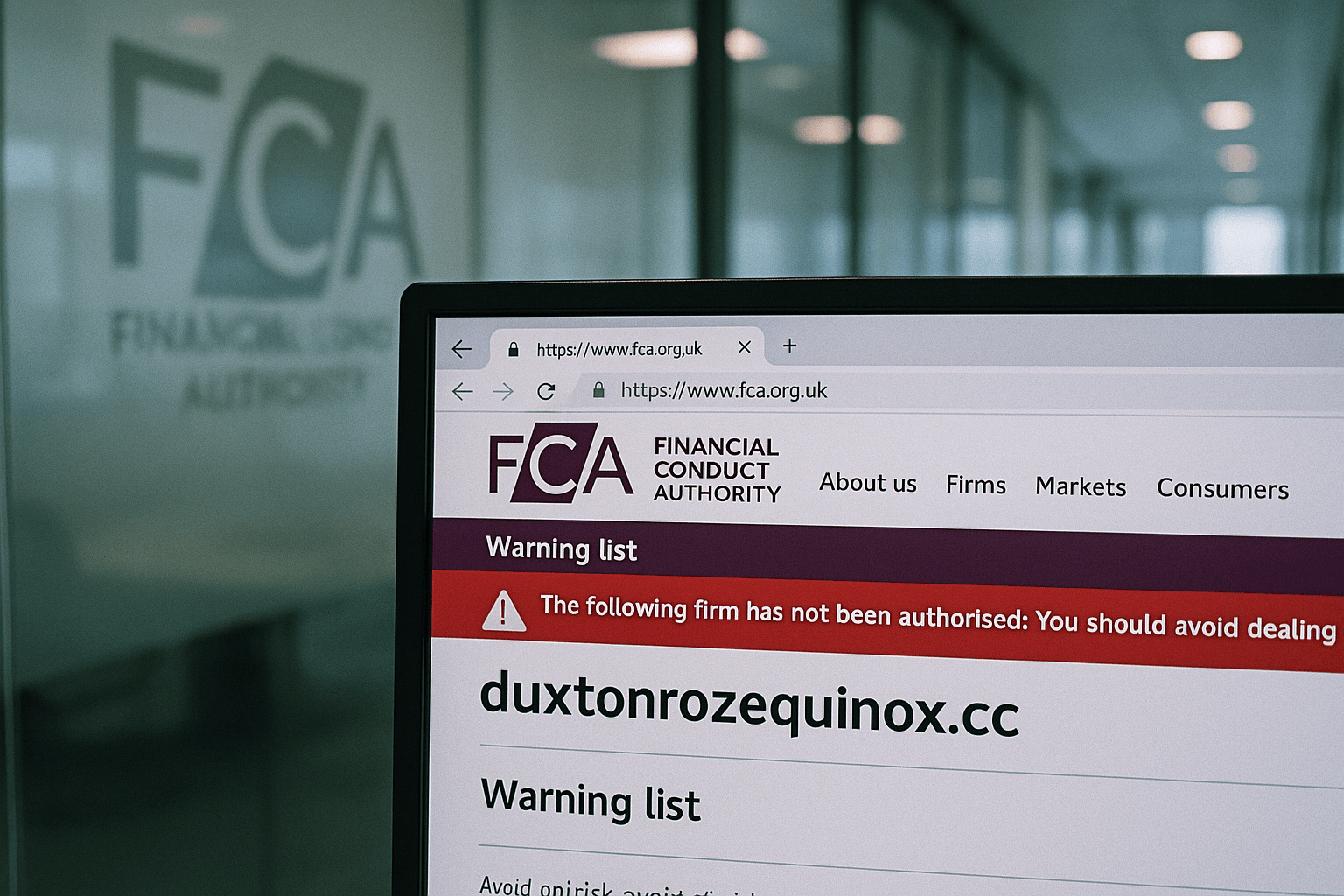
The Financial Conduct Authority (FCA) has issued a warning about a firm operating via the website duxtonrozequinox.cc. The notice, published on 13 July 2026, states that the firm is not authorised by the FCA and may be targeting people in the UK by providing or promoting financial services or products without the required permission.
According to the FCA, almost all firms and individuals must be authorised or registered by the regulator to carry out or promote financial services in the UK. Authorisation requirements are designed to provide a framework of oversight and consumer protection for those engaging with financial providers. The FCA’s warning indicates that the firm behind duxtonrozequinox.cc does not have this authorisation.
Regulatory status and consumer protection
The FCA highlights that consumers who choose to deal with the firm operating via duxtonrozequinox.cc will not have access to key UK regulatory protections. Specifically, they will not be able to refer complaints to the Financial Ombudsman Service if disputes arise.
In addition, customers will not be covered by the Financial Services Compensation Scheme (FSCS) if the firm fails or things go wrong. The FCA notes that, without FSCS protection, it is unlikely that consumers would get their money back if the firm goes out of business.
Payment protections and reporting guidance
The warning also refers to protections introduced by the Payment Systems Regulator (PSR). The FCA states that individuals who sent money to a fraudster on or after 7 October 2024 may be covered by these protections, although it does not provide further detail in the notice.
To help consumers avoid unauthorised firms, the FCA advises the use of its online FCA Firm Checker to verify whether a firm is authorised before engaging in any financial transaction. The regulator further encourages the public to report any suspected unauthorised firms.
Members of the public can contact the FCA to report concerns by calling 0800 111 6768. The warning underscores the importance of checking a firm’s authorisation status and understanding that engaging with unauthorised providers can leave consumers without recourse to UK regulatory protections.