

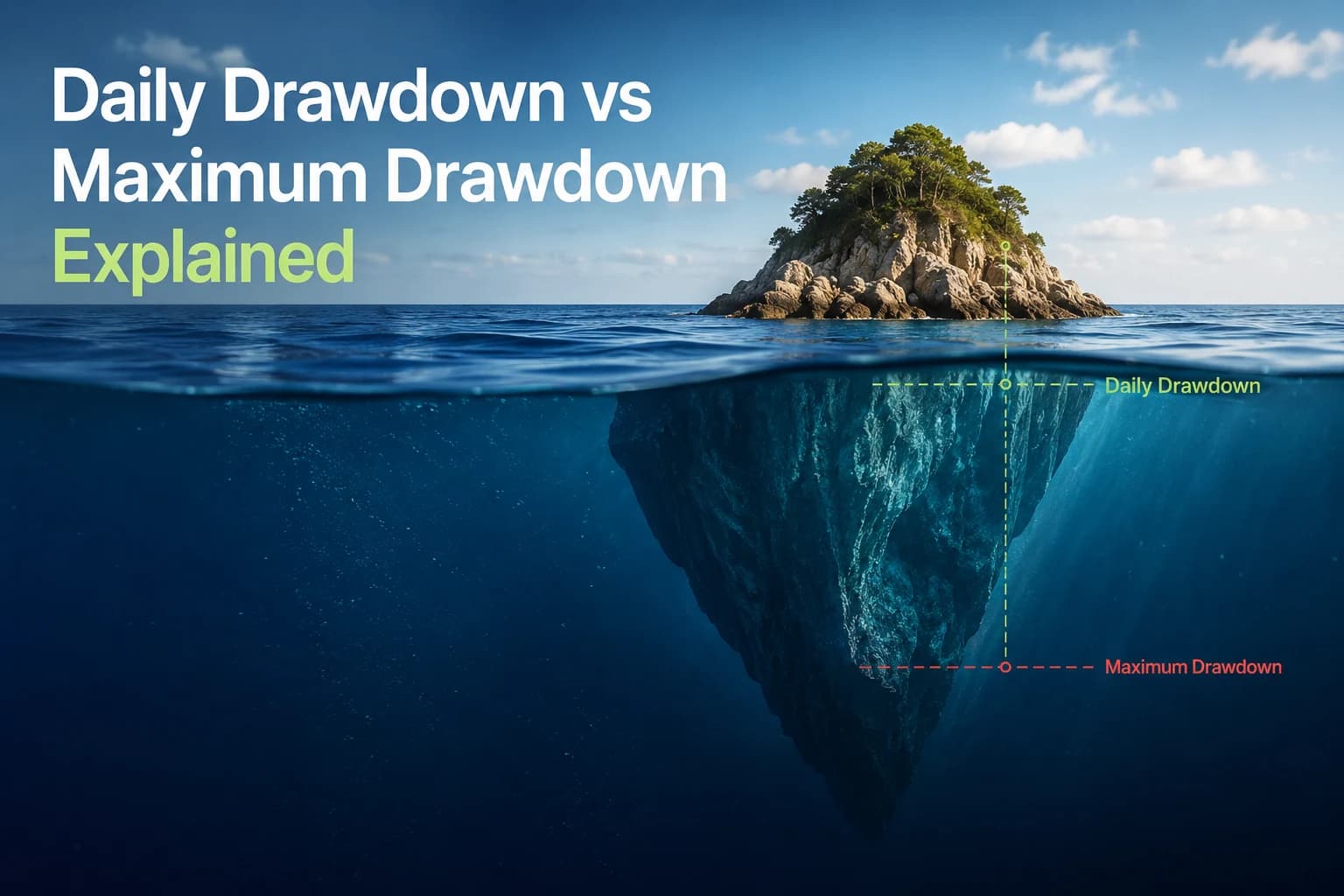
If you have ever dealt with a funded account or participated in a prop firm challenge, you are likely familiar with these types of rules: the maximum drawdown limits set by traders are the disqualification rules, not the trading strategy being used. As an example, you could potentially be disqualified one day for having an accumulating loss over several days, even though you may have accumulated an overall positive balance at the end of that trading day.
This makes it extremely important for any trader to know and fully understand the two types of drawdown: Daily Drawdown and Maximum Drawdown, because they are not only technically important but also essential to survival as a trader, especially when working with the Best Prop Firms for Beginners.
In this article, I will clearly define both Daily and Maximum Drawdown, explain how they differ, and show you how professional traders use and calculate them so they can continue trading successfully without losing their entire capital account.
What Is Drawdown?
Before I define daily drawdown vs max drawdown, we must first define what drawdown is. Drawdown is the amount of net value lost in a trading account. The extent of the drawdown, once lost, will be shown on the balance statement as a deteriorating amount. The same logic can be applied to an increase and subsequent loss of equity value within the trading account itself. Drawdown will, of course, not relate only to the number of lost trades but will, in part, refer to the risk of the money management (trading) strategy.
Pro managers, hedge funds and other institutional money management desks closely monitor drawdown from their accounts. The drawdown amount is a key risk measure.
There are many types of drawdown, but for retail traders, especially prop traders, the two most common are:
1) Daily Drawdown and
2) Maximum Drawdown.
What Is Daily Drawdown?
Daily drawdown meaning refers to the maximum amount you can lose in your account on any trading day. It is calculated as a percentage of your account balance and resets every 24 hours, based on the broker’s server time. If you cross the daily drawdown limit, you are violating the account rules and may face trading restrictions or account termination.
Example:
Account Size: $100,000
Daily Drawdown Limit: 5% of trading account balance
Maximum Daily Loss Allowed: $5,000
If at any time during the trading day your equity falls more than $5,000 below your starting equity, you have violated the daily drawdown limit. These limits are put in place to eliminate emotional trading and/or aggressive/revenge trading, and to help prevent emotional drawdowns.
Maximum Drawdown
Maximum Drawdown (Max DD) is the largest drop from a previous highest account balance (peak) to the lowest point (trough) that has occurred since the account was created. This means Max DD measures the account's value at its lowest point relative to its highest point at any time, not just in a single day.
Example:
Account Size: $100,000
Maximum Drawdown Limit: 10%
Maximum Drawdown Allowed: $10,000
If your equity value falls below (when no additional Max DD limits have been violated) $90,000, you will have violated the Maximum Drawdown Limit.
The Max DD limit is meant to protect the long-term preservation of your capital account rather than control the trader's short-term behaviour.

Key Differences Between Daily and Maximum Drawdown
Here’s a simplified comparison:
Feature | Daily Drawdown | Maximum Drawdown |
Timeframe | 24-hour trading period | Entire account lifespan |
Reset? | Yes (daily) | No |
Focus | Short-term risk control | Long-term capital protection |
Typical Range | 3% – 5% | 8% – 12% |
Main Purpose | Prevent emotional overtrading | Prevent catastrophic account loss |
Understanding this difference changes how you manage trades.
Related Articles: Why Traders Fail Prop Firm Challenges
Fixed vs Trailing Drawdown
A fixed drawdown establishes and maintains the account's drawdown based on the initial account size.
For example, if you start with an account balance of $100,000 and use a fixed drawdown of 10%, your maximum drawdown is $90,000. Once the maximum drawdown is determined, it will serve as the floor for your account and will never change, remaining at $90,000.
A trailing drawdown rises when your account reaches new equity highs, so it will increase when the account hits new highs.
For example, if you start with $100,000 and raise your account balance to $105,000, a 10% trailing drawdown means the new drawdown limit becomes $94,500. If the balance later drops, the drawdown level does not decrease; it only moves up when a new account high is reached.
Trailing drawdowns are more restrictive. They let you lock in gains as equity grows and limit your risk tolerance.
Most prop trading firms will use trailing drawdowns during their assessment of your trading.
Why Do Prop Firms Use These Rules?
Prop firms are not making trading harder. They use the same risk management methods as true professional capital allocators, which are often outlined in Prop Firm Risk Management Rules.
Having a daily drawdown rule helps stem impulsive behaviour by limiting the total risk you are allowed to take each day. Having a maximum drawdown ensures you do not slowly bleed your account over a long period.
From a statistical perspective, most retail traders fail to manage their risk. Most retail traders lose money because of poor risk concentration, not because their trading strategies lack an edge.
By using daily and max drawdown rules, prop firms prioritize consistency over profit.
How Can You Calculate Daily Drawdown?
Daily drawdown calculations vary by firm. There are generally three accepted formulas: the day's initial balance, the day's highest equity, or the previous day's closing balance.
The strictest method is the second one. Unrealized gains increase your highest equity and risk violating the drawdown level if trades thin out.
You should always check with your prop firm to confirm the methods they will use to determine if any of these drawdown metrics will be used for your account.
How Maximum Drawdown Is Calculated
A maximum drawdown can be calculated using one of two methods:
• Fixed percentage from your original capital
• Trailing percentage from your highest recorded equity
The trailing model is (generally speaking) more difficult to manage because the floor of your account is raised after your profits. For example:
• Your account starts with $100,000
• You have achieved a maximum trailing drawdown of 10%
• Your account has now reached $110,000
• Your new floor, or lowest point in your account, is $100,000
If the equity in your account drops below that floor, you will be in violation of the maximum drawdown rule; therefore, you need to scale your accounts carefully and define lot size increases aggressively.

Psychological Impact of Drawdown Rules
Many traders don’t realize how drawdown rules affect trader psychology. It is very common for traders to avoid legitimate setups near the end of the trading day due to daily drawdown pressure. Traders under daily drawdown pressure may close trades prematurely or trade much more conservatively after small losses. Maximum drawdown pressure causes a trader to hesitate when scaling into positions, to hesitate following equity highs, and to experience overcorrection in the size/quantity of risk taken per position.
Professional traders alleviate this issue by clearly defining their risk per trade to be far below the maximum allowable drawdown per trade, following principles similar to Risk Management for Retail Traders.
Professional Risk Allocation Strategy
A basic strategy that is commonly utilized by institutional traders is:
• Limit risk per trade to 0.5% – 1%
• Limit the number of trades placed per day to 3–5
• No trading allowed once a trader has sustained 2 consecutive losses
• Total daily exposure should be less than 50% of the maximum permitted daily drawdown
For example, with a maximum allowable daily drawdown of 5%, a trader should risk no more than 1% per trade and stop trading after sustaining 2 or 3 consecutive losses. By doing so, you will protect yourself from approaching any drawdown breach levels. Consistency in trading generates better results than aggressive trading.
Common Mistakes Traders Make
The following are the most common mistakes made by traders:
Investment of 2–3% of their account in any one trade in a daily maximum drawdown of 5%.
Not considering the floating (and unrealized) losses posted on a trade that are at or near daily maximums.
Trading larger lot sizes following successful streaks.
Not factoring in the trailing drawdown, which will narrow your allowable risk as your account continues to grow.
Generally speaking, a trader will not get into a maximum drawdown position from a single trade; the primary contributor to maximum drawdown risk is poor risk structure.
Is One More Important Than The Other?
Neither method is more important; they have different uses.
Daily drawdown limits your loss in a single trading day, while maximum drawdown limits your overall loss.
When you use proper daily risk management, maximum drawdown will rarely become a concern for you.
Typically, traders who fail to meet their trading account obligations first exceed their daily maximum drawdown before exceeding their maximum total drawdown.
Conclusion
Simply put, daily maximum drawdown and maximum total drawdown are defined by different timeframes and serve different purposes, a distinction often explained in Wikilix Broker Reviews.
The daily maximum drawdown limits how much you can lose in a single day, while the maximum total drawdown caps your overall loss across the entire account history.
Together, they create a two-layered risk protection system that promotes disciplined trading. The most successful funded traders are not the most aggressive, but the most consistent.
If you want to survive as a leveraged trader, mastering drawdown management should come before trying to grow your account.