

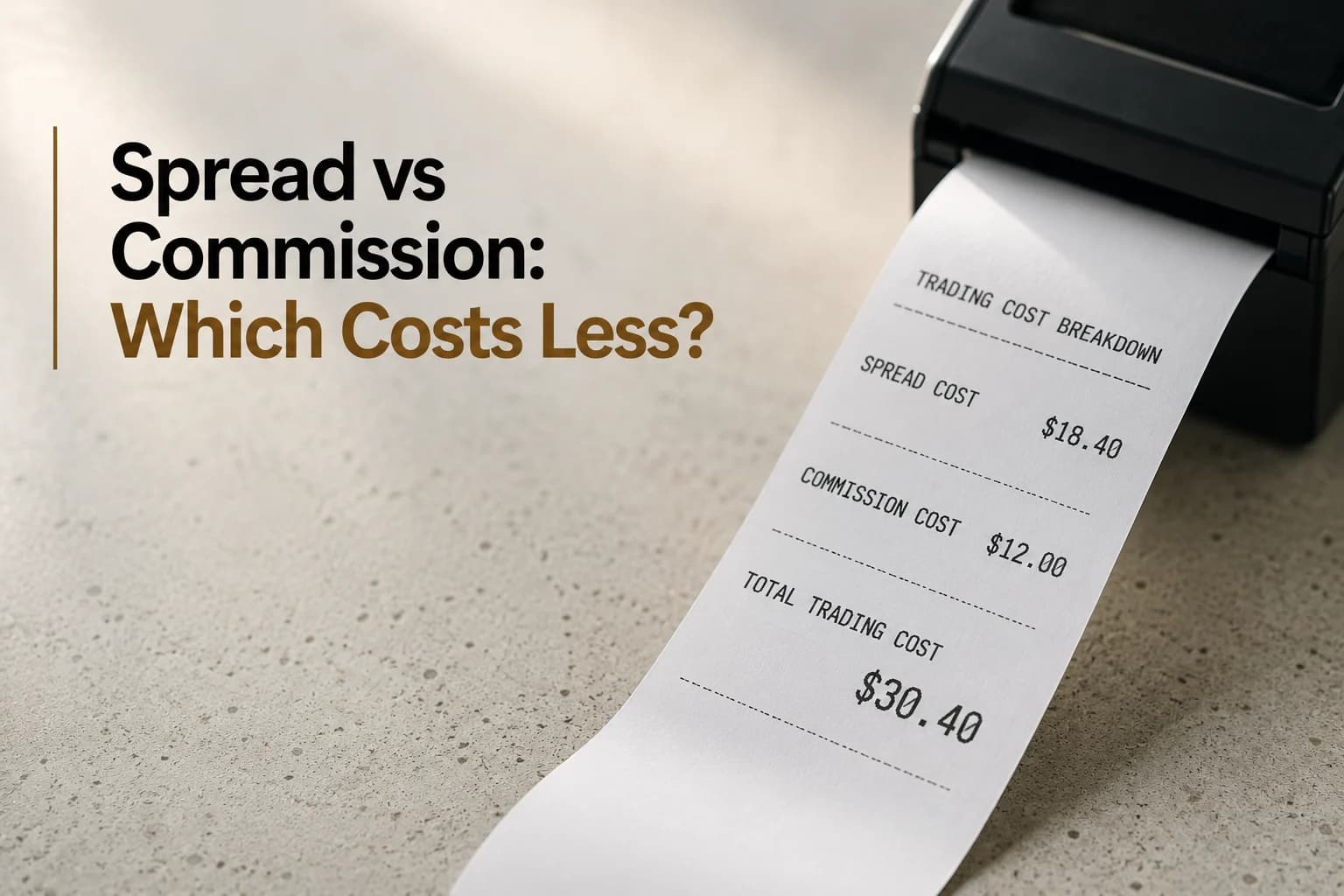
Most traders wonder if they are being charged too much to trade. After making a trade, they may spend hours figuring out if their chosen strategy was right, deciding when to enter, and analyzing risk. If you don’t know how your broker charges for each trade, you might lose profit without realizing it. Spread vs. commission-based pricing means traders comparing commission-based vs spread-only pricing for active traders must consider every part of a broker’s pricing model to find the lowest cost and keep profits.
How Do Brokers Charge?
Before comparing pricing, traders must understand how brokers make income. Most retail fx brokers charge clients in the following ways:
Through spread pricing for their trades (buy/sell trades);
They may charge a commission when you open and close a trade. An extra fee can also be added for the currency or prices in that transaction.
They can use a combination of spreads and commissions (see the examples section).
What is Spread Pricing?
A "spread" is the difference between the buy and sell price of a currency. This gap is how a broker profits from each trade. For example:
For example, if brokers bid EUR/USD at 1.1000 and ask at 1.1002, the spread equals two pip units (2) or pip price differences. Thus:
When you buy currency, your balance is reduced by 2 pips. This means your true trade cost is 2 pips per unit.
What Is Commission-Based Pricing?
Pros of Trading with Spreads:
★ Simple pricing structure.
★ You only pay once for the trade and are not being charged separately for a commission; the trade is priced on a single pricing model.
★ Entry-level traders will find it easier to understand pricing and make decisions on the two types of trade pricing.
★ Pricing is consistent among all models. Usually, prices between brokers are fixed.
Related Articles: Best ECN Brokers in 2026
Cons of Trading with Spreads:
For many currency pairs, spreads are wider than in commission-based accounts.
Many brokers hide markups in spread pricing. Brokers can also raise spreads in volatile markets.
Spread accounts are popular with brokers who use market makers. These are less common for retail institutional clients.
What Are Commission-Based Accounts?
ECN or raw spread accounts offer very low spreads, sometimes as low as 0.0, with costs primarily coming from commissions, as outlined in Commission Per Lot Explained. They also add a commission for each transaction by lot size, for example, 0.1 pip spread and $7 commission for each round-trip trade.
For commission-based accounts, assume the following: To trade via FTP, a $7.00 commission is charged per transaction. This can total $12,345.60 in commission per trade.
All Pros of Commission-Based Trading:
Lower spreads can offer increased potential profit per trade with the same capital.
Commission-based accounts make the expected price more clear, which is why many traders search for the Best Brokers with Low Commission. The price is usually lower than what a broker would charge through spread pricing.
For most traders, commission-based accounts are more cost-effective than spot pricing. This is especially true if trade frequency is high.
Scalpers often use commission accounts rather than spread accounts, especially when choosing among the Best Brokers for Scalping Strategies. Transaction costs are higher in commission-based pricing. This model can be harder to understand than spread pricing. Smaller trades may be costly due to minimum commissions.

Spread vs Commission: A Direct Comparison
Here’s a simplified comparison to help clarify:
Feature | Spread-Based Account | Commission-Based Account |
Visible Cost | Built into spread | Spread + separate fee |
Spread Size | Usually wider | Usually tighter |
Commission | None | Yes |
Best For | Beginners, swing traders | Scalpers, active traders |
Cost Transparency | Medium | High |
Performance in Volatility | Spreads widen | Raw spread widens + commission |
The key takeaway in any broker comparison spreads vs commission cheapest overall analysis is that you must calculate the total effective cost per trade.
Example of Actual Costs: Which is Cheapest?
Compare two hypothetical users trading EUR/USD (1 standard lot).
Account A (spread only)
• Spread = 1.2 pips
• Commission = $0
Total cost per trade = 1.2 pips
For a standard lot, 1 pip = ~$10
Total Trade Cost = $12.00
Account B (commissions)
• Spread = 0.2 pips
• Commission = $7 round trip
Cost of Spread = $2.00
Cost of commission = $7.00
Total cost per trade = $9.00
As shown, the account with commission costs less in this specific scenario than the account with only a spread cost.
Traders using micro lots or holding long-term trades will not notice any cost difference.
What is the Cost of Scalping?
The main goal of scalpers is to profit from very small price changes. With scalping, the profit on even a 0.5 pip move might be greater than all the commissions on that trade. For example, one trader who scalps may use a commission-based trading account that provides raw spreads very close to 0 under liquid market conditions. In general, for traders who are performing tens of trades on a daily basis, the lower spreads provide a greater cost advantage over the commission that one trader has to pay.
What is the Cost of swing trading?
Swing TraSwing traders normally keep a position open for multiple days or even weeks. Therefore, the 1–2-pip difference in entry costs is less important to them than the instrument's total price movement. The cost factors for swing traders may be lower than those for other trading methods, but the trader may find it easier to simply use spread-based accounts.
Costs Considered When Comparing Spread vs. Commission.
When comparing spread vs commission, the costs to be included in the overall cost for trading are often overlooked by traders:
1) Slippage Price at execution may differ from the bid price at the time of execution.
2) Swap Fee Holding a position overnight may incur more cost than the cost of entering the trade.
3) Market Conditions The spreads tend to widen greatly around important/economic shocks.
4) Market Widening Brokers (market makers) may internally widen the spread. ECN models capture the true cost to a trader of holding the instrument.r. All cost analyses should include the above factors.

How Regulation Affects Price Transparency
There is a direct correlation between price transparency and regulatory oversight in financial markets; therefore, many regulators listed below require brokers to clearly disclose their pricing structures.
• Financial Conduct Authority
• Australian Securities and Investment Commission
• Cyprus Securities and Exchange Commission
The level of regulatory oversight will also greatly impact a broker's execution quality and spread stability, even if they are regulated.
When Will Spread-Only Pricing Be Better?
Spread-only accounts usually have a lower cost when:
• The trader does not trade very often
• The trader trades using a small lot size
• The broker offers a competitive fixed spread
• The trader prefers simple cost analysis
Some traders simply prefer not seeing commissions on their statements.
When will commission-based pricing provide a greater advantage?
Typically, commission accounts are cheaper if:
You are trading many shares.
You are engaging in scalping or day trading.
You are trading in a tight spread environment.
You are trading during major overlapping hours.
For experienced traders, raw spread accounts typically give you more control over your trading expenses.
The Psychological Influences of Trading Costs on Traders
Many traders are unaware of how much their cost structure affects their decision-making.
The wider the trading spread, the more likely traders are to shy away from short-term entries. Commission-based pricing often encourages traders to time their entry more precisely.
Understanding how you trade can help you optimize your trading costs.
So, do commission- or spread-based accounts cost you the least?
There is no single answer to this question because the inexpensive option is influenced by:
The frequency of your trading transactions
Your average position size
The type of trading strategy you use
The trading session you are participating in
The execution quality of your broker
Typically, commission-based vs spread-only pricing for active traders forex stocks becomes an important comparison because commission-based accounts often provide the least total cost for active traders, while spread accounts are less expensive and easier for casual or long-term traders.
Final Taking Points
The argument between commission versus spread is not about which form of trading is the best — it is based on your trading style. Many traders compare these models using resources like Wikilix Broker List to better understand real trading conditions.
Spread trading accounts offer simplicity and predictability, while commission trading may offer transparency and often lower trading costs. Thus, the more important question for you is not “Theoretical, which form has the least total costs?” but “Practical, which form of trading has the least total cost for how I trade?”
If you do a great deal of trading based on small price changes, you will typically get lower effective costs with commission trading compared to if you are a long-term trader or do very little trading and order entry, and spread accounts will generally serve you extremely well.
Due to the low margins in trading, consistency is a must. It is critical to know your broker’s fee structure; it is a major factor in your trading risk management plan.