


Broker Summary
What Wikilix has recorded about Nomura Asset Management: its history, the licences it holds, its trading conditions and its fees.
Introduction
Nomura Asset Management Co., Ltd. (NAM) is a strongly innovative and experienced player in the global financial services landscape. As a wholly owned subsidiary of Nomura Holdings, Inc., NAM has gained a market reputation for delivering a full range of asset management capabilities to a wide spectrum of clients, including both individual and large institutional investors. With a history of over 60 years, the firm has transformed by fusing the investment management tradition with innovation and technology, as well as the principles of responsible investment.
In a time when markets can shift quickly and investor expectations are becoming more sophisticated, Nomura Asset Management is setting itself apart with its focus on innovation, ESG integration, and a global investment footprint across Asia, Europe, and the Americas. This article will be a full exploration of Nomura Asset Management's history, capabilities, regulatory environment, trading conditions and fees, the user experience, and updates, to give a comprehensive understanding of the firm in the context of an asset manager in 2025.
Background and History
Nomura Asset Management was established in October 1997 with the merger of Nomura Securities Investment Trust Management Co., Ltd. (NSITM) and Nomura Investment Management Co., Ltd. (NIMCO), respectively founded in 1959 and 1981. This merger brought together four decades of experience in investment trusts and institutional asset management to create a diverse and large asset management company. The origins of the Nomura Group go back to the latter part of the 19th century, when Tokushichi Nomura I began a money-changing operation in Osaka. His son, Tokushichi Nomura II, founded Nomura Securities in 1925, which has grown into the global financial giant we know today. In 2025, Nomura commemorated the 100th anniversary of Nomura Securities and 100 years of continual innovation and service in the financial sector.
Nomura Asset Management is based in Tokyo's Toyosu district but is a global firm with offices in important financial centers such as London, New York, Singapore, and Hong Kong. This international presence enables them to provide clients with access to a wide variety of markets and investment products and services worldwide.
Key Characteristics and Offerings
Core Services
Nomura Asset Management provides investment products and services to both retail and institutional investors. They offer a variety of investment trusts (or mutual funds) for domestic, international equities, bonds, and mixed funds. Nomura Asset Management offers a wide array of exchange-traded funds (ETFs) for its clients, both passive and active, listed on Japanese and global exchanges.
For institutional clients, NAM provides separately managed accounts, which allow for more customized asset management. Segregated accounts are available for pension funds, insurance companies, and sovereign wealth funds. Upon reflecting greater diversity in its product and service offerings, Nomura Asset Management has also entered the alternative investment space, including private equity, real estate, hedge funds, and infrastructure.
Account Types and Instruments
Nomura offers a wide range of account types to address differences in investor profiles, regulations, and other circumstances. For example, Nomura provides investment trust accounts for individuals, NISA (Nippon Individual Savings Account) for tax-advantaged retail investing, defined contribution pension plans, institutional separate accounts, and UCITS funds to address European clients. It's possible for the assets available to span almost all asset classes, including Japanese/global equities, government and corporate bonds, ETFs, real estate investment trusts (REITs), private equity, hedge funds, and infrastructure funds. The variety of investment products and services allows clients to construct diverse portfolios that align with each client's investment objectives and general risk tolerance.
Innovation and ESG Leadership
Nomura Asset Management is at the forefront of establishing innovation in asset management and implementing technology into the asset management process. In particular, the Innovation Lab Department at Nomura Asset Management promotes research and development focused on leveraging advancements in AI, blockchain, and advanced analytics to improve investment decision-making and increase operational efficiency. Nam also has the Responsible Investment Department, which was Japan's first ESG-focused team, offering ESG-integrated funds that meet international sustainable requirements.
Moreover, the Nomura Asset Management Research Center provides clients with insights by publishing analyses of the equity market, economic research, and investment strategy calls to action.
Regulation/Compliance
Nomura Asset Management is owned by the Nomura Group and, across jurisdictions, adheres to rigorous regulatory requirements to ensure transparency, security, and investor protection. As an indicator of both active compliance and best practices, Nomura holds licenses from various regulatory authorities worldwide.
Region | Regulator | License Number | Status |
|---|---|---|---|
Japan | Financial Services Agency (FSA) | Type II Financial Instruments Business (Kanto Local Finance Bureau No. 1) | Active |
United States | Securities and Exchange Commission (SEC) | Registered Investment Adviser (SEC File No. 801-61280) | Active |
Europe (UK) | Financial Conduct Authority (FCA) | Authorized for UCITS and AIFMD funds (FCA Firm Reference No. 122163) | Active |
Hong Kong | Securities and Futures Commission (SFC) | Type 9 (Asset Management) | Active |
Singapore | Monetary Authority of Singapore (MAS) | Capital Markets Services License (CMS100001) | Active |
Trading Conditions and Platform Technology
Trading Conditions
Nomura Asset Management offers competitive trading conditions tailored to both retail and institutional clients. Spreads vary depending on the asset class and market liquidity, while leverage options are designed to balance opportunity with risk management. Minimum deposit requirements reflect the firm’s dual focus on accessibility for retail investors and scale for institutional clients.
Category | Details | Notes |
|---|---|---|
Equities Spread | 0.05%–0.15% | Varies by market and liquidity |
Bonds Spread | 0.10%–0.30% | Depends on credit rating and maturity |
ETFs Spread | 0.03%–0.10% | Bid-ask spread |
Leverage (Retail) | Up to 2:1 | Margin trading in Japan |
Leverage (Institutional) | Up to 5:1 | Subject to risk assessment |
Minimum Deposit (Retail) | ¥10,000 (~$70) | Investment Trusts and NISA |
Minimum Deposit (Institutional) | ¥100 million (~$700,000) | Separate Accounts |
Platform Technology
Nomura offers several digital platforms built to fulfill the unique requirements of different types of investors. For retail investors, the Nomura Online platform is a user-friendly web platform available in English and Japanese. For institutional clients, Nomura Pro offers more sophisticated capabilities, including real-time data, algorithmic trading, and comprehensive portfolio analytics, also available in English and Japanese.
Clients also have access to the Nomura App for IOS and Android, which allows clients to monitor their portfolio, trade, and access research on the go. Nomiura takes security seriously and employs multiple methods of securing clients' data and trade transactions, including two-factor authentication, SSL encryption, and regular penetration testing of security protocols.
Platform | Target Users | Key Features |
|---|---|---|
Nomura Online | Retail Investors | Web-based, bilingual interface, portfolio tracking |
Nomura Pro | Institutional Clients | Real-time data, algorithmic trading, risk management |
Nomura Mobile App | Retail and Institutional | Portfolio tracking, trading, research, iOS & Android |
Fee Structure
Nomura Asset Management’s fee structure is designed to reflect the diversity of its client base and product offerings. While retail investors benefit from relatively low minimum deposits, fees can be complex due to the variety of services and account types. Institutional clients typically enjoy tailored fee arrangements without inactivity charges.
Fee Type | Retail Clients | Institutional Clients |
|---|---|---|
Deposit Fees | Bank Transfer (Japan): Free | Same as retail |
Withdrawal Fees | Bank Transfer (Japan): Free | Same as retail |
Inactivity Fees | ¥1,000/month (if no activity for 12 months) | No inactivity fee |
Account Maintenance | ¥500/month | Free |
Paper Statement | ¥200/month (digital free) | Same as retail |
Fund Switching | ¥500 per transaction | Same as retail |
Commissions | Equity Trading: 0.05%–0.15% (min ¥1,000) | Negotiated individually |
Management Fees | 0.20%–1.50% p.a. (varies by fund type) | Varies by mandate |
User Experience and Market Reputation
Client feedback and industry ratings underscore Nomura Asset Management’s strengths and areas needing attention. On platforms like Trustpilot and Google Reviews, the company earns robust ratings, reflecting strong client satisfaction, especially in Japan. Morningstar and Lipper ratings further validate the caliber of its Japanese equity and bond funds.
Renowned for its expertise in Asian markets and leadership in ESG investing, Nomura commands a strong reputation among institutional investors. However, some retail clients cite the complexity of its fee structure and the limited English-language support outside Japan as notable drawbacks. Despite these issues, the firm’s dedication to innovation and responsible investing continues to resonate with its clientele.
Pros: Deep Asian market expertise, ESG and innovation emphasis, robust institutional network.
Cons: High minimum investment requirements for some products, fewer retail platform features than global peers.
Recent Developments
In 2025, Nomura Asset Management celebrated 100 years since the founding of Nomura Securities. This centennial highlighted its enduring legacy of financial innovation and client service. The company also introduced an AI-driven ESG fund series, reaffirming its commitment to merging technology and sustainable investing.
The Innovation Lab also enhanced its operations by implementing blockchain-based asset tracking, increasing transparency and efficiency. In 2024, NAM grew its assets under management to ¥93.0 trillion (about $646 billion), reinforcing its status as Japan’s largest independent asset manager and a top 20 global AUM leader.
Conclusion
Nomura Asset Management blends tradition and innovation. It offers a wide range of asset management services, backed by a century of financial expertise. With a global reach, an ESG focus, and investment in technology, Nomura meets the evolving needs of investors worldwide. Challenges persist in retail client access and fee clarity. Still, strengths in institutional asset management and market insight drive Nomura’s success.
As finance grows more complex, Nomura Asset Management’s integrated strategies help it remain a trusted partner. Investors seeking stability and growth can rely on its forward-looking approach.
Website snapshots
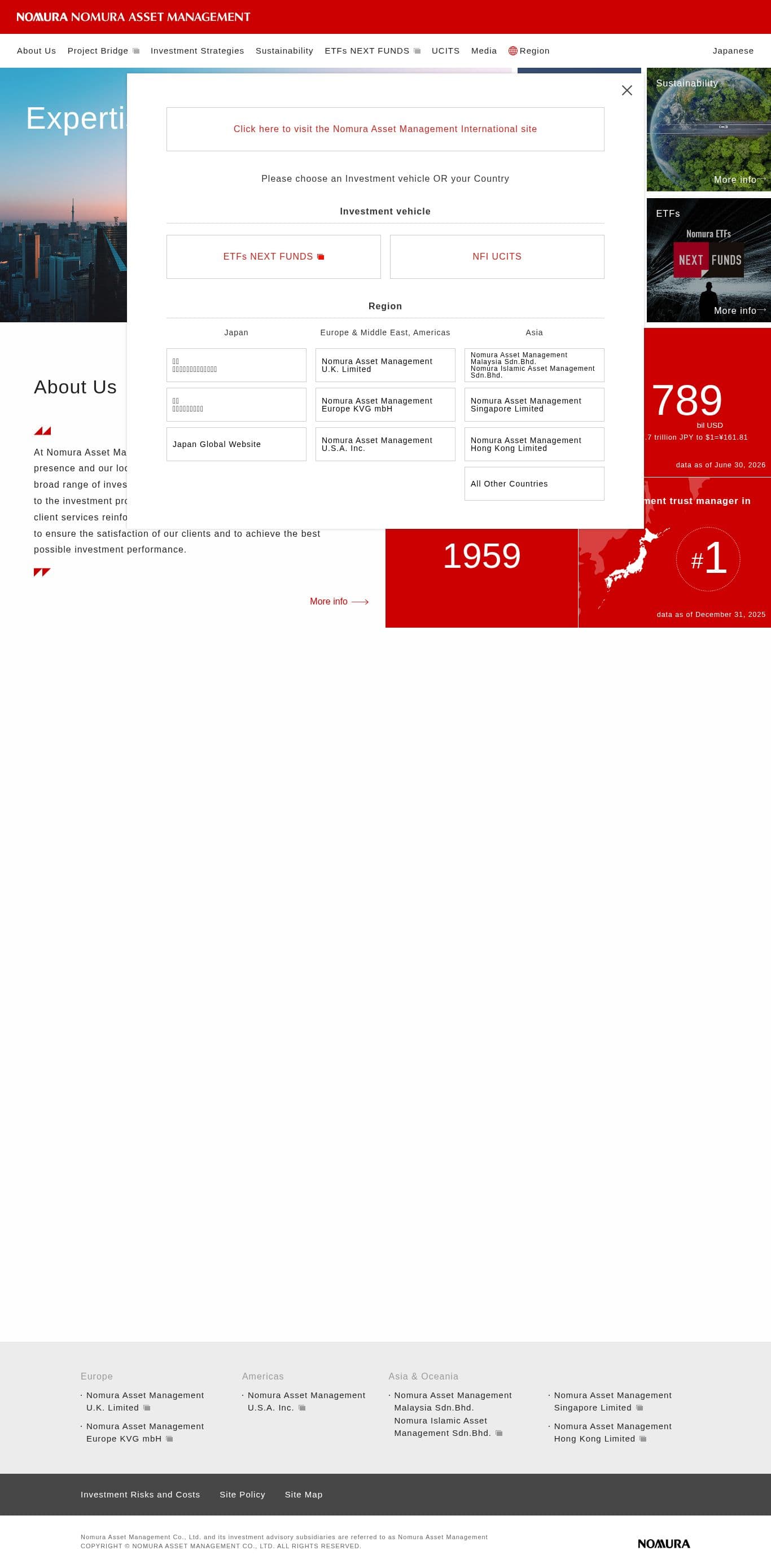
8 full-page captures of Nomura Asset Management's own site, archived so what they said can still be read after the pages change.
Regulatory Licenses
We have not confirmed any regulation for Nomura Asset Management. Money deposited with an unregulated broker is protected only by the company itself.
Trading with an unregulated broker puts your deposit at risk.
No regulation
We have not confirmed any regulation for Nomura Asset Management. An unregulated broker is not supervised by a financial authority, and money you deposit is protected only by the company itself.
What this means for you
- No compensation scheme covers your funds.
- No regulator to escalate a complaint to.
- No audit of how client money is held.
Funding Methods
5 ways to fund an account. 2 credit instantly.
| Method | Deposit fee | Withdrawal fee | Min deposit | Withdrawal min / max | Processing |
|---|---|---|---|---|---|
Bank TransfersBank TransferFunds are returned to the originating account for compliance. Minimum deposit and withdrawal amounts vary by region and account type. | Not recorded | JPY 500 | JPY 100,000 | JPY 10,000Not recorded | Up to 1 day |
Credit/Debit CardsCredit CardSupported only in select regions. No specific withdrawal method mentioned for credit/debit cards. | Not recorded | Not recorded | JPY 100,000 | Not recordedNot recorded | Instant |
| E-WalletsE-WalletFees vary by region. Supported only in certain countries. | Not recorded | Not recorded | Not recorded | Not recordedNot recorded | Instant |
| Local Payment MethodsOtherAvailability and fees vary by country. | Not recorded | Not recorded | Not recorded | Not recordedNot recorded | Not recorded |
Wire TransfersWire TransferWithdrawal fees range from $20 to $50 USD per transaction. Subject to local regulations. | Not recorded | USD 20 | Not recorded | USD 100Not recorded | Up to 3 days |
Global Domains
One domain on record. All active and served over HTTPS.
Corporate Network
One legal entity behind the Nomura Asset Management brand.
- Nomura Asset Management Co., Ltd.ActiveJapanRegistration 7010001054021

Brokers worth comparing
One other broker on the record shares what Nomura Asset Management offers — its country, regulator, account types or platforms — set beside it on the same measures.
Nomura Asset Management
This recordJapan · since 1959· Nomura Asset Management Co., Ltd.Wikilix score 39.0RegulationNo RegulationMax leverageNot recordedPlatformsNot recordedLicencesNot recordedMitoyo
Japan · since 2003· Mitoyo Securities Co., Ltd.Wikilix score 38.0RegulationRegulatedFSAMax leverage1:1PlatformsNot recordedLicences1
Frequently Asked Questions
Common questions about Nomura Asset Management
Comments
Share your thoughts and experiences with Nomura Asset Management