

Pros and Cons of Each Trading Style
Pros and Cons of Each Trading Style
"Explore the pros and cons of different trading styles—scalping, day, swing, and position. Discover which approach best fits your goals, risk tolerance, and trading personality."
Wikilix Team
Educational Content Team
16 min
Reading time
Intermediate
Difficulty
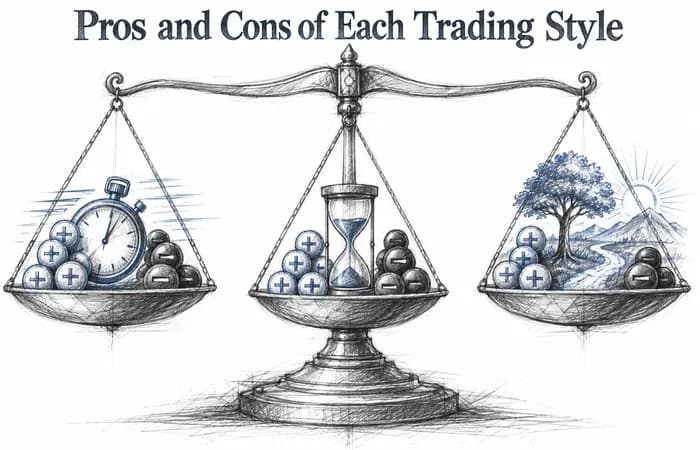
If someone offered you the option of sprinting or marathon running, you would not choose unthinkingly; you would make your decision based on your stamina and temperament. This is also true for Trading. Some people are faster-paced traders seeking adrenaline when making decisions. Others prefer to allow trends to take time - maybe days or weeks.
We will explore each primary trading style (scalping, day trading, swing trading, and position trading) and highlight their respective pros and cons. By the end of the article, you will have a better understanding of which style may be best suited to your temperament and life goals.
Overview of the Primary Trading Styles
Before we explore pros and cons, let's briefly recap what each primary style consists of:
• Scalping: Very short trades for seconds to minutes.
• Day trading: Trades are entered and closed on the same day with no overnight positions.
• Swing or intermediate Trading: Traders hold trades from several days to a few weeks to capitalize on intermediate price moves.
• Position trading: The long view—traders hold trades from weeks to months to sometimes longer and ride the primary trend.
All styles have mental, time frame, or time commitment, psychology, risk, and skill-based demands.

Scalping: Pros and Cons
✅ Scalping Pros
• High frequency, many opportunities: You can make lots of trades in a trading day, generating small but frequent gains.
• Low exposure to market risk: Because the position is held for such a short time, you are less exposed to overnight gaps or possible significant "news" surprises.
• Fast feedback loop—you will know shortly if the trade "works" or if it doesn't, which is a rapid feedback loop with respect to many other elements of the trader's journey.❌ Disadvantages of Scalping
• Your profits will be reduced by transaction costs: Commissions, spreads, and slippage can erode your minor gains when your profit is minimal per trade.
• Highly stressful and psychologically demanding: You must be dedicated, 100% focused, and fast to execute, or otherwise lots of things can go wrong.
• Technical dependent: At the wrong moment, a poor connection or lag in your platform or broker can produce a catastrophe.
• Mental onslaught: Maintaining that kind of pace can wear you down and hinder your focus, discipline, and clarity.
Day Trading: Positives & Negatives
✅ Positives of Day Trading
• No overnight risk: You will be out of every trade each day before the day is over, which limits your exposure to whatever may occur (or may not) overnight.
• Fairly good activity to structure: You can get into many opportunities each day, and at least you will not be racing as fast as scalping.
• Clear structure/boundaries: If you start and stop your day as you identify and monitor targets, it will help you establish discipline and self-care.
❌ Negatives of Day Trading
• Quite the task with considerable stress based on how fast you may need to make decisions. You can make many decisions in a matter of minutes.
• Costs can occur quickly. Whenever you trade frequently, you will incur commission costs, spreads, or slippage - even if the trading process is entirely mechanical.
• Significant concentration is needed: Looking at charts, interpreting signals, and acting consistently for hours as you trade throughout the session.
• Emotional roller coaster: The ups and downs of losing streaks to missed entries can create frustration, impulsivity, or mental fatigue.
Swing Trading: Pros & Cons
✅ Advantages of Swing Trading
• More extensive flexibility of time: You will not need to be focused on often in front of your screen; regular thought every so often is likely sufficient.• More profit potential per trade: Having invested your position for a more extended timeframe means you can capture larger moves.
• Lower transaction costs (relatively speaking): When trading less frequently, you reduce the burden of transaction costs.
• Better for part-time traders: Generally, swing trading is often easier to keep an eye on if you have your own job or other responsibilities.
Cons of Swing Trading
• Overnight / weekend risk: Prices can gap against you when the market is closed, especially with news.
• Fewer opportunities: You may wait days or weeks for the proper signal. This may seem slow to many traders.
• Longer drawdowns: Since you are holding longer, your trades will go against you longer, and this may test your patience/risk.
• Extension of both technical and fundamental knowledge: Typically, when you hold longer, you will want to have a sense of why a trade may work longer than a day trading basis.

Position Trading
Pros of Position Trading
• Capture the significant trends: You are looking to capture large moves. If you get it right, the reward can be substantial.
• Less time over the charts: You don't have to stare at charts for long periods of time.
• Less reactionary Trading: You get to avoid the whipsaw of short-term noise.
• More compounding: These trades take longer to grow, but if you're successful, your gains will be much larger.
Cons of Position Trading
• More prolonged risk: The longer you stay in a trade, the more exposure you have and potential risks (macro events, policies changing, and volatility).• Blocked capital - Your capital might be tied up in trades for an extended period, limiting trade flexibility.
• Emotional dilemma - Seeing your capital swing up and down for weeks or months requires patience and conviction.
• Slow feedback - You might be waiting forever to know if the trade idea was good or bad, which can slow iteration down even more.
Compared by style
Here is a summary for you:
Style Pros (Strengths) Cons (Weaknesses)
Scalping: Many entries, narrow exposure, quick learning. High cost, stressful, dependent on technology
Day Trading: No overnight risk, set schedule, active engagement. Emotional pressure and cost require focus.
Swing Trading: Better balance, larger moves, lower fees. Overnight risk, fewer signals, requires patience.
Position Trading Long-term gains, low maintenance, trend-based Macro risk, slow feedback, capital tied up.
What might be right for you?
When you consider styles, consider:
• Available time - Will you be able to sit and watch the markets for a full day?
• Emotional response - Do you stay calm when you are losing money on the trade?
• Risk tolerance - Are you ok with extreme swings during the day, or is only a moderate swing acceptable?
• Learning style - Do you like fast learning results (scalping/day) or pattern recognition over a longer time (swing/position)?
• Capital considerations - Smaller accounts may have a hard time with a style that requires many trades with high trading costs.
• Demo or small accounts, experiment, and keep track of not only your performance but how it feels. Stress level, enjoyment factor, effectiveness, and other factors.
Final Thoughts & Key Takeaways
Each style has its advantages and disadvantages. Scalping is fun and fast, but it requires high precision, strict discipline, and low transaction costs. Day trading offers active opportunities, but it also entails high stress and a dedicated time commitment to achieve success.
Swing trading provides a happy medium. Space to breathe and make bigger moves, but still feel the obligation to take on extra risk overnight. Position trading is a long-term strategy with low day-to-day stress, but it requires commitment, emotional management, and acceptance of macro-level volatility.
There is no ultimate "best" trading style. The best trading style for you is one that you can execute with relative consistency. You should be able to manage your emotional reactions to each trading decision within the chosen style, considering your time commitment and available capital.
You can try each style on a small scale in demo environments or with small accounts, but be sure also to document your psychological reactions and thought process. Over time, you can start to gravitate towards a style that you can live with every day, rather than one that you dislike, and adapt to the market.
When your temperament aligns with your trading strategy, your edge is not only derived from your trading strategy but also from one of the most fundamental principles of Trading: being consistent and reliable in your execution, as well as in your emotional and thought processes.
Frequently asked questions
Answers to the questions readers ask most about this lesson.
Comments & Reviews
0 entries
Nothing on the record yet
Be the first to share what happened.
What's Next?
Keep building your knowledge with our structured learning path. Each section builds upon the previous one.