
Gold quotes as XAU/USD, but it does not cost what a currency pair costs. On the standard MetaTrader contract one lot is 100 troy ounces, so a $1 move in the gold price is $100 on the ticket, and the spread is quoted in cents rather than pips. Choosing where to trade gold online in 2026 is therefore a different exercise from choosing a broker for EUR/USD, and a broker that ranks well on major-pair pricing can be mediocre on metals.
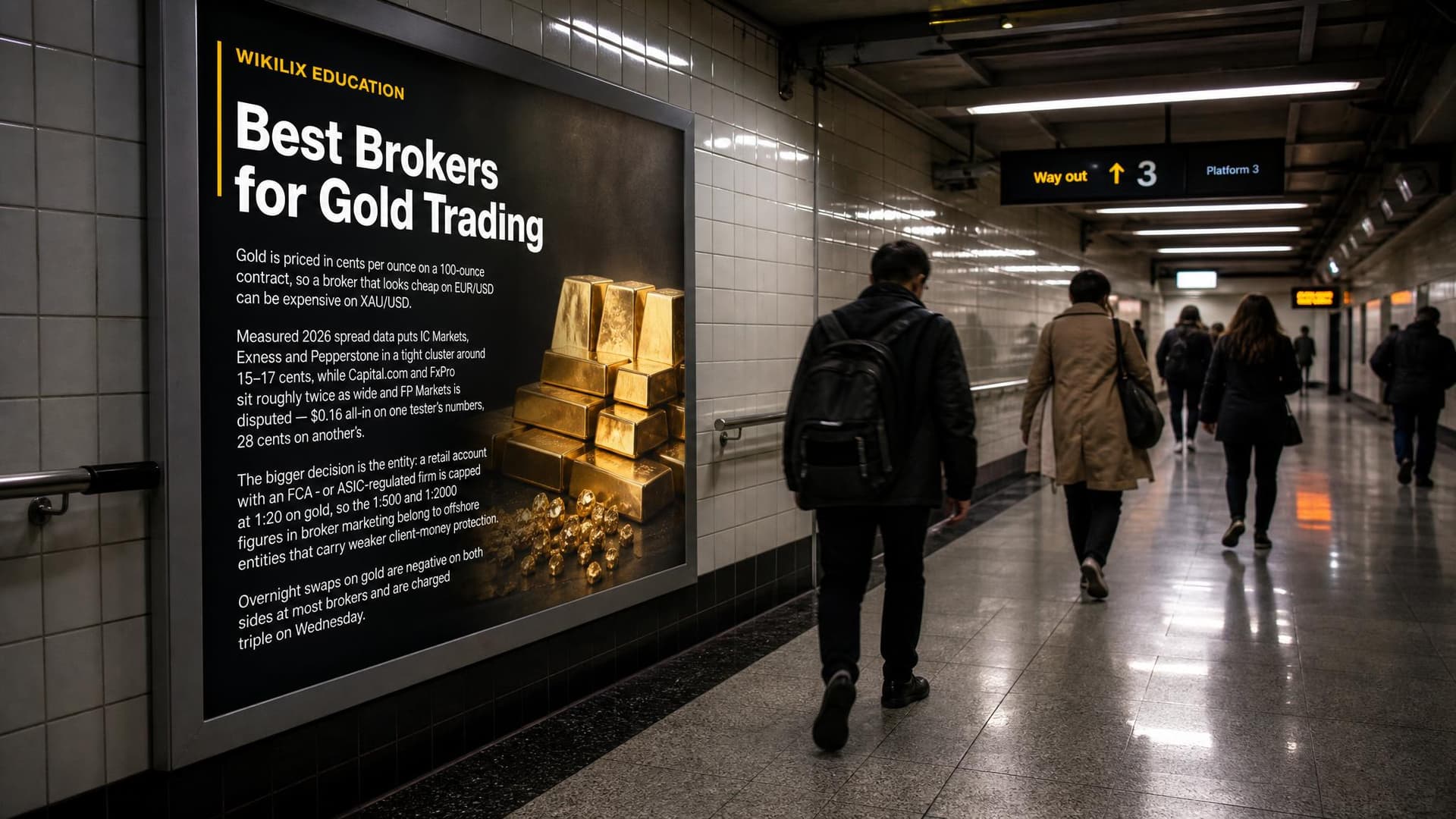
Here is the shortlist, using average XAU/USD spreads measured by FXEmpire and DailyForex in their own 2026 testing rather than advertised minimums:
| Broker | Typical XAU/USD spread | Headline max gold leverage |
|---|---|---|
| IC Markets | ~15 cents | 1:500 |
| Exness | ~16 cents | 1:2000 |
| Pepperstone | ~17 cents | 1:200 |
| FP Markets | ~$0.16 all-in, but disputed — FXEmpire measured 28 cents | 1:500 |
| Capital.com | ~30 cents | 1:200 |
| FxPro | ~34 cents | 1:200 |
Read the leverage column carefully: those are headline figures from offshore or professional-client entities. A retail account with an FCA- or ASIC-regulated entity is capped at 1:20 on gold, as the leverage section below sets out, so what you can use depends on which legal entity holds the account rather than on the brand above the door.
What Makes a Good Gold Trading Broker?
Five criteria, roughly in the order of how much money they move.
Average spread, not minimum spread. The advertised "from 0.0" floor exists for seconds a day in the London–New York overlap; the time-weighted average is what you actually pay, and it is what the figures above are. Ten cents of extra spread is $10 per lot, per trade.
Execution stability around US data. Gold reacts to CPI, payrolls and FOMC decisions harder than most currency pairs. A broker whose 30-cent spread becomes 200 cents for ninety seconds has removed you from the market at the moment you wanted to be in it. Test it on a live account at minimum size before you scale up.
Swap on both sides. Gold has no yield, so financing a long costs money almost everywhere, and at many brokers the short side is negative too. Over a multi-day hold, swap can outweigh spread.
Leverage that matches the entity, not the brand. Commodities brokers margin gold on its own tier — tighter than oil, looser than a major pair — and a brand with six licences offers six different products. Check the leverage, the segregation and the compensation scheme of the entity named on your account agreement.
A published contract specification. Contract size, tick value, minimum lot and margin rate are all the broker's to set on an OTC CFD. A broker that makes you hunt for them is telling you something.
Best Brokers for Gold Trading Compared
Comparison Table
| Broker | Avg XAU/USD Spread | Commission | Max Gold Leverage | Contract Size | Swap Long/Short | Regulation (entity verified at register) |
|---|---|---|---|---|---|---|
| IC Markets | ~15 cents (Raw) | Yes, on Raw/cTrader | 1:500 (offshore) | 100 oz | Negative both sides, set daily | IC Markets (EU) Ltd — CySEC 362/18 |
| Exness | ~16 cents (Standard) | Nil on Standard | 1:2000 (offshore) | 100 oz | Negative both sides; swap-free tiers offered | Exness (Cy) Ltd — CySEC 178/12 |
| Pepperstone | ~17 cents (Razor) | Yes, on Razor | 1:200 | 100 oz | Negative both sides, set daily | Pepperstone EU Limited — CySEC 388/20 |
| FP Markets | ~$0.16 all-in (disputed) | ~$0.08 minimum fee on Raw | 1:500 (offshore) | 100 oz | Negative both sides, set daily | First Prudential Markets Ltd — CySEC 372/18 |
| Capital.com | ~30 cents | Zero commission | 1:200 | 100 oz | Negative both sides, set daily | Capital Com SV Investments Ltd — CySEC 319/17 |
| FxPro | ~34 cents | Nil on spread-only accounts | 1:200 | 100 oz | Negative both sides, set daily | FXPRO Financial Services Ltd — CySEC 078/07 |
Three columns need a caveat. The regulation column names only the entity we could verify against a regulator's own register — CySEC's list of Cypriot investment firms, as of 4 May 2026. Each of these brands runs several entities under different regulators, the headline leverage above generally comes from an offshore one, and any other licence a comparison site attributes to a brand is unverified until you see it on a register yourself. No broker publishes a fixed long/short gold swap rate either: it is recalculated daily from the gold forward curve plus the broker's markup, and you read it in the platform's symbol specification. And the 100-ounce contract, near-universal on MetaTrader, is still a broker setting — some platforms use 10-ounce minis, which shifts every figure below by a factor of ten.
All six quote gold across the same near-24/5 metals session, with a daily break of roughly an hour around 22:00 UTC when the trading day resets and swap is applied.
Broker Profiles
IC Markets posts the tightest measured gold spread of the group, roughly 15 cents on Raw accounts, on MT4, MT5, cTrader and TradingView. Its limitation is that the figure is a Raw-account one and carries a separate commission line.
Exness prices Standard accounts at around 16 cents with no separate commission, on the Exness Terminal, MT4 and MT5, and offers swap-free tiers. Its limitation is that neither headline is free: swap-free recovers the financing through a wider spread or an administration fee, and the 1:2000 belongs to an offshore entity rather than the CySEC one, so the top leverage and the European protections are not available on the same account.
Pepperstone sits at about 17 cents on Razor, on MT4, MT5, TradingView and its own web and mobile platform. Its limitation is that it is the widest of the tight cluster and Razor still carries commission on top, so the all-in gap to IC Markets is wider than the two cents suggest.
FP Markets measured roughly $0.16 average all-in cost in DailyForex's 2026 testing, with raw spreads from 0.0 and a minimum fee near $0.08, on MT4, MT5, cTrader, TradingView and Iress. Its limitation is that the two testers disagree — FXEmpire measured 28 cents, near the wide end of this table — so treat the figure as unsettled until you have watched it on your own account.
Capital.com is about twice as wide at 30 cents but charges no commission, on its own web trader plus MT4 and TradingView. That is a reasonable trade for a swing trader placing a few trades a month and a poor one for a scalper.
FxPro is the widest of the six at around 34 cents on spread-only accounts, offset by a raw-plus-commission option, on its own web platform plus MT4, MT5 and cTrader. Check which account type you were defaulted into.
How Gold CFD Trading Works
XAU/USD is quoted in US dollars per troy ounce. A quote of 3,410.25 / 3,410.55 means you buy at 3,410.55 and sell at 3,410.25 — a 30-cent spread.
One standard lot is 100 troy ounces, so profit or loss is the price move in dollars multiplied by 100, multiplied by your lot size. A 1.00-lot position that gains $1 on the gold price gains $100; 0.10 lots gains $10, and 0.01 lots gains $1.
That is the sizing formula run backwards. If you are willing to lose $50 and your stop is $5 below entry, your lot size is $50 ÷ ($5 × 100) = 0.10 lots. Most gold accounts blow up because that division never gets done.
Gold Spreads and Costs Explained
Gold spreads are quoted in points — hundredths of a dollar, usually called cents — not in pips, because there is no second currency whose fourth decimal place defines a pip. "Spread from 12" means 12 cents per ounce, which is $12 on a standard lot.
The spread is not constant, and the variation is larger than the average. It is tightest in the London–New York overlap, wider through the Asian session, sharply wider during the rollover break around 22:00 UTC when market makers step back, and widest in the seconds around a US data release.

So the honest cost of a gold trade depends on when you place it: entering at 03:00 UTC on a 45-cent spread and entering at 14:00 UTC on a 15-cent spread are three times apart for identical execution. Compare brokers at the hour you actually trade — and if you are comparing cost models more generally, our guide to spread versus commission covers how the two structures net out.
Leverage and Margin on Gold
Gold sits in a lower leverage tier than major currency pairs almost everywhere it is regulated. ASIC's product intervention order, in force from 29 March 2021, caps retail CFD leverage at 20:1 "for CFDs referencing an exchange rate for a minor currency pair, gold or a major stock market index", against 30:1 for a major currency pair and 10:1 for commodities other than gold. The FCA puts gold on the same rung, in its rulebook rather than its press releases: COBS 22.5.11R requires margin of 5% of the exposure — that is 20:1 — where the underlying is gold, a major stock market index or a minor currency pair, against 3.33% (30:1) for a major pair. The FCA's restrictions took effect on 1 August 2019.
A worked example. Gold at $3,400, one standard lot: notional 100 × $3,400 = $340,000. At the regulated retail cap of 1:20, required margin is $17,000. At an offshore 1:500, the same position needs $680.
The second number is the dangerous one. Read the current average true range off your own daily chart before you size: a $30 adverse move on one lot is $3,000, more than four times a $680 margin. Both the FCA and ASIC require negative balance protection, and the FCA additionally requires firms to close positions at 50% of required margin. Neither rule stops you losing the account.
Swap Rates on Gold Positions
Gold pays no interest. Holding a long gold CFD is economically a financed purchase of metal, so you pay the cost of carry, and at most brokers the short side is also negative once the broker's markup is applied. Swap-free accounts recover the cost through a wider spread or an administration fee.
Swap is applied at the daily rollover just after 22:00 UTC, and on Wednesday it is charged at triple rate to cover the weekend, because spot settlement is T+2. A position opened Wednesday morning and closed Thursday morning pays three nights of financing for one night of exposure. Swing traders who ignore this often pay more in swap than in spread over a month.
Best Times to Trade Gold
| Window (UTC) | Session | Conditions |
|---|---|---|
| 00:00–08:00 | Tokyo | Thinnest liquidity, widest spreads, range-bound more often than not |
| 08:00–13:00 | London | Good liquidity, first real directional moves of the day |
| 13:00–17:00 | London–New York overlap | Tightest spreads, highest volume; the LBMA PM gold auction runs at 15:00 London time — 14:00 UTC in summer, 15:00 UTC in winter |
| 17:00–22:00 | New York only | Moderate, thinning into the close |
| ~22:00–23:00 | Rollover break | Avoid — spreads can multiply several-fold |
The events that move XAU/USD hardest are US CPI and non-farm payrolls, both released at 08:30 New York time — 13:30 UTC while US daylight saving is in force, 12:30 UTC in winter — and FOMC decisions at 14:00 New York time, an hour that shifts the same way. Weekly jobless claims use the same 08:30 slot on Thursdays and produce smaller but tradeable moves.
Gold vs Forex Trading: Key Differences
| XAU/USD | EUR/USD | |
|---|---|---|
| Typical daily range | Dollars per ounce — read the current ATR | 50–90 pips |
| Contract size | 100 troy ounces | 100,000 units |
| Value of smallest quoted increment (1 lot) | $1 per cent | $10 per pip |
| Typical spread | 15–35 cents | 0.1–1.0 pips |
| Regulated retail leverage cap | 1:20 | 1:30 |
| Overnight swap | Usually negative both sides | Can be positive on one side |
| Main drivers | Real yields, USD, risk sentiment, geopolitics | Rate differentials, EU/US data |
The practical consequence is position size: the same nominal leverage carries more risk per lot on gold than on a major pair, because the underlying moves further. Traders arriving from forex who keep their usual lot size are the ones who get closed out.
Common Mistakes When Trading Gold
Carrying forex lot sizes across. One lot of gold is not one lot of EUR/USD. Recompute size from your stop distance every time.
Sizing off leverage rather than risk. Leverage tells you what you are permitted to open; the stop distance tells you what you should open.
Ignoring swap on multi-day holds. Check the platform's symbol specification before you hold gold over a Wednesday.
Trading the Asian session on a scalping strategy. A method that needs a 15-cent spread does not work at 45 cents.
Assuming the contract size. Confirm 100 ounces in your own platform.
Choosing on headline leverage. Our guide to comparing forex brokers works through how to check which entity you are actually signing with, and you can verify a licence against the regulator directory before you deposit.