
Selecting a forex broker is one of the most significant choices any trader has to make. While strategies, technical indicators, and market analysis tend to get most of the attention, the broker or trader a trader chooses can greatly affect the overall trading experience. A good broker provides reasonable prices, excellent execution, and security in keeping their customers' funds safe. On the other hand, a poor broker will create additional costs, technical difficulties, and could create serious risks to the trader's capital.
There are hundreds of forex brokers worldwide, many of which offer low spreads, advanced trading platforms, and superior trading conditions. For a beginning trader, distinguishing among the various brokers can be very difficult. Many of the marketing claims made by brokers are very similar; as a result, it may be challenging for a trader to identify which broker offers the best trading environment.
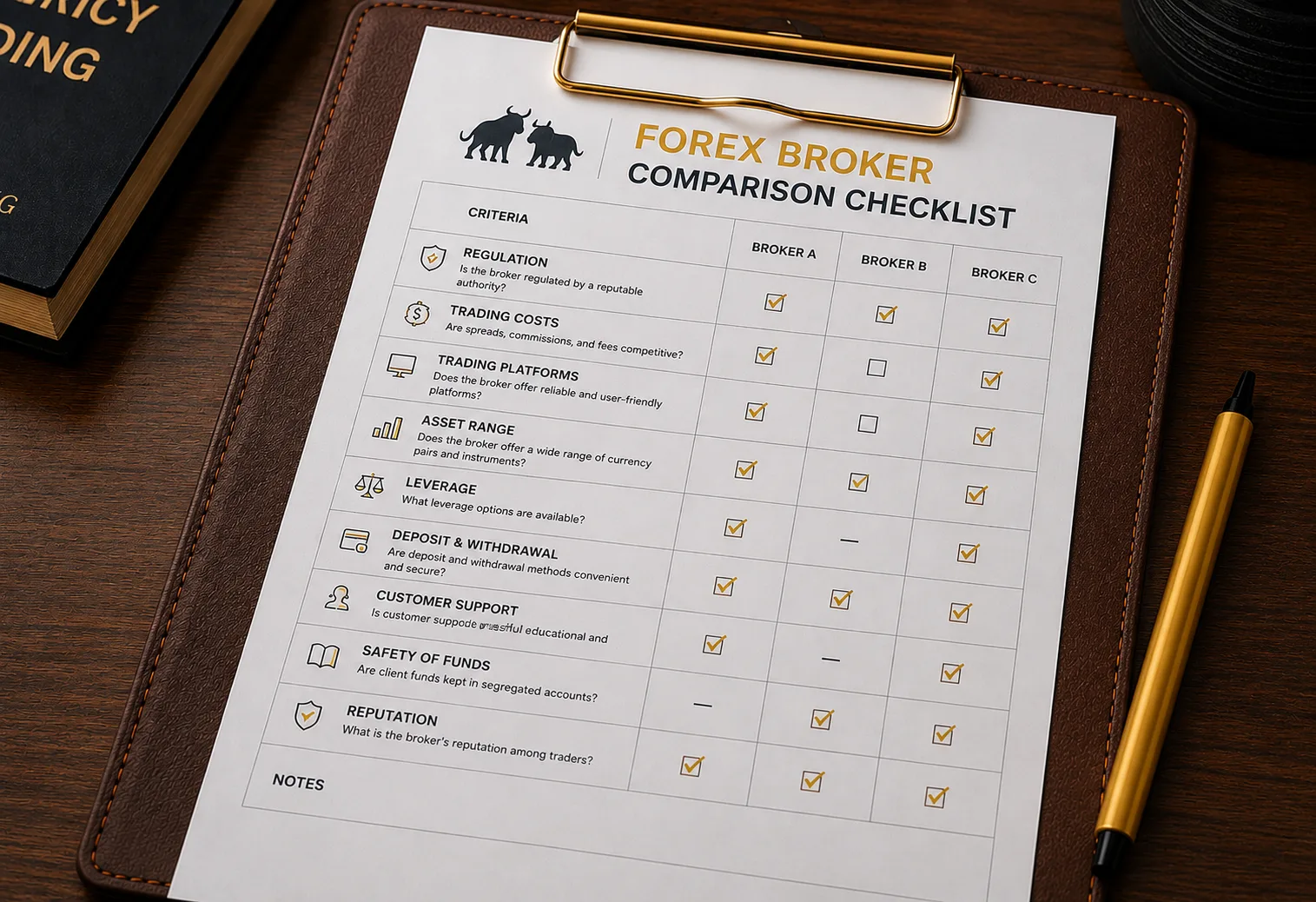
To that end, it is very important for traders to take their time and thoroughly compare the various forex brokers before deciding where to trade. Rather than relying on how well a broker's advertisements are written or how popular they may be with other traders, traders should create a comparison checklist and use it to evaluate brokers based on their regulation, trading conditions, trading platform quality, commissions and fees, and customer service.
The purpose of this guide is to provide traders with a comprehensive checklist for comparing forex brokers and to help them determine what is most important to them as they select a trading partner in the global currency markets.
Why Comparing Brokers Is Important
The forex market is decentralized. This means that trading takes place between traders and brokers rather than through a single centralized exchange. Therefore, brokers provide traders with access to the market.
Brokers can provide different environments for the traders to execute their trades. One broker may have very high liquidity and institutional-level execution, while another may offer high spreads and/or slower order execution. Differences like this can have a huge impact on how traders perform.
For example, if a trader uses a broker with lower spreads than their competitor, they can reduce their trading costs on many trades (and may be able to execute hundreds of trades, saving many dollars). Additionally, if the trader uses a broker with faster execution, they may be able to avoid slippage during volatile market conditions. Any type of difference (i.e., commissions, technology) can accumulate into millions of dollars over time.
By thoroughly comparing brokers, traders can find a trading platform that aligns with their trading style, risk parameters, and long-term goals.
Related Articles: What Is an ECN Broker?
Forex Broker Comparison Checklist
Step 1: Check Regulation and Broker Legitimacy
Regulation is the first and foremost factor to consider when comparing foreign exchange brokers, especially when learning How to Verify a Broker's License. Regulated brokers are required to comply with strict financial regulations designed to protect traders.
Regulators require brokers to have enough capital, keep client and company funds separate, and report transparently. Some of the better-known regulatory authorities are:
• FCA (Financial Conduct Authority): United Kingdom
• ASIC (Australian Securities and Investments Commission): Australia
• CySec (Cyprus Securities and Exchange Commission): European Union
• CFTC (Commodity Futures Trading Commission): United States
Choosing accredited brokers helps protect your investments and fosters confidence in the trading process.
Step 2: Compare Trading Costs and Fee Structures
Profitability is greatly affected by trading costs, with transaction costs most influenced by a trader's activity level. The highest costs incurred when trading Forex through a broker are commissions and spreads, as explained in Spread vs Commission: Which Costs Less.
The larger of the two fees incurred in trading Forex is the spread between the price at which a trader buys a currency, known as the ask price, and the price at which a trader sells the same currency, known as the bid price. Some brokers offer fixed spreads, while others offer variable spreads that fluctuate with market conditions.
Traders who use commission-based accounts pay lower commissions than those using spread-based accounts; however, this comes at the expense of paying a commission to their brokers per transaction, which is charged to commissionable accounts. Thus, the commission structure is found to be less costly to the majority of professional traders than the spread structure.
Other trading costs that may be incurred by traders include overnight swap fees, withdrawal fees, and inactivity fees; thus, professional traders should consider the total cost of using all the services provided by their brokers to fully understand the actual cost of each transaction.
Related Articles: Broker Execution Models Compared
Step 3: Evaluate Trading Platforms and Technology
Traders rely on the trading platform daily; thus, its quality significantly impacts their trading experience.
Forex brokers usually provide platforms such as MetaTrader 4, MetaTrader 5, or their own platform.
These platforms allow traders to view charts, trade, and track market movement.
An effective platform should offer;
• Stable performance and fast execution
• Advanced charting tools
• Supporting a variety of order methods
• Walk-in support for mobile trading.
Execution time is particularly significant during periods of heavy trading activity. If a platform is delayed or has technical difficulties, you may lose your trading opportunity due to slippage.
Step 4: Analyze Available Markets and Instruments
Forex trading is centered around pairs of currencies, but there are numerous additional markets available through many brokers (not just . These instruments allow traders to develop their strategies and manage risk more effectively.
By providing access to additional types of instruments such as commodity gold) and stock indices), Brokers that offer multiple asset classes also provide traders with more options for long-term growth.
Step 5: Review Account Types and Leverage Options
Typically, forex brokers offer several account types for traders; for example, they may include standard, ECN, and raw spread accounts, which are often explained in What Is an ECN Broker. Each account type may offer different commission and spread structures, as well as various execution models. In addition, leverage is something you should consider when selecting a broker; it allows you to control larger positions with less capital at risk, but it also increases your account's risk.
Well-respected brokers are clear about the leverage available to them and provide risk disclaimers. By reviewing the account structures offered by different brokers, you can make a more informed decision on which broker best meets your needs when choosing your trading environment.
Forex Broker Comparison Checklist
Factor | What to Look For | Why It Matters |
Regulation | Licensed by reputable regulators | Protects client funds and ensures transparency |
Trading Costs | Competitive spreads and low commissions | Reduces long-term trading expenses |
Trading Platform | Stable platform with advanced tools | Improves analysis and execution |
Market Access | Multiple currency pairs and asset classes | Enables diversification |
Account Types | Flexible accounts with fair conditions | Supports different trading styles |
Customer Support | Fast and responsive assistance | Helps resolve issues quickly |
Deposits & Withdrawals | Simple and reliable payment methods | Ensures smooth fund management |
Step 6: Test Customer Support and Service Quality
When looking at brokers for the first time, many people overlook the importance of good customer support, but this may be crucial if a problem arises with one of your accounts.
Traders need to consider how quickly their broker's customer service team responds to help requests and whether support is available through multiple channels, such as live chat, email, or phone.
Most professional brokers will offer multiple languages for customer service and are committed to communicating effectively with clients.
It is a good idea to test a broker's customer support before opening a live trading account, as this will help you determine whether the broker will be dependable.
Related Articles: Spread vs Commission: Which Costs Less?
Step 7: Test the Broker with a Demo Account
Traders should test their brokers before using real money by using a demo account.
Demo accounts let traders simulate real market conditions with fake money, so they can test the platform without risking real money.
While demo-testing the platform, traders can assess how quickly orders execute, the size of the spread, the platform's reliability, and the tools available.
If a broker performs well during this demo testing phase, they are more likely to provide traders with a smooth trading experience when using real money.
Common Mistakes When Comparing Forex Brokers
Traders often make common errors when selecting a forex broker and use the wrong criteria to assess them.
One of the most common mistakes traders make is choosing a broker solely because they offer high leverage. Leverage can multiply your profits, but it will also increase your risk. High leverage should not be the only reason you choose a broker.
Another common mistake traders make is to rely on marketing hype, rather than verifying a broker's regulatory status and checking actual customer reviews.
Hidden fees can also occur when trading with a broker and can decrease your profitability over time.
To avoid these mistakes, use an objective comparison tool with a suggested checklist.
FINAL THOUGHTS
Choosing a reputable and trustworthy forex broker is vital to your success as an active trader. Brokers are your gateway to the global currency marketplace. The costs you incur when trading, along with the reliability and technology each broker provides, will directly impact the outcome of your trades.
Traders should compare multiple brokers side-by-side using a defined checklist, including regulations, trading costs, platform quality, access to multiple markets, account types, and customer support quality, as commonly structured in Wikilix Broker Analysis.
By covering all of the above while conducting your comparison, you will be able to determine a broker that offers you equitable trading conditions, dependable execution, and dependable protection under a regulated environment.
In conclusion, the best forex broker is not necessarily the most popular, but rather the one that matches your trading style, risk tolerance, and long-term financial objectives.