


The last few years have seen the emergence of a significant opportunity for retail traders: the use of proprietary firms (prop firms). Prop firms allow traders to operate through a funded account (rather than using their own capital) and to share in the profits.
One of the main aspects that traders will consider when selecting prop firms to work with is the profit split (the amount of profit kept by the trader compared to the amount taken by the firm). For example, some prop firms pay 70% of the profit to the trader (paying the firm only 30%), while others pay the trader up to 80%, 90%, or even higher percentages of any generated profits, depending on circumstances.
At first glance, it may seem that the prop firm with the highest profit split is the best choice. However, an experienced trader knows that numerous factors should be considered in the evaluation process, including evaluation rules, drawdown limits, the frequency of payments to the trader, and the stability of the prop trading firm's platform.
This guide will provide you with information on the Best Prop Firms with High Profit Splits, how profit splitting works, and prop firms that provide competitive trader payouts versus other trading companies.
Profit Split
In prop trading, a profit split provides a trader with a percentage of profits from a funded account from a prop trading firm. For example, under an 80% profit split, if a trader generated $10,000 in profit while working with a prop trading firm, the trader would earn $8,000 (80% of the profit), and the prop trading firm would earn $2,000 (20% of the profit).
Profit splits are beneficial to both the trader and the prop trading firm: a successful trader earns profits (from applying a successful trading strategy), and the prop trading firm earns a share of the performance profits generated by the trader, which directly explains How Prop Firms Make Money.
Due to increased competition among prop trading firms, many have raised their profit splits to remain competitive in attracting traders. Additionally, prop trading firms have created various scaling programs to further increase their traders' profit splits, the longer a trader consistently produces positive trading results.
When evaluating each prop trading firm's profit split, the trader should consider the full set of trading conditions offered by the firm.
Related Articles: What Happens After You Pass a Prop Firm Challenge?
The Effect of Profit Splitting on Trading Success
Profit splitting can positively impact a trader's earnings over time, depending on the returns generated by each trading company and the amount invested. In this case, even a minor difference in the percentage of profits generated between companies could yield huge differences in profit when trading with large amounts of cash.
Consider Prop Firm A offering an 80% profit split versus Prop Firm B offering a 90% profit split:
Assuming a trader generates $50,000 in profit for both prop firms, the likelihood of being able to trade for more money at the company with the different profit-sharing arrangement is exceptionally high.
The other area where profit sharing can negatively impact a trader is when it creates a higher challenge fee to work through the evaluation than would normally be required during a challenge phase. As a result, traders should review all aspects of a prop firm before making a final decision to join.
Some Considerations When Evaluating Prop Firms
Profit share is certainly a crucial component to a trader’s decision regarding which prop trading firm they would like to become a trader for, but there are many additional variables that play a vital role in determining which prop trading company is right for a particular trader.
Evaluation Rules
Most prop firms require a trader to complete an evaluation phase (commonly known as the "challenge phase") before receiving the firm’s funding. If the evaluation rules do not yield realistically achievable goals, there is a significantly increased risk that traders will make unnecessarily high-risk investments to achieve unattainable goals.
Acceptable Draw Downs
Drawdowns refer to the maximum amount of money (in dollars) a trader can lose before their trading account is terminated by the prop firm. Allowing for a few drawdowns above and below can help a trader successfully utilize their most effective strategies without fear of being terminated for exceeding the drawdown limits.
Dependable Trading Platforms
Most prop firms send out licenses to use their trading platforms (MT4, MT5, cTrader). All traders need a reliable platform that executes their trading systems quickly and efficiently.
Payout Frequency
Some prop trading firms pay their traders weekly, while others pay monthly. Weekly payout schedules are preferred by most traders seeking to generate a reliable, consistent income from trading.
Transparent Rules
Clearly defined trading restrictions (news trading/risk limits) will help traders understand how to avoid fines or other issues arising from miscommunication about them.
Related Articles: Are Prop Firms Worth It in 2026?
Popular Prop Firms with High Profit Split
Several proprietary trading firms have gained recognition for offering competitive profit-sharing structures. The following table highlights some prop firms frequently mentioned in discussions about high trader payouts.
Prop Firm | Maximum Profit Split | Trading Platforms | Key Features |
FTMO | Up to 90% | MT4, MT5, cTrader | Established reputation and scaling program |
The Funded Trader | Up to 90% | MT4, MT5 | Multiple challenge models |
MyForexFunds* | Up to 90% | MT4 | Popular evaluation structure |
E8 Funding | Up to 80–90% | MT4, MT5 | Flexible trading rules |
True Forex Funds | Up to 90% | MT4, MT5 | Competitive scaling plans |
Availability and regulatory status may vary by jurisdiction and company operations.
These firms differ in their evaluation structures, challenge fees, and trading rules, but they are often discussed among traders seeking high profit-sharing opportunities.
The function of Evaluation Challenges
Evaluation challenges are often used by many prop companies to assess a trader's performance before they are allowed to trade with real money.
Usually, these evaluation challenges are designed around a specific profit target and a set of strict risk management rules that a trader must abide by, such as maximum loss per day and maximum drawdown.
Although the requirements for passing an evaluation challenge may seem very difficult, they have been created to filter out traders who demonstrate both good discipline and the ability to consistently perform.
If a trader has successfully passed an evaluation, they’ll be given access to trade with more funds, without risking their own money.
Growing through Scaling Programs and Building for Longevity
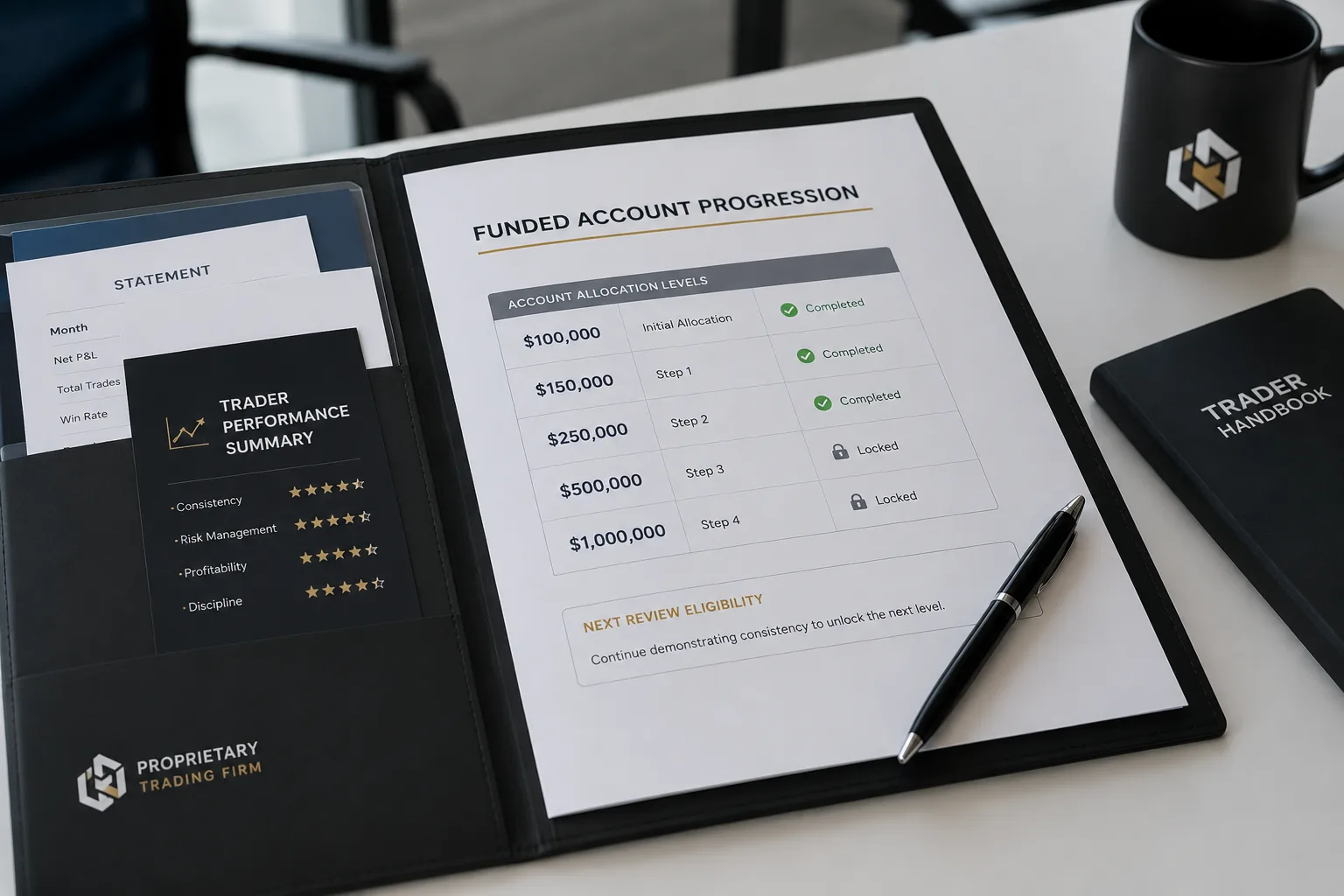
Many prop businesses offer scaling programs in which a trader gradually increases the size of their funded account.
A trader who demonstrates consistent profits will generally receive a greater allocation of funds to trade over time; therefore, they have the opportunity to grow their earning potential without ever needing to invest more of their own money.
Scaling programs can be very appealing to a trader who wants a long-term trading career.
For example, if a trader began with a $100,000 account and maintained consistent profits, they could eventually trade on an account with several hundred thousand dollars in total capital.
Related Articles: Prop Firm vs Retail Broker: Key Differences
Risks and Considerations in Prop Trading
Although prop trading opportunities are attractive, there are some things that a trader must be aware of in order to have realistic expectations from working for a prop trading firm. The discipline required to complete the evaluation challenges is strict, and not all traders will pass them on the first try. The challenge fees can also represent a cost to a trader that must be considered before participating in an evaluation challenge.
The credibility and transparency of the prop trading firm are other considerations that traders should take into account when joining, especially when evaluating Are Prop Firms Legit? Red Flags to Watch. Traders should research a particular prop firm’s reputation (or lack thereof), payout history, and overall operational structure before joining.
Most reliable prop trading firms have clear communication, consistent payouts, and clear trading rules.
The Increasing Popularity of Prop Trading
With the advent of technology and the increasing accessibility of remote trading, the prop trading industry has grown tremendously over the last few years. Many prop trading firms now allow traders around the world to participate in evaluation challenges and to trade funded accounts completely online. As a result of this growing availability globally, many skilled traders who did not have access to large capital can now join prop trading.
As competition among prop trading firms increases, the number and size of funding opportunities for traders have also improved, as have the profit splits and the flexibility of prop firms' rules.
Conclusion
Finding the best prop firms with the highest profit split requires evaluating several different factors. Among them are the structural differences in how profits will be shared, the qualifications for each evaluation challenge the trader must complete, the platform the prop firm will allow trading on, and the firm’s policies regarding payouts.
While a higher profit split can significantly increase a trader's potential earnings, other aspects of a prop firm’s business model must be considered when evaluating it, such as its drawdown limits and trading conditions.
Traders who want to be successful have to ensure they work with industries that have fair evaluation systems, clear rules, and stable trading environments that minimize the risk of being penalized and allow them to concentrate on strategy and performance without distractions, using platforms recognized as Your Trusted Broker Resource.
In the ongoing evolution of the prop trading industry, traders have more opportunities than ever before to access significant capital and build a successful professional trading career.
Ultimately, the best type of prop firm trade is one that aligns with the trader’s risk management philosophy and long-term financial objectives.