
If you have compared forex or CFD brokers, you may have noticed the use of the term “offshore” in different ways. For some traders, offshore regulation offers flexibility and opportunity, while others view it as a risk. As with everything else in financial markets, the truth is somewhere in the middle.
It is not appropriate to say that offshore broker regulation is either automatically unsafe or automatically trustworthy. Offshore regulators have their own regulatory structures, meaning the rules, regulations, and protections differ from those of the major regulators. Understanding offshore forex license regulation is important before opening an account with an offshore broker.
The purpose of this guide is to help you understand how offshore broker regulation works, why brokers use offshore jurisdictions, how their licensing process is different from major regulators, and what traders should reasonably expect to find in 2026.
What Is Offshore Broker Regulation?
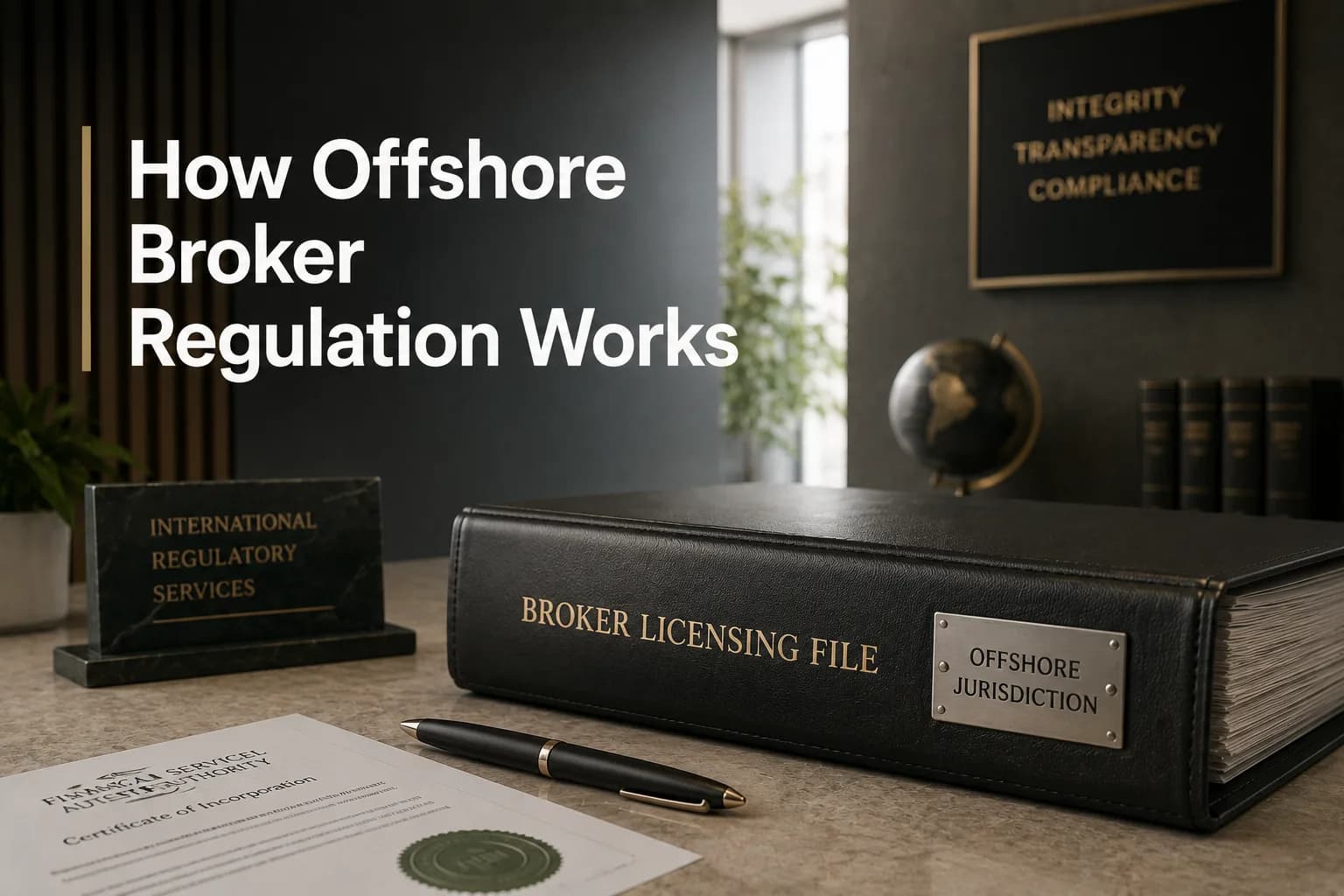
Offshore broker regulation refers to financial licenses granted by regulatory authorities in jurisdictions outside major financial centers such as the UK, EU, US, or Australia. These are mostly small countries that have developed a regulatory framework for international brokerage operations.
When an offshore broker is regulated by an offshore regulator, it means the regulator has authorized the broker to provide trading services globally, usually through a corporate entity registered in that offshore jurisdiction.
Some common offshore regulatory hubs include:
• Mauritius
• Seychelles
• Belize
• Vanuatu
• Comoros
All of these offshore regulatory jurisdictions regulate international brokerage activity; however, each has very different capital requirements and supervises them very differently than Tier 1 regulators.
Related Articles: How to Avoid Forex Scams
Which Brokers Choose Offshore Regulation?
There are several fundamental reasons why many brokers have developed an offshore entity:
Lower Capital Requirements
Many Tier-1 regulatory exchanges require very high capital reserves for a brokerage. The minimum thresholds for establishing a broker under offshore regulation are much lower than those of Tier-1 brokerages.Flexible Leverage Policies
Leverage is generally capped for retail customers in countries with severely regulated retail trading, such as the UK and the EU. Generally speaking, offshore regulators will allow a broker to offer leverage greater than 1:500, which is why many traders look for the Best Offshore Brokers with High Leverage.Fast Licensing Process
Offshore regulators often have much faster application processing times, allowing a broker to commence trading sooner.More Global Client Access
There are many heavily regulated countries where a broker will not have unrestricted access to market their services internationally. Offshore entities generally will not have restrictions imposed by a particular geographic country.
For brokers, offshore regulation is about operational flexibility, and for traders, it is important to understand the trade-offs that come with it.

How Does Offshore Licensing Work?
In fact, offshore regulation does provide you with the same protections that a licensed broker would provide, meaning that offshore licensing is still a “licensed broker.” All offshore-licensed brokerage companies go through the same standard process to obtain a license from their respective offshore regulator.
Here is a general overview of the offshore licensing process:
Company formation in the jurisdiction
Application for financial authority licensing
Compliance documentation (AML/KYC frameworks)
Appointment of a compliance officer
Payment of the licensing application fees
Ongoing reporting requirements
That said, the level of supervision of offshore entities by their regulators varies dramatically. Some offshore brokerage regulators provide periodic audits and leave little room for fund commingling. Other offshore regulators do not focus much on the active supervision of the broker, but instead focus more on compliance with registration.
Offshore vs Tier-1 Regulation
To understand offshore frameworks properly, it helps to compare them with major global regulators.
Feature | Offshore Regulation | Tier-1 Regulation |
Capital Requirements | Lower | High |
Leverage Limits | Flexible / High | Restricted |
Investor Compensation Scheme | Often none | Usually available |
Reporting Requirements | Moderate | Strict |
Regulatory Oversight | Varies | Intensive |
Client Fund Segregation | Often required | Mandatory |
Tier-1 regulators such as:
• Financial Conduct Authority
• Australian Securities and Investments Commission
• Cyprus Securities and Exchange Commission impose stricter operational standards, conduct
enforcement actions publicly, and often provide investor compensation schemes. Offshore regulators generally do not offer compensation funds if a broker becomes insolvent.
Are Offshore Brokers Legal?
Yes, offshore brokers can be legal when they operate under a valid license issued by a recognized authority in the jurisdiction in which they operate.
However, just because their operations may be deemed legally compliant with applicable laws does not mean that the level of investor protection provided is the same as what you would find in a highly regulated market.
The critical distinction is not between regulated and unregulated, but rather between the regulatory strength and enforcement authority of the respective regulatory body.
Offshore Regulatory Risks
Even though many offshore brokers operate in a responsible manner, traders must understand the inherent problems associated with trading through such firms:
Limited Investor Protection:
There are no compensation funds if an offshore broker fails.
Difficulty with Resolving Disputes:
The legal process to obtain a remedy can be tedious and costly.
Regulatory Arbitrage:
Some brokers use offshore brokers to circumvent more stringent regulations on leverage or advertising.
Differences in Transparency:
Publicly available information about enforcement actions may not be readily accessible in many offshore jurisdictions compared to those with more stringent regulatory bodies.
In general, trading with an offshore broker does not imply that the broker is unsafe; rather, the onus is on the trader to exercise additional due diligence before trading.
Benefits of Trading with an Offshore Broker
Despite the concerns associated with offshore brokers, there are benefits to using these types of firms to trade:
• Higher leverage
• Reduced margins
• Less restricted trading
• Access from restricted geographical areas
• Flexibility in bonus programs
Professional traders who are adept at managing trading risk may opt to trade with offshore brokerage firms due to the flexibility offered by this type of operation.
Evaluating an Offshore Broker
There are several important things to consider when looking for an offshore broker:
License Verification
Confirm the broker is licensed by checking the regulator’s official website for the license number, following best practices on How to Verify a Broker's License.Corporate Transparency
The broker should have all necessary information available, including who owns the company, where the broker is located, and who manages the broker.Client Fund Segregation
Ensure client funds are kept in segregated accounts.Trading Conditions
Review the spreads, commission, and execution policies to determine whether they are reasonable.Reputation History
Look for a long-term operational history and whether the broker has consistently paid clients.
Related Articles: Global Forex Regulation Overview
Regulatory Arbitrage and the Role of the Regulator
Brokers often seek more relaxed regulations when choosing where to operate, a practice known as regulatory arbitrage. Regulatory arbitrage is not illegal, but it places more of the burden on traders to assess whether they can trust a broker to abide by their agreement.
Recently, global cooperation among regulators has increased, and even offshore jurisdictions are tightening their compliance frameworks in efforts to maintain their credibility.

2026 Landscape for Offshore Regulation
The offshore brokerage sector is evolving:
• There are higher standards of compliance in the leading offshore hubs.
• Federal regulators are increasing their enforcement of anti-money laundering (AML).
• Cooperation among nations on regulatory issues continues to grow.
• There are more brokers with hybrid models (brokers who operate both in an offshore jurisdiction and a tier-1 jurisdiction).
The offshore regulatory environment is no longer just about categorizing brokers as safe or unsafe. Instead, it is now a continuum, with offshore brokers ranging from highly to minimally regulated, depending on their specific compliance standards and oversight. This means that risk varies along a spectrum rather than as a simple yes/no condition.
Conclusion
Regulatory analysis for offshore brokerage requires understanding the regulatory structure, not making assumptions. Offshore regulation offers flexibility in leverage and operations, but Tier-1 countries generally provide stronger client protection, which is why many traders turn to The Broker Reference when comparing regulatory frameworks.
Using an offshore broker is not necessarily bad, but due diligence and risk assessment are imperative. Focus on transparency, license verification, reputation, operational history, and proper risk management.
Evaluate both counterparty and market risk. A clear understanding of a broker’s regulatory structure enables more confident, informed decisions.