
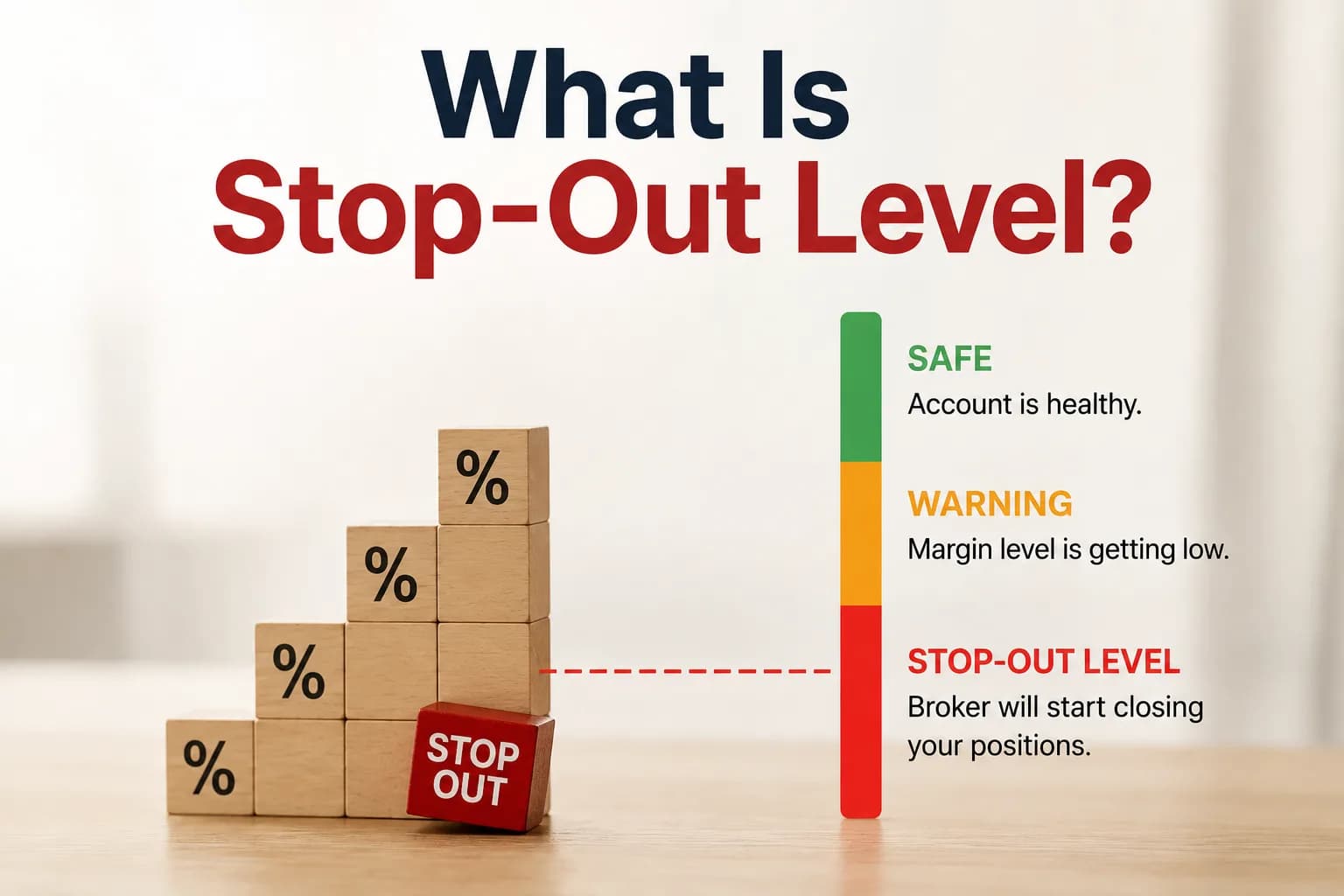
Every trader will ultimately experience a time when the market turns sharply against their position. The degree of the loss will vary; with some losses manageable and recoverable, while with others the trading account will reach an emergency level, and the broker will start to close all your positions to partially protect the account balance. This is called the stop-out level.
For the average trader, especially many beginners, the stop-out level can be confusing or even frustrating. A trader sees that their position(s) are closing automatically even though they chose not to close them manually. This is part of the risk management process that the broker has established for themselves and for their customers.
Traders need to understand how stop-out levels work, as leverage can have serious consequences. Leveraging allows traders to control larger amounts of capital with a smaller amount of capital. As such, when the market goes against them, a trader will quickly experience larger-than-expected losses.
This article explains what a stop-out level is, how it works in the forex and CFD markets, why brokers use them, and how you, as the trader, can manage your risk of getting stopped out.
Understanding the Stop-Out Level
A stop-out level is a specific percentage margin level that triggers a broker to automatically close one or more of your open positions when your trading account reaches that level.
In other words, a stop-out level is a limit designed to keep your trading account from going to a negative balance, similar to safeguards described in Negative Balance Protection Explained.
When using leveraged positions, you must maintain a minimum margin balance. If losses cause account equity to fall below the margin threshold, the broker will automatically begin closing positions.
The overall goal of closing positions is to ensure that your account does not incur a loss greater than its balance.
Related Articles: Daily Drawdown vs Maximum Drawdown Explained
Margin, Equity, and Stop-Out: How They Are Connected
To fully understand stop-out levels, it is important to understand several related concepts in trading accounts.
Term | Definition | Importance |
Balance | The total funds in the account excluding open trades | Starting capital |
Equity | Balance plus or minus floating profit or loss | Real-time account value |
Margin | The amount required to maintain open positions | Collateral for leveraged trades |
Margin Level | Equity divided by margin used | Determines account health |
Stop-Out Level | The margin level where the broker begins closing trades | Risk protection mechanism |
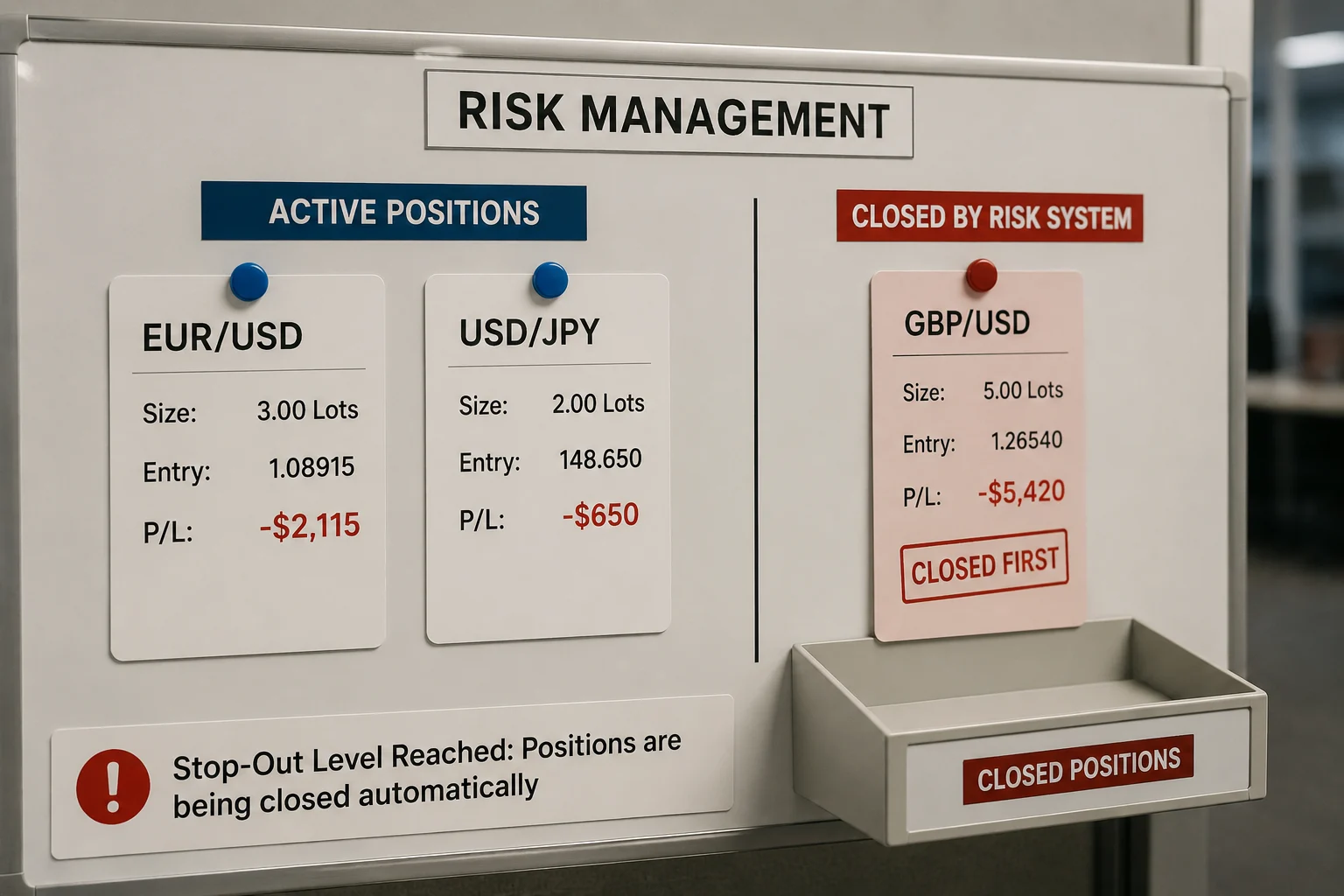
The margin level is usually expressed as a percentage. When this percentage drops to the broker’s stop-out threshold, the system automatically closes the most losing positions first.
How the Stop-Out Level Works in Practice
Picture a trader who has opened multiple leveraged positions within a forex trading account. If the market moves against those positions, the floating loss will continue to increase, thereby decreasing the account's equity.
With the continued drop in the equity, comes a decrease in the margin level.
Many brokers have defined two important levels when determining what actions they will take regarding closing out a trader's positions:
• Margin Call Level - this is an alert level that tells the trader that they are getting close to running out of margin on the account, as explained in What Is Margin Call in Forex?.
• Stop-Out Level - this is the point at which a broker will begin closing out positions for the trader without the trader's consent.
For example, if the broker has a stop-out level of 20% on the account, the broker may start closing out the trader's positions once the account's margin level reaches 20%.
Typically, the broker will close the largest losing position first to decrease their risk exposure as quickly as possible.
Typical Stop-Out Levels Used by Brokers
Stop-out levels vary by broker and account type, which is an important factor to consider in How to Compare Forex Brokers: Full Checklist. Some brokers offer lower stop-out levels to give traders more flexibility, while others set higher thresholds to reduce risk.
Below is a general overview of common stop-out levels used in the trading industry.
Broker Model | Typical Stop-Out Level |
Conservative Brokers | 50% |
Standard Retail Brokers | 20% – 30% |
ECN Accounts | 10% – 20% |
High-Risk Accounts | Below 10% |
Lower stop-out levels give traders more room for positions to fluctuate, but they also increase the risk of deeper losses.
Why Brokers Use Stop-Out Levels
The purpose of a stop-out method is to protect brokers and traders from large losses that could occur if the market moves significantly.
Leveraged trading allows traders to open up large trades with small amounts of capital. If the market makes a large move, losses could be substantial in a short amount of time for traders. If there is no stop-out mechanism, there could be an instance where a trader has a negative account balance (i.e., the trader owes the broker money).
In this type of scenario, brokers automatically close a trader's positions when the trader's account equity reaches zero, thereby keeping risk within manageable levels.
Difference Between Margin Call and Stop-Out Level
Many traders do not distinguish between margin calls and stop-out levels because each represents a distinct stage in risk management. The account's margin level has dropped below a threshold, and the trader still has an opportunity to take corrective action (close out some positions, reduce exposure per open position, or deposit more funds into the trading account).
op-out represents the end stage of the risk management process. When the margin level continues to decrease and reaches the stop-out level, the broker will automatically close the trader's trades.
Recognizing these differences will enable the trader to take appropriate action before margins decrease to the point that the broker must initiate a stop-out.
Related Articles: Best Brokers for Beginners 2026
How Traders Can Avoid Stop-Out Levels
Traders work to avoid reaching a stop-out point, as it protects them. One risk management strategy for traders is to maintain proper risk management, which entails establishing limits on the amount of capital that can be committed to a single trade, set at a small percentage of the total account value, to reduce the possibility of a large account drawdown.
Position size is also crucial: if a trader opens a position that is disproportionately sized relative to their account (too much margin), and their account is then affected by this imbalance, the likelihood of the position being near a stop-out point increases.
Leverage also carries a significant risk for traders, since they can control a total dollar value greater than they actually possess; it therefore has the same effect as a higher potential profit and a higher amount of accumulated risk from market price reversals. A stop-loss order allows a trader to limit losses at a specified price before their account becomes subject to margin or stop-out requirements.
The Role of Leverage in the Stop-Outs
Leverage is one of the driving forces of stop-out events. Leverage enables the trader to control a larger dollar amount with only his/her actual cash; it therefore magnifies the dollar value of his/her loss when he/she is unable to obtain the price level expected by the market (which is labeled as "stop-out").
Leverage is used primarily by retail traders. Most retail traders would not be using the same level of leverage as professional traders, however.
Most regulatory bodies in the financial markets require retail traders to limit the amount of leverage they may use. By imposing leverage limits on retail traders, regulatory authorities are reducing the risk of stop-out events.
Hence, to ensure sustained success in trading, it is vital for the trader to use leverage appropriately in his/her trading account to properly manage his/her risk. This means that traders should only use the leverage they have established for themselves, while relying on established account and position sizes when making trades.
Risk Management Through Technology
Most online trading platforms automatically calculate the equity in the trading account and provide real-time monitoring of its margin levels.
As the account's margin level approaches a critical level, the trading system will send an alert to the trader.
At the stop-out level, the platform will automatically close or liquidate positions in accordance with account rules. The performance of the trading platform management system will take less than a millisecond, ensuring that traders' accounts remain within the risk parameters established by the platform's management. From a perspective, closing positions at the stop-out point may appear to occur suddenly; however, it is the most important part of maintaining the financial viability of trading under leverage.
Summary
Understanding the stop-out level (the level at which the broker automatically closes out the trader's position when the trader's margin levels are too low in their trading account) is the essential building block for managing risk while trading under leverage.
The stop-out level protects the broker from large losses and the trader from exposure to them.
The stop-out level is tied to leverage, margin, and equity, which are all core components of Forex and CFD trading.
By adhering to sound risk management principles, including controlling position size and using appropriate leverage, a trader can reduce the likelihood of triggering a broker's stop-out level, as emphasized by The Broker Authority.
Ultimately, being a successful trader does not only require profiting from trades; it also requires properly managing risk to conserve capital and ensure longevity in the trading profession.