

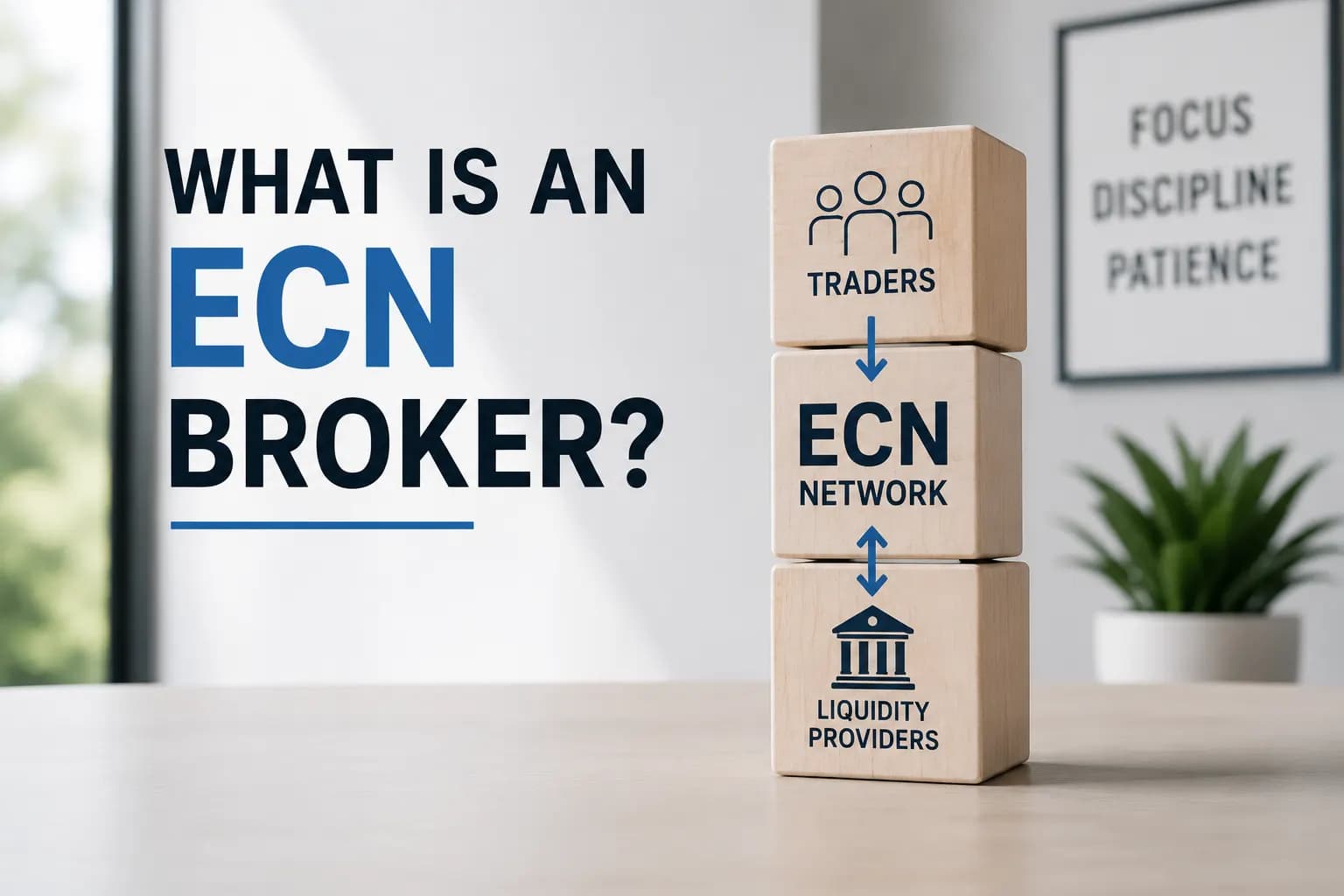
Traders have long been curious about who takes the opposite side of their trade in the Forex Market. Every time you place either a buy or a sell order to open or close a position, you’re posing the question. A complex pricing structure determines how much you will pay per trade, how long it will take to execute, the spread charged, and whether there are any conflicts of interest to consider.
ECN Brokers are among the most widely discussed trading structures used within trading circles, especially when traders search for the Best ECN Brokers in 2026. But what is really an ECN Broker, and why do more experienced traders utilize them?
To help you better understand exactly how the ECN Broker works and whether it fits your trading style, this guide provides a detailed explanation of the ECN Broker model, free of complicated language and terms.
Is an ECN Broker in Forex Trading?
An ECN Broker typically functions as an online Forex broker that matches traders’ buy or sell orders with specific liquidity providers (which are always Banks, Hedge Funds, and/or Financial Institutions). The ECN Broker creates a trading platform that aggregates (and matches) buy and sell orders to multiple liquidity providers without creating its own price feed.
To clarify the role of an ECN Broker as an intermediary: ECN Brokers stream all available bid and ask prices from multiple liquidity providers to clients in real-time.e.
How Does an ECN Broker Work?
Now that you know what an ECN Broker is, let's explore how an ECN Broker actually works.
To better understand how the ECN Broker functions, you first need to understand "Liquidity Aggregation,” which is the process that UR (the ECN Broker) undertakes when creating market prices to provide to its clients.
Liquidity Aggregation can best be defined as collecting a database of bid and ask prices from the ECN Broker's entire network of liquidity providers (the liquidity providers will typically include a mix of Global Banks, Financial Institutions, Hedge Funds, and other market participants) and once collected, delivering a composite feed of the prices to the ECN Broker's clients.
When a client's order is placed, the following occurs:
1. The order is sent to the ECN Broker system.
2. The ECN Broker system receives the order and simultaneously scans all of the available liquidity providers connected to the ECN.
3. The ECN Broker system identifies the best available bid or ask price within the ECN network at that moment.
4. If the best price requires splitting the order among multiple liquidity providers for a better fill, this is done.
5. The trade will be automatically executed at the market price.
By creating a competitive environment for its clients through pricing from multiple liquidity providers within the ECN network, the ECN Broker may be able to offer tighter spreads (which are usually available during "normal" market conditions). The bid and ask prices are based on actual market supply and demand; the resulting spreads will vary.
During periods of high liquidity (e.g., during a major market session overlap), the market spread is generally near zero. significantly due to increased market risk. In dealing desk brokers, ECN Brokers do not typically profit from spread expansion.
Which ECN Brokers make a profit by collecting a transparent commission (per trade) from their clients for using their brokerage services (the ECN Broker's earnings structure reduces potential conflicts of interest and aligns the ECN Broker's profit with trading volume—not client losses).
ECN vs Market Maker Brokers
Many traders confuse ECN brokers with standard retail brokers, which is why understanding Market Maker vs ECN: Full Comparison is essential before choosing a broker.
Feature | ECN Broker | Market Maker Broker |
Pricing Source | Multiple liquidity providers | Broker-generated prices |
Spreads | Variable | Often fixed |
Commission | Yes | Usually no (spread markup instead) |
Conflict of Interest | Lower | Potentially higher |
Slippage | Possible (positive & negative) | Often controlled internally |
Order Execution | Market execution | Instant or market execution |
ECN brokers are generally considered more transparent because they do not profit directly from client losses.
Essential Features of a Genuine ECN Broker
Not all brokers claiming to be ECN brokers operate correctly and deserve to be called such. However, a legitimate ECN broker usually possesses the following features:
• Unadulterated spread (frequently, as low as 0.0 pips)
• Upfront commissions for each lot traded
• No dealing desk manipulation/interference with trades
• Mass-market execution (no requotes)
• Access to Depth of Market (DOM)
The Depth of Market (DOM) feature allows traders to view available liquidity across all possible price levels simultaneously. By viewing the DOM, traders can better understand overall market activity.
Benefits of Trading with an ECN Broker
Reduced Spreads: As market prices derive from a multitude of competing liquidity providers, spreads are typically very tight when the London markets and New York markets are simultaneously open
Faster Order Execution: Orders for players who engage in scalping or high-frequency trading will be automatically executed through the ECN network.
Transparent Pricing: All ECN brokers provide real-time pricing and do not manipulate spreads internally.
No Re-quotes: The nature of the ECN broker executing orders at the market price means that you are not subject to re-quotes (however, if there is a significant amount of volatility in the market, there is room for slippage).

Drawbacks of Using an ECN Broker
All that glitters is not gold! Although ECN brokers offer many attractive product features, they also pose challenges and difficulties:
• Commission charges can accumulate (for instance)
• Spreads may increase dramatically during low-volume times
• Depending on your broker, you may be required to maintain a higher-than-traditional minimum deposit balance.
• Variable spread accounts may be unnerving to a beginning trader who is unfamiliar with this type of trading.
Before trading with an ECN broker, consider redundancy and uncertainty when determining whether trading will be profitable. Which kinds of Traders are Best Suited to use an ECN Broker?
The best trades in an ECN environment would be scalping, day trading, algorithmic trading, high-volume trading, or traders who have been in the traditional FX market long enough to fully appreciate true ECN execution without limits. If you rely on an extremely low spread and fast execution, then an ECN is a perfect environment for you.
On the other hand, if you are beginning your trading career and require a more predictable fixed spread, you might want to consider using a standard (non-ECN) trading account until you gain additional experience.
ECNBoth types of accounts execute orders externally; however, there are differences between the two types of accounts.tween the two types of accounts.
An STP (Straight Through Processing) broker sends orders from the account holder directly to the Liquidity Provider (the Bank) without going through a dealer. This means Lower costs to trade. A STP broker usually has fewer Liquidity Providers but tighter spreads than an ECN Broker. Depending on how the broker has set up their Liquidity Providers, they may charge a small amount on their spreads. This is usually $0 - $0.5 pips.
On the other hand, ECN Brokers connect to multiple Liquidity Providers and allow for trading with the Market Directly.
The main difference in practice is the way the broker has established his/her liquidity relationships.
The Trading Costs of an ECN Broker
Understanding the cost structure of trading is important, especially when comparing Spread vs Commission: Which Costs Less? in different account types.
The Total Cost of trading with an ECN Broker = spread + Commission.
By way of example:
Spread = 0.2 Pips
Commission = $7 Round Turn per Lot
Even when all of the spreads being offered by the broker are low, in order to accurately determine the breakeven level, you also need to factor in the commission that will be paid.
Most Professional traders prefer a fixed commission because it provides pricing transparency.
Regulation of ECN Brokers
When selecting an ECN Broker, it is always important to consider the regulatory oversight provided by the Broker and not just the ECN Label.
Some of the more respected regulators include:
Financial Conduct Authority (FCA),
Australian Securities and Investments Commission (ASIC),
Cyprus Securities and Exchange Commission (CySEC).
Most regulatory authorities require brokers to have client fund segregation and operational transparency. Regulatory agencies do not guarantee success; they greatly reduce counterparty risk.
Related Articles: Broker Liquidity Providers Explained
Common Misconceptions about ECN Brokers
Myth One - ECN Brokers guarantee profitability. There is no broker that can guarantee you will be profitable; execution quality is beneficial, but the trade strategy is much more important.
Myth Two - Zero Spreads = Free Trading; Although some ECN Brokers may have zero spreads, they charge commission.
Myth Three - All ECN Brokers are the Same: Execution Quality, costs of Liquidity Providers, and pricing depth can vary widely across ECN Trading firms.
How to Spot an Authentic ECN Broker
Check these before opening an account:
- Does the broker clearly state commission charges?
- Are spreads and commissions market-based, or are fixed fees added?
- Are liquidity sources specified?
- Does market execution occur without requotes?
- Is the broker regulated?
Review the broker’s legal documents and execution policy to answer these questions.
Will ECN Brokers be Better in 2026 Than they Are Now?
Many brokers now offer ECN and STP accounts, giving traders more options. Advances in technology have improved execution speed and liquidity aggregation, benefiting trading.
However, true ECN brokers still provide direct market access, transparency, and competitive pricing. For serious traders, execution quality and transparency often matter more than the slightly higher ECN commissions compared to market-maker brokers.
Conclusion
An ECN broker connects you directly to liquidity providers instead of acting as a counterparty. ECN brokers offer experienced traders greater transparency, tighter spreads, and faster execution than market-maker brokers, which is why many traders rely on The Broker Authority when comparing execution models.
ECN brokers may provide a better trading environment than market-maker brokers, but you must understand their commission structures and variable spreads. Traders seeking a professional environment for execution quality or transparency may benefit from ECN accounts. Your trading method, risk tolerance, and goals should guide your choice of broker. Understanding ECN operations also clarifies the trade execution process.