
Every broker offers many different types of trading services, including pricing, execution quality, regulation, and trading platform. Each of these factors could determine whether or not a trader can successfully trade with their desired broker. There are many retailers worldwide who will hopefully narrow their choices to a few forex brokers, and both XM and Exness are two such brokers that have continued to attract retail traders.
XM and Exness are both considered trustworthy brokers with good trading conditions and competitive pricing, and they provide excellent customer support worldwide. However, the two brokers differ in the leverage they offer, the account types they allow, and the technology used for trade execution.
For new traders, this can create confusion and affect their ability to choose between XM, which offers education materials and name recognition, and Exness, which is flexible with leverage and processes withdrawals quickly, which is why many compare the Best Brokers for Small Account Traders.
The following guide provides a detailed comparison of XM and Exness, covering regulations, trading conditions, trading platforms, fees, and the overall trading environment, so you can make an informed decision on which broker is best for your individual trading needs.
Summary of XM and Exness
Both XM and Exness are online forex and CFD brokers that offer trading in forex and CFDs to traders worldwide.
XM was established in 2009 and has quickly developed a strong reputation for its high-level customer service, numerous educational programs, and ease of account opening. XM offers an extensive list of tradable instruments and provides extensive education through live webinars, in-person seminars, and training videos.
On the other hand, Exness was founded in 2008 and has been in business longer than XM, and it operates in over 53 countries. Exness has made its name through sophisticated technology and by enabling traders to use leverage, thanks to its unique strategies for global forex trading. Traders who use automated trading strategies and/or are high-frequency traders will appreciate Exness's extremely fast execution times.
XM and Exness, while developing different strategies for their target customer base of global forex traders, have both shown commonalities and subtle but significant differences in trading conditions and in the technologies they use to provide their respective trading environments.
Regulation and Safety
When it comes to forex trading, it's critical to consider the regulations in place at any broker you are considering. A regulated forex broker must operate in accordance with the country's financial regulations and maintain transparency and full compliance to protect the rights of all clients who have deposited funds with the broker.
XM is regulated by multiple regulatory authorities throughout the world (for example, the Cyprus Securities and Exchange Commission (CySEC) and the Australian Securities and Investment Commission (ASIC)). Regulations from CySEC and ASICs come with strict operational and reporting guidelines that the broker must follow.
Exness is regulated by multiple regulatory authorities, including the Financial Conduct Authority (FCA) (the UK regulator) and CySEC, and furthermore publishes periodic reports on its business and provides customers with access to real-time trading volumes and all details regarding its forex operations.
Both XM and Exness have established segregated accounts to hold client funds and operate in accordance with minimum international compliance standards, thereby enhancing client security and trust.
Technological and Trading Platforms
Exness and XM share many popular trading platforms.
• MetaTrader 4
• MetaTrader 5
The major platforms used by XM are…
Traders prefer MT4 and MT5 because they allow robots, known as Expert Advisors, to automatically execute trades, create and use individual indicators, and display market data via advanced charts.
The major platforms used by Exness are…
Traders also use MT4 and MT5 with Exness, but Exness has invested significantly in developing its own systems and structures for doing business with them. Their execution speed and connection latency can significantly benefit algorithmic traders and scalpers.
XM and Exness offer similar services through their technology platforms, but Exness is often seen as superior in terms of technology performance and execution speed.
Related Articles: Swap Rates Explained
Trading Accounts and Conditions
The greatest differentiating factor between XM and Exness is their account structures.
XM offers accounts for traders of all levels, including Standard, Micro, and Ultra Low, as well as Islamic accounts for those who wish to trade in accordance with Islamic law.
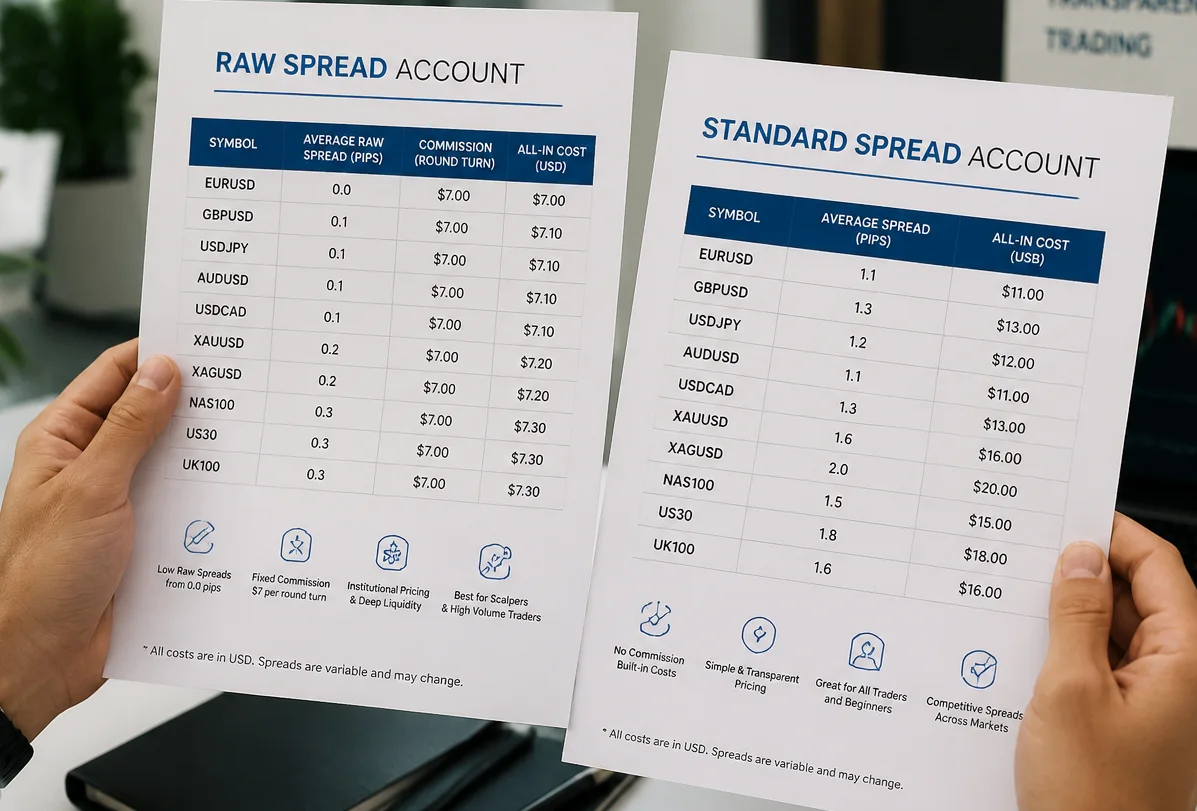
Exness offers more account types than XM. They offer Standard and Professional accounts, including Raw Spread and Zero accounts. The zero-spread accounts are designed specifically for professional traders and offer extremely low commissions, resulting in very low overall trading costs.
It is important to keep in mind that Exness is also known for offering very high leverage, with actual leverage varying by account type and compliance requirements depending on the jurisdiction in which it operates, which is why it is often compared among the Best Offshore Brokers with High Leverage.
Spreads, Fees, and Trading Costs
A key consideration when comparing brokers is the overall cost to trade.
XM uses a spread pricing model. Although XM has very low minimum deposit amounts and provides a user-friendly way for clients to do business with them, XM’s spreads are still generally higher than those of other raw-spread brokers, who typically have only raw spread accounts.
Exness has both spread accounts and raw spread accounts. The professional accounts offered by Exness can have spreads as low as near zero, with trade commissions applied to each trade.
If you are looking for the lowest spreads and overall cost of trading, Exness may be the better choice.
Key Comparison Table
Feature | XM | Exness |
Founded | 2009 | 2008 |
Main Focus | Beginner-friendly trading environment | Advanced trading conditions |
Regulation | CySEC, ASIC and others | FCA, CySEC and others |
Platforms | MT4, MT5 | MT4, MT5 |
Minimum Deposit | Low entry level | Low entry level |
Spreads | Competitive spread-based accounts | Raw spreads available |
Leverage | High leverage depending on region | Extremely flexible leverage |
Account Types | Micro, Standard, Ultra Low | Standard, Raw Spread, Zero |
Execution | Reliable execution | Very fast execution infrastructure |
Trading Instruments and Market Access
Both XM and Exness offer a wide range of financial instruments for trading.
XM offers the following products for trade: forex currency pairs, CFDs on stocks, indices, commodities, metals, and energy products.
Exness offers similar markets and also includes cryptocurrencies among its products.
Overall, both XM and Exness will offer enough asset variety for most retail traders.
Depositing, Withdrawing, and Payment Systems
When it comes to the financial flexibility of the payment systems these brokers offer, they are very competitive with one another.
XM offers many deposit and withdrawal methods, including bank transfers, credit cards, and online payment systems; however, withdrawal processing times vary by payment provider.
Exness has become known in the industry for having a very fast withdrawal process. Most of the time, a trader's withdrawal is processed automatically through Exness’ internal payment system.
Traders looking to access their funds quickly typically view Exness as one of the fastest brokers for withdrawals.
Education and Customer Service
XM is well known for providing a wide range of high-quality educational materials to help beginner traders learn more about trading in the Forex and CFD markets. They provide free webinars, trading tutorials, seminars, and other educational content to help novice traders understand the basics of trading.
Exness has also produced some educational material for traders, though not as much as XM. Exness also provides market analysis data and research; however, their educational offerings are not as extensive.
Both XM and Exness have multilingual customer service departments that can be contacted by phone, live chat, or email.
Conclusion
Both XM and Exness are very reputable brokers in the Forex and CFD trading industry and have established themselves as trusted institutions in the trading world, a comparison often featured in Wikilix Broker Reviews. They both offer reliable trading platforms, a wide range of trading conditions, and access to diverse markets.
XM is an ideal broker for new traders, as it offers extensive educational materials and a supportive environment, including training accounts to learn on.
Exness is an ideal broker for experienced traders because of its technology, flexible leverage, and low spreads on professional accounts, which will appeal to day traders, scalpers, and algorithmic traders.
Ultimately, the decision of whether to use XM or Exness will come down to your trading priorities as a trader; if you are looking for good educational support and simplicity in your trading account, then you will probably want to trade with XM; whereas if you are focused on speed of execution, flexible leverage, and low spreads, then you will probably want to use Exness.