

Instant funding means you pay a fee and trade a funded account the same day — no evaluation, and no profit target standing between you and your first withdrawal. What you buy is a tighter rulebook and a smaller share of the early profits.
Four firms whose instant funding terms are published and checkable, as of September 2026:
- City Traders Imperium — $2,500 to $80,000, $79 to $1,599. 6% static drawdown, no daily limit. Trade-off: you start on a 50% split and half the size you bought.
- FundedNext Stellar Instant — $2,000 to $20,000, $41.99 to $419.99. 6% trailing drawdown, no daily limit. Trade-off: the loss floor follows your equity up, and sizes stop at $20,000.
- FXIFY Instant Funding — $1,000 to $100,000, from $69. 8% trailing drawdown that locks at your starting balance once you are 8% up. Trade-off: the $19 Lite tier swaps it for a 4% trailing limit plus a 3% daily one.
- Goat Funded Trader — $5,000 to $400,000, from $17 on Instant HERO, $65 on Instant GOAT, $95 on Instant Premium. 6% trailing maximum loss, 3% trailing daily. Trade-off: GOAT's 15% consistency rule, waived only on the $95 Premium plan.
What Is Instant Funding?
A challenge account is an audition: you pay a smaller fee, trade a demo account, hit a profit target inside the loss limits, and the firm then issues a funded account. Instant funding removes that step. The account opens funded on purchase.
Three things follow, and together they are the whole model:
- No profit target to clear. You can be eligible for a payout in your first week, subject only to minimum trading days and the payout cycle.
- A higher fee for the same nominal size. A $10,000 instant account is $209.99 at FundedNext and $259 at City Traders Imperium. Two-step evaluations are a fraction of that: Goat Funded Trader's enter at $17, and FundedNext's Stellar 2-Step prices $6,000 at $29.99 and $15,000 at $119.99.
- A tighter loss limit. Instant accounts cluster between 4% and 8% maximum drawdown. Two-step accounts run 10% at FTMO, FundedNext and Goat Funded Trader, static against the initial balance at all three.
The capital is simulated at most firms in this market, which is why they have largely operated outside broker authorisation. The CFTC, the FCA, ASIC and EU national authorities such as Germany's BaFin and Italy's Consob have been testing whether the funded-account model sits inside their perimeters at all, with several still mid-consultation. ESMA's measures are a separate instrument: product intervention capping retail forex leverage at 1:30 and restricting CFD marketing.
Best Instant Funding Prop Firms Compared
Comparison Table
| Firm | Account sizes | Upfront cost | Max DD | Daily DD | Profit split | First payout | Scaling |
|---|---|---|---|---|---|---|---|
| City Traders Imperium | $2,500–$80,000 | $79–$1,599 | 6% static, on balance | None | 50% at start, 70–100% fully funded | 5 days at fully funded; no minimum profitable days | Doubles per 10% target, to $2M per account |
| FundedNext Stellar Instant | $2,000–$20,000 | $41.99–$419.99 (list $59.99–$599.99) | 6% trailing | None | 70% from day one, up to 80% | On demand at +5%, or bi-weekly at +1% | Instant scale-up to $2M |
| FXIFY Instant Funding | $1,000–$100,000 | From $69 | 8% trailing, locks at start balance | None | Up to 90% | Not published | Not published as tiers |
| FXIFY Instant Funding Lite | $2,500–$100,000 | From $19 | 4% trailing | 3% | Up to 90% | Not published | Not published as tiers |
| Goat Funded Trader (HERO / GOAT) | $5,000–$400,000 | From $17 (HERO) / $65 (GOAT) | 6% trailing, resets after payout | 3% trailing | 80%, 100% with add-on | 14 days, 5 minimum trading days | To $400,000 allocation |
| Goat Funded Trader (Premium) | $5,000–$150,000 | From $95 | 6% trailing, resets after payout | 3% trailing | 80%, 100% with add-on | 10 days, 5 minimum trading days | To $150,000 allocation |
Firm Profiles
City Traders Imperium is the only one of the four with a static floor: 6% of the initial balance, measured on balance rather than equity, so an open losing position cannot breach it. Payouts are weekly at Bronze VIP and on demand from Silver up. The real restriction is structural — you are allocated half the size you bought, at a 50% split, and both improve only through the 10% scaling milestones.
FundedNext Stellar Instant is the cheapest genuine entry at $41.99 for $2,000, and the only one paying 70% from day one with no consistency rule and no minimum trading days. Against that: a 6% trailing maximum loss, and a hard $20,000 ceiling on instant sizes.
FXIFY runs two tiers. Standard has no daily drawdown and an 8% trailing limit that converts to a static floor at your starting balance once you are 8% up or have taken a payout — the friendliest drawdown structure here. Lite costs $19 but adds a 3% daily limit, a 4% trailing maximum and a 20% consistency rule.
Goat Funded Trader prices the rulebook rather than the size: all three instant tiers start at a $5,000 account. HERO is $17, GOAT is $65 with a 15% consistency rule, and Premium is $95 with none and a 10-day cycle. It is the only one publishing a payout service level with a penalty attached — two business days or $1,000 compensation. None of these records is independently audited; they are what each firm publishes about itself.
Instant Funding vs Challenge Accounts
| Instant funding | Two-step challenge | |
|---|---|---|
| Upfront cost, $10,000 nominal | $210–$260 | $30–$120 at the nearest published sizes |
| Time to first payout | 5 to 14 days | Evaluation plus payout cycle — weeks to months |
| Max drawdown | 4–8%, usually trailing | 10% static at FTMO, FundedNext and Goat |
| Profit split at start | 50–80% | 70–90% |
| Fee refunded | Rarely | Yes at FTMO and FundedNext, with the first reward |
| Expected cost to get funded | The fee, once | The fee on every attempt you fail |
The last row is the entire argument, and it is the one most comparisons leave out.
The Catch: Why Instant Funding Costs More
The evaluation is not just an obstacle course; it is a filter the business depends on, because fees from traders who never reach a payout are the model's most predictable revenue. Remove the filter and the firm has to recover that expected value elsewhere. It does so in four places at once:
- The fee, three to five times the challenge fee for the same nominal size.
- The drawdown, cut to 4–8% and usually made trailing, which raises the chance the account fails before it pays.
- The starting split, 50% at City Traders Imperium and 70% at FundedNext, against 80–90% on funded challenge accounts.
- The payout threshold, staged behind minimum trading days, cycle dates and growth minimums.
Each one is small. Together they are the price of the audition you skipped.
Drawdown Rules on Instant Funding Accounts
A static drawdown is a fixed line, and a separate rule from the daily cap — the two limits work differently. City Traders Imperium's 6% on a fully funded $80,000 account puts the floor at $75,200, and it stays there whatever you earn.
A trailing drawdown follows your high-water mark. FundedNext's 6% trailing limit on a $10,000 account starts the floor at $9,400; take the account to $11,000 and the floor moves to $10,340. You can now be stopped out while still $340 in profit on an account that never lost money.
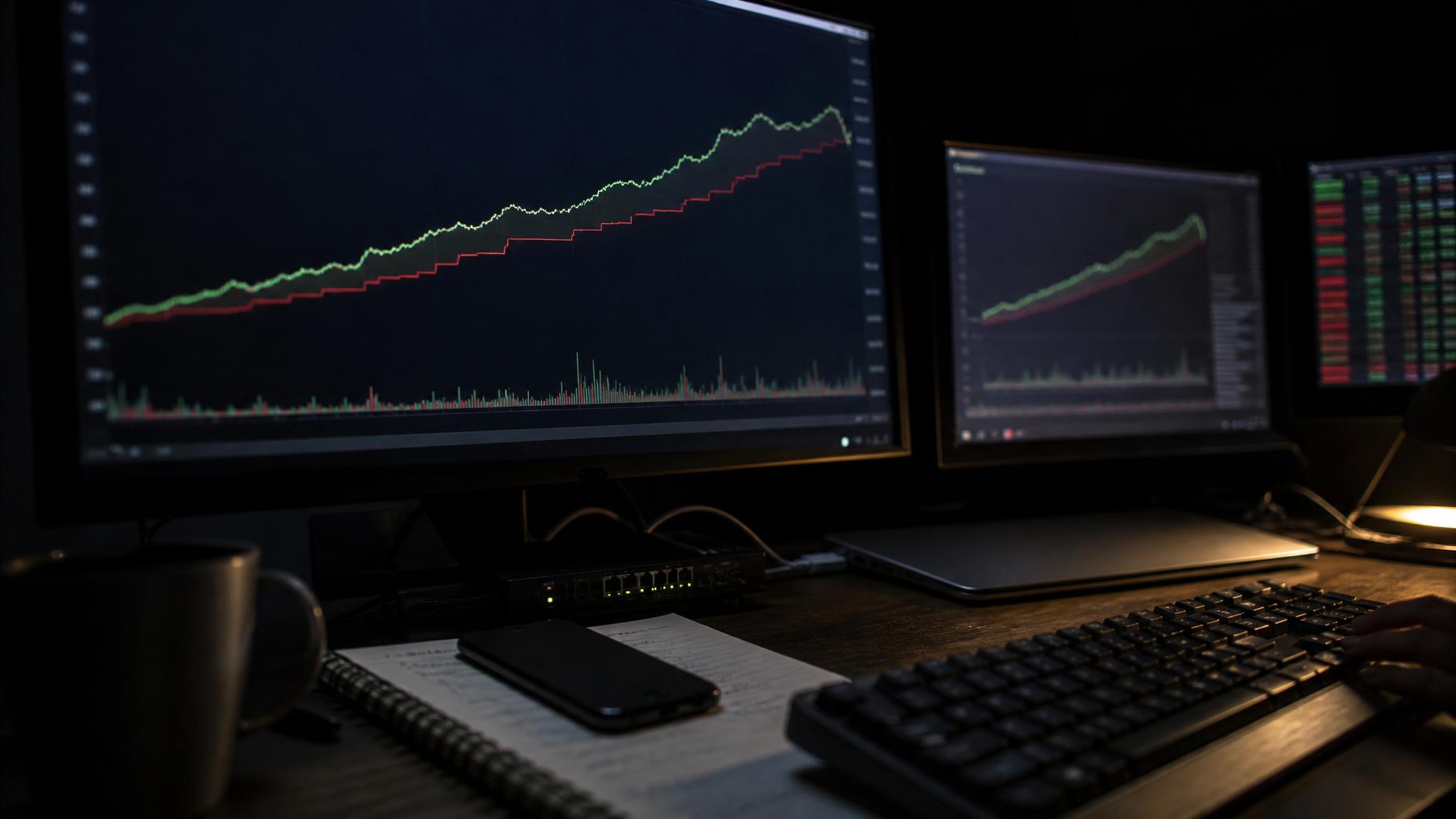
That difference decides which strategies survive. A trailing floor penalises giving back an open profit, so it punishes runners, held positions and anything that round-trips. Two of the four soften it: FXIFY's 8% floor locks at your starting balance once you are 8% up or have taken a payout, and Goat Funded Trader's resets after each payout. Instant accounts run tighter limits because the loss limit is now doing the filtering the evaluation used to do — so check whether a number is static or trailing before comparing two headline percentages.
Profit Splits and Payout Schedules
The headline split is rarely the starting split. City Traders Imperium begins at 50% and reaches 70–100% only through fully funded and VIP tiers. FundedNext starts at 70% and tops out at 80%. Goat Funded Trader quotes 80% as standard and sells 100% as a paid add-on. FXIFY's "up to 90%" is a ceiling, not an entry point.
The waiting periods matter as much:
- Minimum trading days: five at Goat Funded Trader; none at FundedNext, FXIFY or City Traders Imperium.
- First payout: five days at City Traders Imperium's fully funded level; 14 days at Goat Funded Trader, 10 on Premium.
- Growth minimums, which act as de facto minimum payout amounts: FundedNext requires 5% account growth for an on-demand withdrawal, or 1% to join the bi-weekly cycle.
- Frequency after that: weekly at City Traders Imperium's Bronze tier and on demand from Silver; 14-day cycles at Goat Funded Trader.
Is Instant Funding Worth It?
Do the arithmetic before the marketing, starting with what you are comparing against — two-step evaluations are not priced in a narrow band. Goat Funded Trader's 2-Step products enter at $17 for a $5,000 account; FundedNext's Stellar 2-Step has no $10,000 tier, pricing $6,000 at $29.99 and $15,000 at $119.99. Against FundedNext's own $209.99 instant $10,000 account, the fee you avoid is $30 to $120.
The refund matters more than the gap. FTMO returns 100% of the initial fee with the first reward withdrawal, and FundedNext refunds the challenge fee with the first reward — so attempts you pass eventually cost nothing, and only the ones you burn cost anything. Instant funding is therefore the cheaper route only if you pass fewer than about one evaluation in eight at $29.99, or one in three at $119.99. Pass first time and the challenge cost you nothing net, against $209.99 sunk.
Equal cost is not equal value either: a 50% split behind a trailing floor is worth materially less per dollar of profit than 80% behind a static one. Instant funding wins on cost far more often than it wins on expected value.
Who Should Choose Instant Funding?
It fits a trader with a documented edge whose honest pass-rate estimate sits below the break-even rates above, who wants capital working now rather than in six weeks. It also fits traders whose problem is the evaluation itself — people who trade their own money competently and then oversize into a profit target because a deadline is attached. Removing the target removes that failure mode; it does not remove the loss limit, which is now tighter.
It does not fit anyone still building a strategy. A 6% trailing floor and a 15% consistency rule make a worse learning environment than a demo account and a far more expensive one, so start with a broker account or a cheap evaluation. If you weighed prop firms against trading your own capital and the rules were the sticking point, instant funding tightens them rather than loosening them.
How to Verify a Firm Actually Pays
Instant funding sends money to the firm before it has demonstrated anything, so counterparty risk is the first check rather than the last. An estimated 80 to 100 prop firms have closed since 2024.
- Dated, attributable payout proofs. A dashboard screenshot with a date and an account size, from a trader who posts repeatedly, is evidence. An aggregate "paid out $40M" banner is not.
- The Trustpilot trajectory, not the score. FundingTicks slid from roughly 4.1 to 3.2 as retroactive rule changes cancelled profits traders had already earned, and wound down in 2026. Direction of travel is the signal.
- Reports of retroactive rule changes. The recurring pattern before a collapse is that payouts slow, rules tighten and earned profit gets cut retroactively — and of the three, a rulebook that can move under profit you have already earned is the loudest signal.
- The legal entity. Find the company name, its jurisdiction and its registration number, and confirm they match the terms you are agreeing to.
- Length of operation, and what the firm depends on. True Forex Funds lost its MT4 and MT5 licences in early February 2024, after MetaQuotes objected to the third-party equity-synchronisation provider it had used since 2021; it announced a relaunch on cTrader, then closed permanently in May 2024 citing financial insolvency, with an estimated 300 traders owed roughly $1.2M. A single platform dependency can stop a firm overnight; the balance sheet decides whether it reopens. The Funded Trader paused with a payout backlog in late March 2024.
Read regulatory silence carefully in both directions. The CFTC's fraud case against My Forex Funds, brought in August 2023 and still listed as a live option in older guides, was dismissed with prejudice on 13 May 2025, with Rule 11 sanctions of more than $3 million in attorneys' fees and costs imposed on the agency for its own conduct. The court never ruled on the allegations themselves. No regulator is vouching for any firm in this market — and none of them has been cleared either.