

If you're just starting with trading, you've likely faced a common issue: low capital. You may have the skill, discipline, and motivation, but without capital or debt, your growth lags behind other opportunities.
All of this is why prop trading companies have become increasingly popular in recent years. They provide access to funded accounts, offer profit-split arrangements, and require traders to pass through an evaluation phase.
However, not all prop trading companies are friendly to new traders, which is why many traders spend time searching for the best prop firm for beginners before paying an evaluation fee. In this article, I will assess the best prop trading companies for new traders in 2026, outline the factors new traders should consider before selecting a company, and identify common pitfalls to avoid.
What Is A Prop Trading Company & How Does It Work?
A proprietary trading company (Prop Firm) provides traders with capital to trade. Instead of risking your own entire account with substantial amounts of money, some companies will allow you to buy access to their trading challenge, and if successful in passing the challenge, you can then become eligible to trade on a funded trading account, sharing in the profit generated while trading with that account.
For novice traders, prop trading companies offer:
• More capital to trade
• Structured risk management
• Performance reviews
• Lower personal financial risk
The evaluation criteria for prop trading firms will vary; it is very important that all new traders understand what evaluation criteria will apply to them so they do not select a prop trading firm that is not appropriate.
Related Articles: Best Instant Funding Prop Firms
Best Prop Firms for Beginners in 2026 – Top Picks
Below are some well-known prop firms frequently mentioned in industry discussions and often included in prop firms for beginners comparison articles as accessible options for newer traders.
Prop Firm | Evaluation Type | Profit Split | Beginner-Friendly Features |
FTMO | Two-step challenge | Up to 90% | Clear rules, strong reputation |
MyForexFunds (entity updates vary) | One-step / Two-step | Competitive splits | Flexible account sizes |
The Funded Trader | Multiple programs | High split potential | Different risk models |
True Forex Funds | Two-step | Competitive | Simple evaluation structure |
E8 Funding | Evaluation-based | Scaling plans | Straightforward rules |
Always verify the firm’s current operational status and rules before applying.
Why Beginners Are Choosing Prop Firms
In my view, new traders are drawn to prop firms for three main reasons:
Limited Financial Risk
With prop firms, your only financial exposure is the challenge fee, not a significant trading account loss.Structure and Discipline
The imposed limits on daily losses and drawdowns enforce stronger risk management habits.
Prop firm rules and their enforcement can provide helpful discipline for newer traders who are still developing consistent habits.

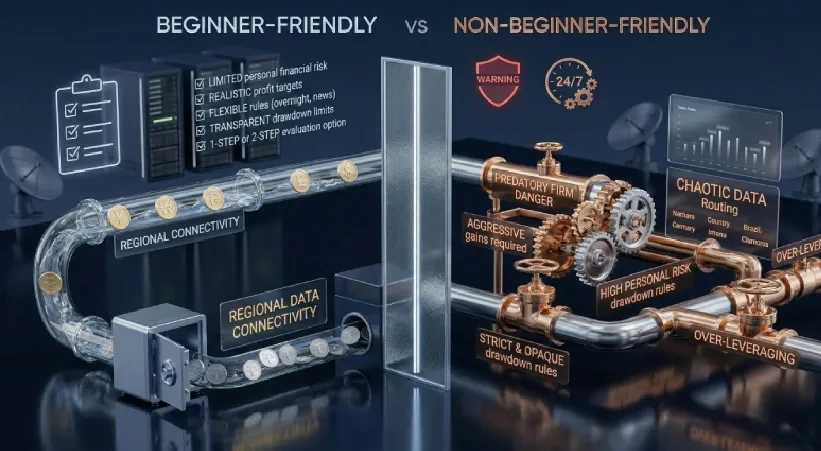
What are the Differences Between Prop Firms that are beginner-friendly and those that are not?
While many prop firms target experienced traders, beginners seeking beginner-friendly prop trading with OFP should focus on rules, risk limits, and payout clarity before registering:
Realistic Profit Targets
If the evaluation sets impractical profit targets and tight deadlines, beginners may overtrade.Clear Drawdown Limits
Confusing or ambiguous daily loss limits are the leading reason why traders fail evaluations at prop firms, especially if they do not fully understand Daily Drawdown vs Maximum Drawdown Explained.Flexible Trading Rules
Most beginner-friendly prop firms will allow:
• Swing Trading
• Holding Trades Overnight
• News Trading (in some situations)Clear Profit Payout Structures
Profit-sharing percentages must be explicit and free from hidden delays, especially when comparing Best Prop Firms with High Profit Split.
Which is Better for Beginners, One-Step or Two-Step Evaluations at Prop Firms?
Most firms offer two types of evaluations: One-Step, where you reach a single profit target with risk guidelines, and Two-Step, which requires two targets (the second usually lower).
Two-step evaluations may feel less intense if profit goals are fixed, while one-step formats allow quicker progress after initial completion. The number of stages is less important than compatibility with your trading style.
Mistakes that Beginners Make in Identity Prop Trading
Top identity prop firms cannot fix bad habits. Typical beginner mistakes include: Excessive leveraging to accelerate profits, ignoring daily loss limits, trading without understanding market volatility, and changing approach during evaluation.
Evaluators prioritize consistency over speed throughout the evaluation process, which directly explains Why Traders Fail Prop Firm Challenges when discipline is lacking.
How to Pick Out the Most Suitable Prop Trading Firm for Beginners
Before paying an evaluation fee, examine the firm’s rules and regulations in detail and understand How Prop Firms Make Money to avoid hidden disadvantages.
Determine their maximum daily and overall maximum losses while trading.
Examine their payout timeline.
Ensure they have a scaling plan.
Find out what other traders are saying about them through community feedback. Use any other trader connections you may have.
Avoid firms that frequently alter rules without adequate notice.
Risk Management is the Most Critical Factor for Passing the Prop Trading Evaluation.
Passing a prop trading evaluation depends more on risk management than your initial strategy.
Successful beginners typically: Limit risk per trade to 0.5-1%, master emotional control, maintain consistent position sizing, and prioritize capital preservation.
Rushing is the easiest way to fail the prop trading evaluation.
Advantages and Disadvantages of Prop Trading Firms for Beginners
Advantages include access to significant capital, structured trading paths, limited personal risk, and performance review for further growth.
Disadvantages include evaluation review pressure, strict loss limits per evaluation, mandatory evaluation fees ($500-$1500), and potential disqualification for rule violations.
The more disciplined your trading, the greater your rewards; aggressive trading, however, increases your likelihood of penalties.
The Safety of Prop Trading Firms in 2026
The prop trading industry is booming, but is facing increased regulatory scrutiny. Firms differ widely in transparency.
As a beginner trader evaluating prop firms, you should:
• Check the firm's registration.
• Determine if it has a long history of success.
• Avoid firms making claims that seem too good to be true.
• Be cautious of services that promise you'll pass.
Thorough firm research is as essential as strong trading performance.
Conclusion: How to Determine the Right Prop Trading Firm for You as a Beginner
By 2026, the most beneficial prop trading firms for beginners will offer realistic opportunities and set transparent standards for rules, evaluation processes, and payout timelines, which is why many traders rely on resources like the Wikilix Broker Reviews to better understand their options.
No prop trading firm can substitute for strong personal discipline. Passing the evaluation requires consistent, patient, risk-aware trading. Approach the process with realistic expectations and treat it as a professional assessment, making it a valuable step toward becoming a successful trader.