
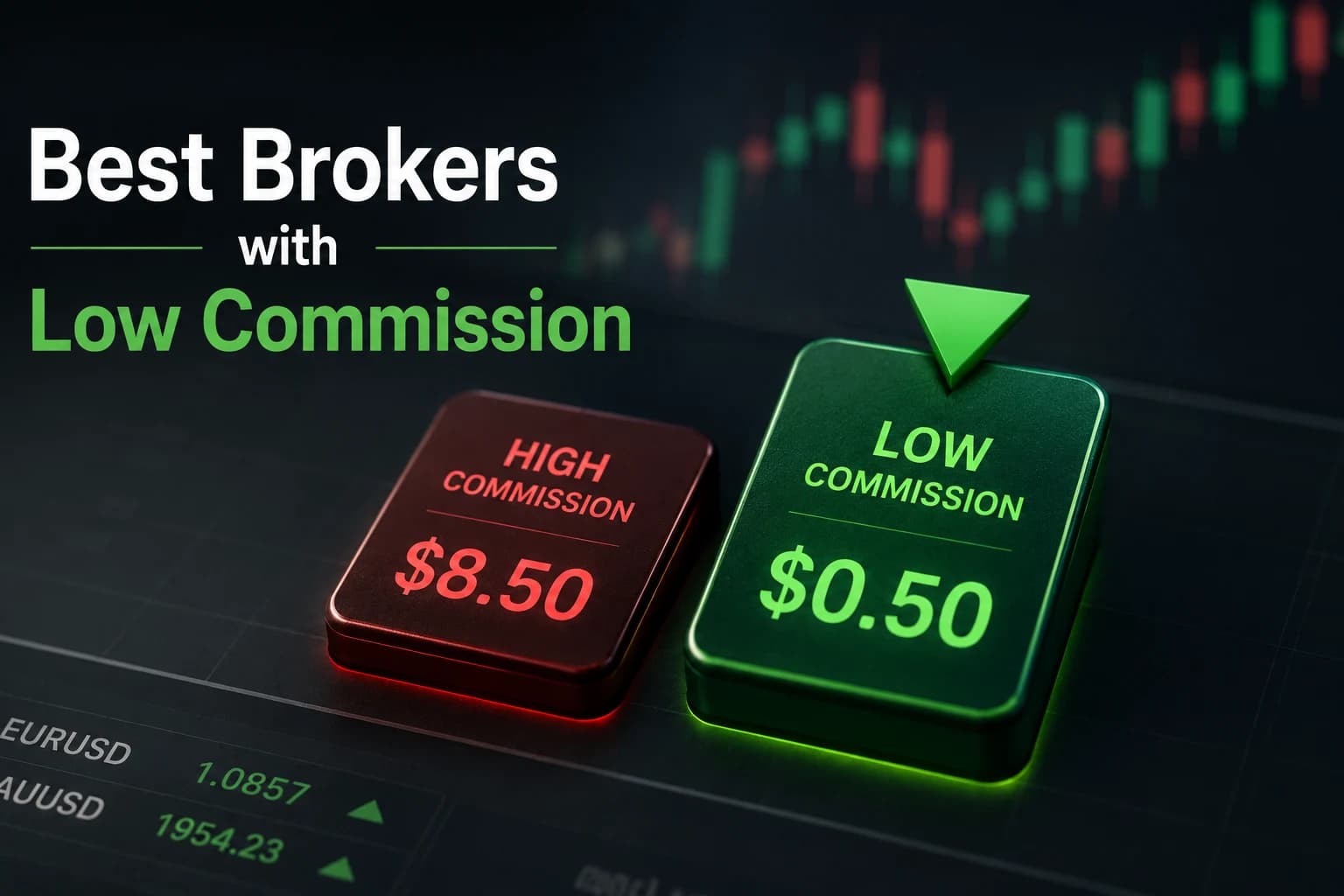
Commissions charged by brokers and trading costs have a significant influence on a trader's long-term success. Most traders focus completely on technical indicators, reviews of the market, and further development of strategies; but, they seldom look into the long-term ramifications of different commission models, which can impact their performance as a trader (differentiated between low and high commission models) dramatically, particularly for people who are executing a higher number of trades, which is why many compare Spread vs Commission: Which Costs Less?
Due to increased competition in the online trading industry, the number of brokers offering low commissions to clients has increased dramatically. More and more brokers are creating commission-based accounts with tighter spreads (and much greater transparency) and faster entry/exit speeds than their traditional accounts. Active traders, scalpers, and algorithmic traders will also benefit from lower commission rates compared to traditional environments, enabling them to execute more efficiently.
While a number of brokers do advertise low commissions as an advantage when it comes to choosing a broker, there are many other factors that potential clients should take into consideration when selecting a broker, such as the details of their trading platform, the quality of trade execution, the fact that they are regulated, and finally, the overall transparency of the company.
The purpose of this guide is to educate the user on the types of low-commission brokers, how commission structures work, and the features of a cost-effective brokerage that any trader should consider before choosing one.
What is Commission-Based Trading?
Most trading companies have two primary pricing structures: (1) a 'spread' based account and (2) a commission-based account.
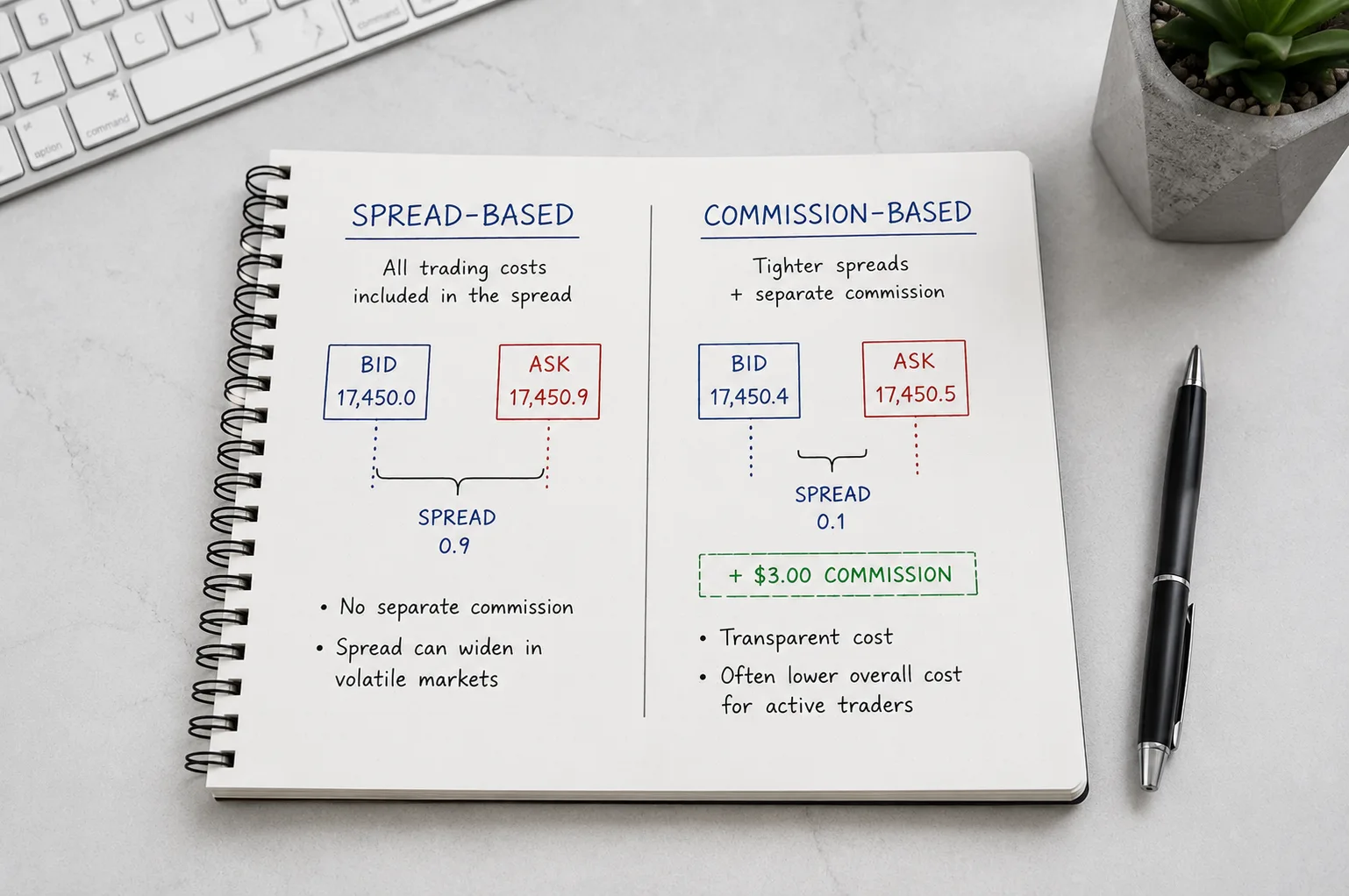
A spread-based account charges a trader a commission on the spread (the difference between the bid and ask prices) between a buyer and a seller. This pricing structure provides a clear total commission charged by the broker, but it may result in wider spreads during periods of high volatility, driven by higher volume.
A commission-based account operates differently from a spread-based account. They typically have smaller spreads (less than $0) than either type of account. In a commission-based account, the broker charges the trader a "rental fee" per transaction rather than a flat fee. This allows the trader to perform very clear calculations of their total trade cost and achieve very definitive results by the end of the month.
Related Articles: Best ECN Forex Brokers in 2026
Why Low Commissions are Important for Active Traders
Low-commission trading environments are critical for traders who perform many trades and for those whose trading style relies on existing market prices (scalpers). If the number of competitive completed orders within a specified time frame is too high to facilitate execution, the scalper's small profit margin is eliminated.
Day traders and algorithmic traders will see additional value in lower-commission trading environments. Because they execute many trades during their trading sessions, the differential between a low-commission broker and a high-commission broker can be materially large over a number of trades over several days commuting to work.
While long-term traders will not experience quite as large a differential in their trading costs due to commissions, over an extended period, they will still see benefits from reduced trading costs compared to what they would experience in high-commission environments.
Key Features to Look for in Low-Commission Brokers
In addition to commission costs, traders should consider other factors when choosing a broker.
Tight Raw Spreads
Generally speaking, low-commission brokers offer traders the opportunity to invest at a zero-pip spread by offering raw spread accounts. Low-commission traders benefit from advanced technology and precise execution to enter markets at the exact moment they choose.
Fast Execution Speed
Low-commission trading environments are highly sought after by high-frequency traders, creating a need for fast, reliable order placement and minimal delays.
Strong Regulatory Oversight
Regulated brokers tend to be more trustworthy, as financial authorities enforce laws and client protection measures.
Professional Trading Platforms
Most low-commission brokers offer access to professional-grade platforms such as MetaTrader 4, MetaTrader 5, and cTrader. Professional trading platforms provide traders with tools and procedures to analyze the market, automate strategies, and mitigate potential losses.
Popular Brokers with Low Commission
Several respected brokers offer competitive commission-based trading accounts. The following table lists popular brokers for traders seeking lower commission rates.
Broker | Platforms | Typical Commission | Key Features |
IC Markets | MT4, MT5, cTrader | Low per-lot commission | Raw spreads and institutional liquidity |
Pepperstone | MT4, MT5, cTrader | Competitive commission | Fast execution and deep liquidity |
Tickmill | MT4, MT5 | Low commission structure | Designed for active traders |
FP Markets | MT4, MT5, cTrader | Competitive pricing | Strong liquidity and tight spreads |
Fusion Markets | MT4, MT5 | Ultra-low commission | Cost-efficient trading environment |
These brokers are often considered by traders looking for transparent commission structures and institutional-style trading conditions, as featured in Forex Broker Comparison Hub – 2026 Edition.
Spread vs Commission: Which Is Better?
The two pricing methods of trading are spread-based and commission-based. Many traders have varied opinions when discussing these two methods. Depending on one’s style of trading (day trader vs. swing trader), the answer is different as to what type of pricing is best for each one of them.
For example, spread-only trading accounts may be easier for beginners to work with because all trade costs are already included in the spread. However, with high market volatility, the spread can widen significantly.
On the other hand, commission trading accounts provide a clear understanding of what a trader pays for each trade. So, they should provide a more stable price with tighter spreads.
For someone day trading or scalping, overall trading costs should be lower with commission-based accounts.
Related Articles: Best Brokers for Beginners 2026
How Technology Has Lowered Trading Costs
Over the last 10 years, there have been numerous technological advances in the trading industry. The use of electronic trading platforms has allowed traders to reduce their costs and the amount they pay to the brokerage firm, and has given retail traders the opportunity to access competitive commission rates.
Electronic Communication Networks (ECNs) and liquidity aggregation systems have enabled brokers to connect their customers directly to multiple liquidity sources, thereby increasing competition among liquidity providers and offering more liquidity at lower commissions.
Additionally, there have been major advancements in the technology that underpins the trading industry. Technological advancements enable lower commissions in retail trading by reducing execution speed and latency. As a result, the trading environment has opened up to more and more retail traders.
Cost Considerations & Risk Management
When working with low-cost brokers, traders must consider the full cost of trading. While commissWhile commissions are just one aspect of the total cost of trading, additional costs such as slippage, spreads, and overnight swap fees can also reduce a trader's profitability. Readers monitor their costs and incorporate them into their risk management plan.
Knowing the complete cost of a broker allows traders to determine if their trading strategy will continue to generate profits over time.
The Importance of Regulation & Broker Transparency
When looking for low-cost brokerages, traders must also consider the regulations that govern the broker. Regulated brokers must disclose their pricing structures clearly and meet higher operational standards. Transparency in pricing helps traders understand the actual cost of trading with a broker and minimizes the risk of hidden costs.
Regulation helps ensure that client funds are protected and that brokers follow fair trading practices.
Traders who choose to trade with a broker regulated by a reputable financial regulator can have greater confidence in their trading environment.
Final Thoughts
When looking for the Best Brokers with Low Commission, it is not as simple as comparing commission rates. In addition to commission rates, traders should evaluate spreads, execution quality, the reliability of the brokerage's platform, and regulatory transparency, following a How to Compare Forex Brokers: Full Checklist, which is why many traders rely on Wikilix Broker Reviews for deeper insights.
Low-cost brokers are extremely beneficial for active traders because they often execute many more trades and rely on tight spreads to generate profits. These trading environments typically offer the same pricing as previously available only to professional traders. Traders, therefore, must evaluate the total cost of a broker rather than simply evaluating commission rates. The total cost of a broker includes spreads, swaps, execution quality, etc., and each can directly influence a trader's trading success.
So what is the best low-cost broker? One that has highly competitive pricing, reliable execution, and strong regulation. By carefully evaluating the total environment and components of the total cost of trading, traders can develop better, more efficient trading environments and ultimately enhance their long-term trading success in the global financial market.