


Accessing substantial capital for trading is a major hurdle for most retail traders and has historically been one of their primary barriers to entering the professional trading world.
The whole trading landscape has evolved recently because of proprietary trading firms, otherwise known as "prop firms", which allow traders to access funded accounts after successfully completing some sort of evaluation process. In particular, over the past few years, the "one-step prop firm challenge" model has rapidly increased in popularity amongst traders.
Compared to traditional prop firm evaluations, which typically require traders to pass through two or more phases, the one-step prop firm challenge takes a simpler approach: the trader must pass through only one evaluation phase before applying for a funded account. Many traders are drawn to the one-step prop firm challenge format because it allows them to get funded much sooner and reduces the complexity of the evaluation process.
Not all one-step challenges are the same, though; some offer adequate trading conditions and realistic targets, while others impose very restrictive rules or require traders to achieve large profits to pass. Therefore, it is critical that traders research various prop firms before choosing the one that best suits them.
This document will list the Top 5 One-Step Prop Firm Challenges, explain how evaluations work, and identify a few of the firms that traders commonly share when looking for faster ways to gain access to a funded account.
Related Articles: How Prop Firms Make Money
Get Started with One-Step Prop Firm Challenge
The one-step prop firm challenge is a proprietary trading-firm evaluation model used to assess traders' performance before they receive access to a funded trading account. Traditional prop firm evaluation models use a two-phase approach: in the first phase, the trader must meet a profit target, and in the second, replicate their results. After completing both phases, the trader will qualify for a funded trading account.
On the other hand, the one-step prop firm challenge uses a single-phase evaluation process. To qualify for a funded trading account through the one-step challenge, a trader must meet the established profit target while following the designated risk management rules. Therefore, if the trader reaches the profit target and adheres to the risk management rules, they can proceed directly to obtaining a funded trading account.
This evaluation model was specifically developed for experienced traders who have confidence in the strategy they are trading and prefer to get funded as quickly as possible.
Why One-Step Challenges Are Becoming Popular
The popularity of single-phase (one-step) evaluations has increased rapidly as proprietary trading firms compete to recruit talented traders. Many traders prefer one-step evaluations over two-phase evaluations because they take less time to be funded.
A disadvantage of a two-phase evaluation is the additional psychological pressure on the trader to successfully complete the first phase, only to feel even more stressed in the second. A one-step evaluation removes the extra hurdles.
For skilled traders, one-phase evaluations greatly accelerate their journey to manage large amounts of capital.
It's important for traders to keep in mind that while they may be able to obtain funding faster through one-step evaluations, this does not necessarily imply that the requirements will be easier. In fact, most one-step evaluations require the trader to have good risk management and discipline in executing trades consistently.
Related Articles: Daily Drawdown vs Maximum Drawdown Explained
Key Factors to Consider When Choosing a One-Step Challenge
Traders looking to pick a prop company to trade with should consider a few key properties, even if they are offered a single-day challenge.
1. Real Implementation of Profit Targets
Having achievable profit targets that don't require too much risk is important to ensuring you don't take on unnecessary risk with a high target, which could lead to account failure.
2. Balance on the Drawdown Certificate
Most prop firms set daily and overall risk limits. It is important to have low drawdown thresholds so you can operate your strategy without constantly worrying about breaking the rules.
3. Understand the Trading Rules
Many firms impose restrictions on certain types of trading, such as news trading or holding trades into a weekend, which is a key part of Prop Firm Rules Explained: What You Must Know. It is important for a trader to understand all the rules regarding trading before signing up for a challenge with a particular prop firm.
4. Stable Trading Platforms
During a prop firm evaluation, you need a platform that is stable. Most prop firms provide traders with access to platforms like MetaTrader 4, MetaTrader 5, or other professional trading software.
5. Payout Structure
گWhenever you fund your account with a prop firm, you need to review the payout and profit-sharing structure.
Related Articles: Are Prop Firms Legit? Red Flags to Watch
Popular One-Step Prop Firm Challenges
Several prop firmsnow offer one-step models for faster access to funded accounts. This table highlights the firmness discussed among traders using this model.
Prop Firm | Profit Target | Maximum Drawdown | Platforms | Key Features |
FTMO (Instant Models) | Varies | Moderate | MT4, MT5, cTrader | Strong reputation and scaling plan |
The Funded Trader | Varies | Competitive | MT4, MT5 | Multiple challenge structures |
E8 Funding | Around 8–10% | Flexible | MT4, MT5 | Simplified evaluation process |
Funding Pips | Moderate | Balanced | MT5 | Beginner-friendly rules |
True Forex Funds | Moderate | Structured | MT4, MT5 | Fast evaluation process |
Each firm offers slightly different evaluation requirements, pricing models, and funding options.
Traders Take on One-Step Challenges
Traders completing a one-step challenge use a disciplined, systematic trading approach.
Most traders starting out will prioritize strict risk management to avoid losing their capital by not making large enough profits quickly.
In addition, prop firms usually evaluate traders based on consistency as part of their evaluation process. This means they take a trader's performance history into account to see whether they are following prudent trading methods or betting on a few big trades.
In many cases, experienced traders approach their trading evaluations with a well-tested approach, defining their trades using a trading plan and daily risk limits.
Pros and Cons of One-Step Evaluation Process
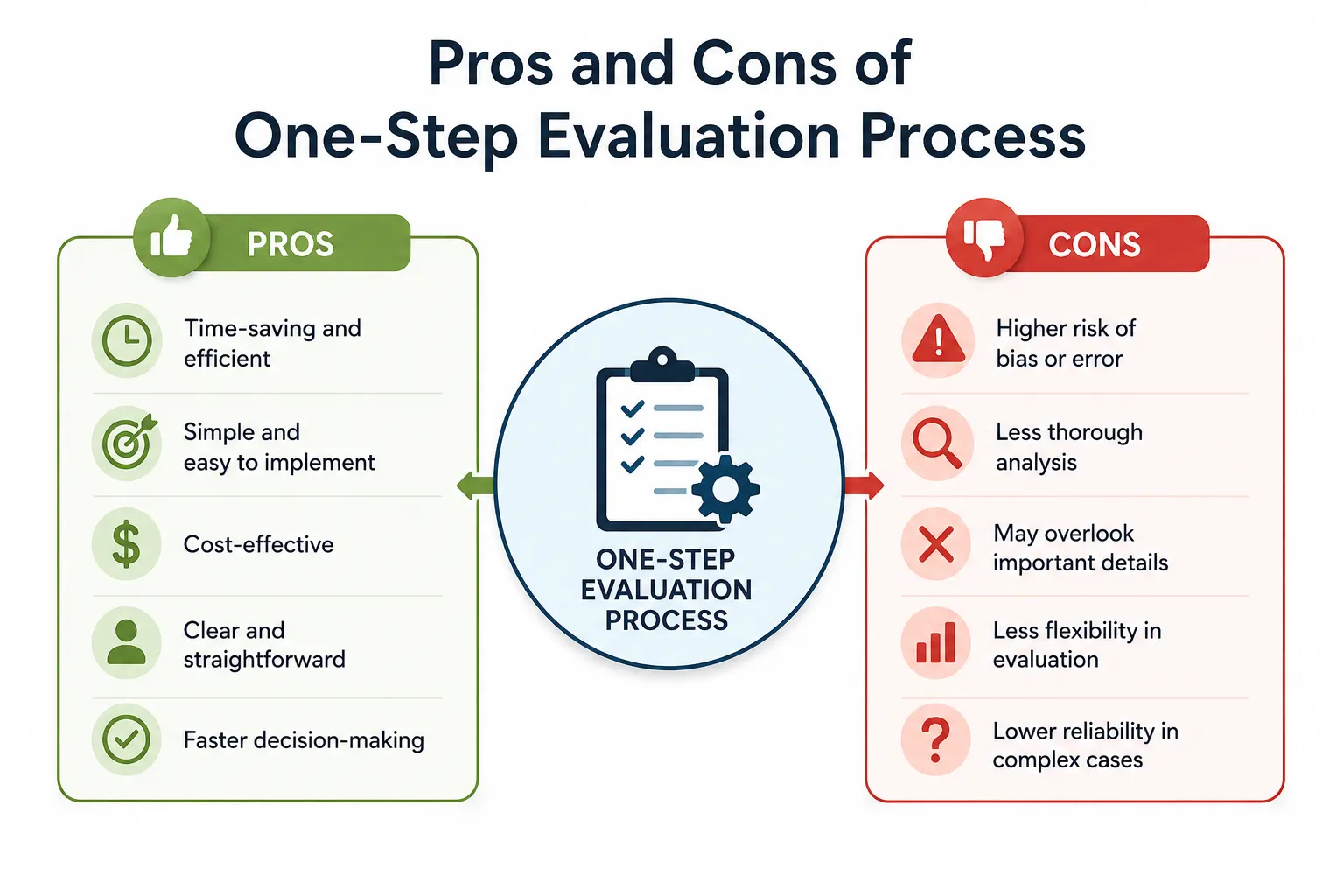
The primary advantage of the one-step challenge is its greater efficiency. A trader can reach funded status more quickly using this type of evaluation than with a multi-step evaluation method.
Additionally, unlike multi-step evaluations, which have several performance measurement periods, the one-step challenge offers only one period to assess performance. This simplification makes the process easier for traders to understand.
Many traders also believe that one-step challenges better reflect the actual market conditions they will experience when trading, as they do not require sustained performance over multiple periods.
For many traders with proven track records, a one-step challenge can provide a shorter path to managing larger trading capital.
Risks & Challenges with Staying in the Prop Trading Industry
There are many prop trading firms that have simplified their evaluation processes by only requiring that traders meet certain standards (i.e., acceptable performance levels & acceptable draw-down limits); however, there are also many prop firms that will create stricter policies than traditional monetary evaluations by introducing less margin and lower draw-down limits into their evaluations. Develop discipline and manage risk to consistently produce profits as a trader.
Challenge Fees
Many prop firms require or charge a fee to participate in the test phase of their prop evaluation process. Therefore, you will want to ensure that the prop firm is reputable and will deliver on its promise to pay you upon successful completion of the challenge, before investing any money in return for completing it.
It is recommended that you perform due diligence before joining a challenge. Review the prop firm's history with incentive payments. Evaluate their customer service and other client experiences.
Related Articles: What Happens After You Pass a Prop Firm Challenge?
Changes in the Prop Trading Industry
Over the last 10 years, the proprietary trading industry has evolved significantly. The introduction of global trading technology, enabled by expanded global access, has allowed prop firms to recruit traders from around the world.
There are remote evaluations, online trading platforms, and automated monitoring systems that allow a firm to evaluate its traders' performance; therefore, you can be easily evaluated under these three systems.
With increased competition, prop trading firms have developed new ways to evaluate their traders, such as the one-step challenge and instant funding. These changes create more opportunities for traders to access prop trading capital.
Final Thoughts
To evaluate which prop firm provides you with the best one-step challenge opportunity, you will need to compare various aspects of the prop firms, for example, profit targets, draw-down limits, etc. (as stated above), similar to the approach used in Wikilix Broker Reviews.
Excellent rep firms provide an unchanging system, strong trader support, and a fair profit-sharing arrangement based on risk-adjusted returns.
Traders with a written, disciplined strategy and strong risk management will find one-step challenges an excellent way to access more trading capital.
As the proprietary trading industry has continued to evolve, traders are much better able to find a reputable proprietary trading firm, making it more likely that they will succeed by applying strong discipline.