

Traders looking for a more methodical approach to the financial markets often turn to swing trading. Rather than chasing every short-term market movement, swing traders look for larger price movements that span multiple days or weeks. These traders do not have to worry about being glued to their screens all day while trying to get in on important price moves.
Many swing traders struggle to capitalize on successful trading strategies because their trading accounts are too small. Even if they have a very good strategy, their profits may be limited because their account is smaller than others'. This is one reason why many swing traders like to use proprietary trading firms (also known as prop trading firms).
Prop trading firms offer individual traders access to large amounts of trading capital in return for a share of the profits generated from their trading activity. Once a trader successfully passes the prop firm's evaluation process, they usually have access to much more substantial funds than they could trade with their own capital alone.
However, not all prop firms are well-suited to swing traders. Some have strict rules against holding positions overnight or over the weekend, which would make it difficult for traders who use swing trading strategies.
This guide reviews the top prop trading firms for swing traders, important features, and how to select the right firm for specific strategies.
What is a Prop Trading Firm?
A proprietary trading firm provides capital to traders. Instead of depositing funds, you complete an evaluation to show profit consistency and risk management skills.
After completing the evaluation and being selected as a successful candidate, you will be awarded a funded trading account. While you will keep a percentage of any profits you generate from your trading, the prop firm will retain the balance.
Most modern prop firms use structures including: profit targets, daily loss limits, overall drawdown limits, and required trading days.
At most prop trading firms, each trader keeps anywhere from 70% to 90% of the profits generated from their trading activity (subject to individual firm policies and a trader's progress towards the firm’s scaling program).
Why Swing Traders Use Prop Firms
Traders who engage in swing trading need to exercise both patience and discipline. Unlike day traders who complete numerous transactions in a single day, swing traders focus on making fewer trades but aim for larger gains.
Prop firms ideally meet the needs of swing traders. They provide swing traders with the capital needed to trade (larger accounts mean higher returns based on successful trades). Swing traders use strategies that deliberately capitalize on larger market moves; thus, a larger capital account increases profitability by enabling more trades with greater potential per trade.
Prop firms give swing traders access to more capital faster than personal accounts. Many prop firms increase allocations based on performance through scaling programs.
Finally, prop firms offer a stable, structured environment that supports disciplined risk management. These traits align with the principles of swing trading.
Things to Consider When Choosing a Prop Firm to Swing Trade With
Swing traders must be careful to ensure the prop firm they work with properly accommodates their swing trading style. Some prop firms may have policies that limit swing trading by limiting the number of days that a position can remain open.
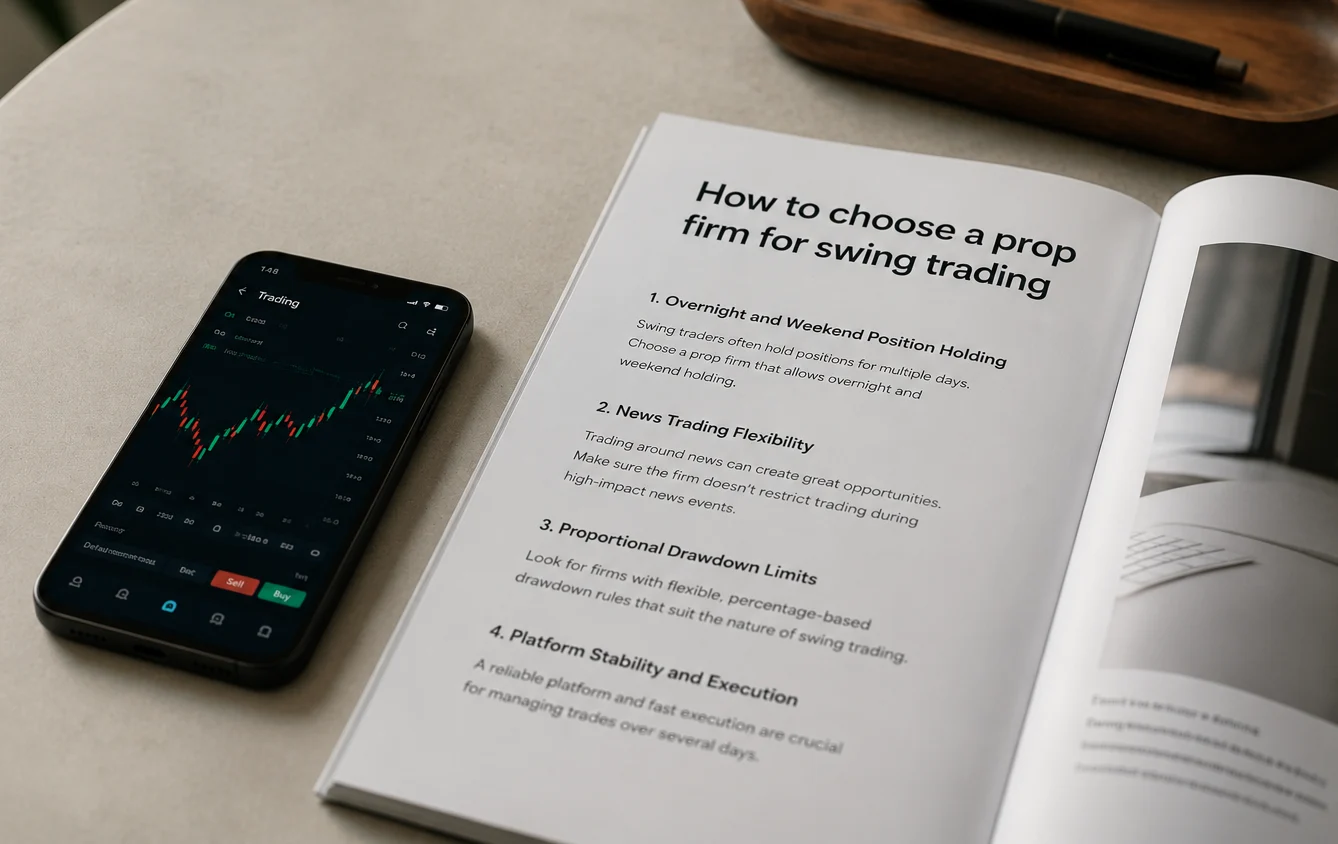
The following are some specific factors to evaluate: overnight and weekend position holding, news trading restrictions, drawdown limits, and platform stability. frequently hold positions for more than just one day. Therefore, a firm that permits overnight and/or weekend position holding is much more suitable to accommodate the swing trader. Most prop firms that close a position before market close on the previous day are typically day traders.
Flexible News Trading Restrictions
Swing traders want to capitalize on volatility, often driven by economic news releases. Some prop firms do not permit you to trade prior to or during the announcement of an economic event; therefore, be sure to confirm whether or not the prop firm has such restrictions on its rules.
Proportional Drawdown Limits
Typically, swing traders use longer stop losses than day traders, leading to larger drawdowns. Most prop firms that work with ratio-drawdown limits provide swing traders with flexibility while managing risk.
Execution and Stability of Platform
Swing traders need a stable trading platform and reliable order execution, as their positions require significant time in the market, which is why many traders also search for the Best Brokers for Swing Trading. Most prop firms support platforms such as MetaTrader and cTrader, which are widely used by forex traders.
Best Prop Firms for Swing Traders
Several prop firms have developed reputations for offering trading conditions that suit swing trading strategies.
The table below highlights some well-known firms frequently used by swing traders.
Prop Firm | Maximum Funding | Profit Split | Overnight Holding | Key Advantage |
FTMO | Up to $400,000 | Up to 90% | Allowed | Well-known evaluation model |
The Funded Trader | Up to $600,000 | Up to 90% | Allowed | Strong scaling opportunities |
Fidelcrest | Up to $2,000,000 scaling | Up to 90% | Allowed | High capital growth potential |
Lux Trading Firm | Up to $1,000,000 scaling | Up to 90% | Allowed | Long-term funding structure |
Topstep | Program dependent | Up to 90% | Limited depending on rules | Structured risk system |
Each of these firms offers slightly different conditions, so traders should review their trading rules carefully before starting an evaluation.
Common Challenges Swing Traders Face With Prop Firms
Swing trading is trading in which an investor or trader holds a position(s) for a number of days, anticipating closing out once the security reaches its highest point or lowest point. Many swing traders use prop firms because they offer leverage; however, these firms also impose restrictions and obstacles that can create challenges for swing traders.
Daily Drawdown Restrictions
Drawdown limits are among the most common restrictions and obstacles that swing traders encounter when trading with prop firms, making it essential to understand Daily Drawdown vs Maximum Drawdown Explained. Swing traders often place more trades than day traders; however, day traders often reach their profit target(s) more quickly because they place fewer trades daily.
Economic News Restrictions
Most prop firms restrict traders from placing trades during economic announcements, creating limitations and barriers for swing traders who want to execute their trading strategy in today’s marketplace.
Understanding these obstacles will help the trader determine which prop firm is the right fit for their individual trading needs.
Swing Trading with Prop Firms
To succeed with prop firms, swing traders must make slight adjustments to their trading style. They need to meet the firm’s guidelines for traders. Adjustment is in risk management. Swing traders traditionally use larger stop losses, which require them to carefully consider position sizing.
Risking 0.5-1% will help the swing trader mitigate the limitations of prop firms, which may be limited to a specified amount, vs. just 1 or 0.5%.
A second factor to consider when developing their trading strategies is the type of instruments they will trade. Swing traders should focus on equities that are trending, have strong technical levels, or are driven by economic fundamentals, rather than on intraday traders who are solely focused on shorting and/or scalping.
The third critical component for swing traders to succeed is patience. Swing traders must wait for trade opportunities with a high probability relative to the number of trades they place.
If swing traders develop and use disciplined risk management and focus on high-quality trades, they can succeed in line with the prop firm’s guidelines.
Related Articles: How Scaling Plans Work in Prop Firms
Future Outlook of Prop Firms for Swing Traders
The most thrilling aspect of the prop trading industry is that prop firms are developing and growing rapidly; therefore, as long as they continue to grow, there will be swing trader opportunities.
As prop firms continue to innovate and improve their business models/conditions for swing traders, they will increase their profit-sharing percentages and establish more cost-effective ways for swing traders to scale the amount of capital they put at risk.
Additionally, the prop firms have been leveraging technology in their businesses, enabling them to run advanced calculations that assist their traders in analyzing their trading systems, determining risk levels, and tracking cumulative statistics and continuity in their trading activities in real time.
Additionally, there will come a point when the general public becomes aware of the prop trading industry, prompting some regulatory oversight or increased scrutiny.
For now, though, prop firms are the easiest way for swing traders to access an institutional-level account.
Conclusion
Swing trading has many advantages, as it helps balance the market and allows investors to capture large price movements without frequent trading. The availability of capital and resources through prop trading firms offers swing traders opportunities to achieve long-term profitability. As emphasized by The Broker Authority, to trade successfully within prop firm guidelines, swing traders should review overnight holding periods, drawdown limits, and methods to achieve profit objectives.
The combination of evaluating prop firm rules and applying a disciplined risk management strategy enables traders to execute high-quality trades and achieve more consistent results with funded capital. The prop trading industry has proven to be one of the most effective ways to access significant capital and continue supporting traders throughout their long-term trading journey.