
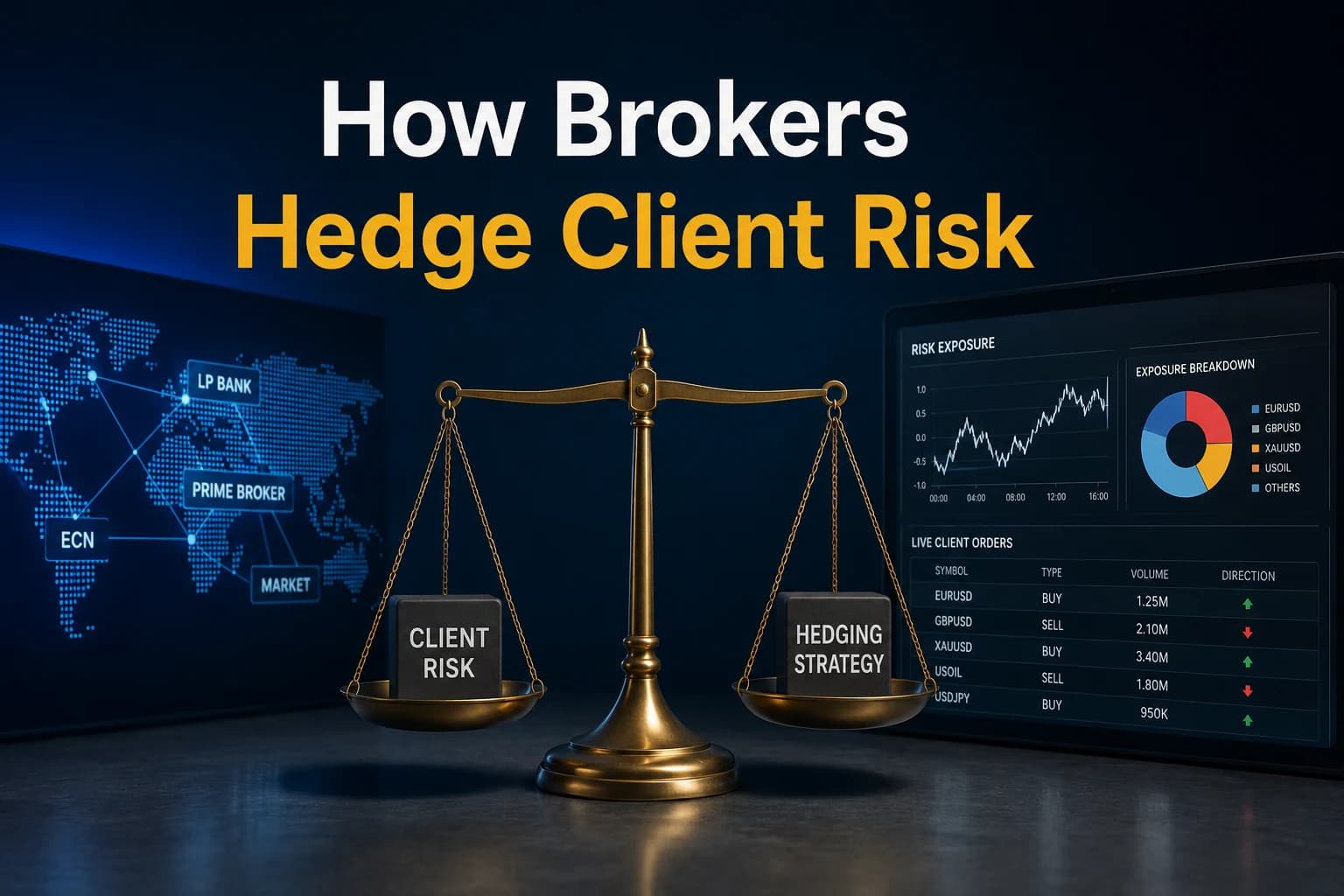
Generally speaking, most retail traders focus their attention on charts and indicators, as well as various market trends. However, many fail to recognize what goes on behind the scenes at their broker’s end of the trade when an individual trader places an order for forex or contracts for difference (CFD). To make a trade happen, someone must take the opposite side. The big question becomes: how will a broker hedge all the risk for thousands of clients and their trades/deals at any given point in time?
The answer to that question lies in risk hedging. Brokers can use various risk-hedging strategies to offset exposure to the trades their clients are placing. Without adequate risk management, a broker may be exposed to significant price fluctuations and exchange rate movements when clients trade in the same direction in large volumes, highlighting the importance of safeguards such as Negative Balance Protection Explained.
To appropriately manage the risks created by their clients, modern brokerage firms utilise sophisticated risk management systems that evaluate client activity and monitor it in real time. In addition, the system will help the broker determine when to use external hedging, when to internally hedge when it makes sense, and what is required to maintain a balanced exposure across all markets.
This guide will provide a thorough explanation of how brokers hedge the risk they assume from clients, discuss the most common models they use, and offer additional insight into how they manage exposure and maintain a balanced marketplace for retail traders.
Why It Is Important for Brokers to Manage Client Risk
The broker is responsible for executing the trader’s buy and sell orders through the trader's trading platform when the trader opens a position with the broker. Let’s say, for example, that there are thousands of clients buy/selling (longs/shorts) the same instrument or currency pair at exactly the same time. In a situation like the above, where brokers are taking the opposite side of trades without hedging, they can be exposed to large market movements when many clients trade in the same direction.
A broker must have an adequate risk management strategy in order to prevent the situation described above from occurring. The most common way a broker can reduce their exposure to clients’ trades is to hedge (balance) their clients’ exposure. When a broker uses risk management as described in the example above, they can continue to offer their clients uninterrupted access to the markets.
Related Articles: How Offshore Broker Regulation Works
What is Broker Exposure?
When a broker takes the opposite side of their clients' trades, the broker’s entire market risk exposure is based on all their clients' trades. If there is a relatively even number of clients on both sides of the trade, then ultimately the broker’s risk exposure is somewhat naturally offset by these trades, and therefore, what would otherwise be a financial risk will become very little or no financial risk. On the other hand, there are numerous instances of an inordinate number of clients on one side or the other of a trade, which increases a broker’s risk exposure on that side.
A perfect example of a client cluster would be a strong market trend. In other words, if many clients are buying the same currency (or instrument) because of a strong upward market trend, this would create directional risk exposure that leads to an upward cluster.
Brokers' risk management systems continually monitor and evaluate market risks (i.e., long and/or short) and make recommendations to the broker on hedging to mitigate the broker’s overall risks resulting from clients’ trades.
Common Risk Management Models Used by Brokers
Brokers generally use different models to manage client risk. These models depend on the broker’s business structure, liquidity relationships, and risk tolerance.
The most common approaches are summarized in the table below.
Risk Model | Description | Typical Usage |
A-Book | Trades are passed directly to liquidity providers | ECN and STP brokers |
B-Book | Broker internally takes the opposite side of trades | Market maker brokers |
Hybrid Model | Combination of A-Book and B-Book approaches | Many modern brokers |
Dynamic Hedging | Broker hedges positions based on exposure thresholds | Advanced risk systems |
These models help brokers maintain stable operations regardless of market conditions.
The A-Book Model: Passing Risk to Liquidity Providers
In the A-Book model, brokers pass their clients’ trade orders directly to an external liquidity provider, such as a bank, financial institution, or prime broker; thus, the broker does not assume any internal trading risk. The broker acts only as a conduit to the external counterparty of the client’s trade order.
The broker earns commissions or spreads as it would from any client, rather than against its clients when operating via an A-Book execution.
A-Book execution brokers generally operate as ECN or STP brokers, providing clients with direct access to the interbank currency market and transparent pricing, as explained in What Is an ECN Broker.
B-Book Execution: Internal Matching of Client Trades
B-Book brokers internally match clients' trades and act as the counterparty. When a client buys a currency pair, the broker sells it to the client internally.
B-Book brokers can choose to hedge or not hedge certain trades externally because many retail traders lose money to market participants. Nonetheless, reputable B-Book brokers will use conservative risk management policies to limit their clients' exposure to losses.
Therefore, B-Book brokers can provide their clients with tighter spreads and simpler pricing structures.
Hybrid Risk Management Models for Online Trading
Many brokers use hybrid risk management strategies. A hybrid model includes aspects of A-Book execution and B-Book execution.
Brokers utilize hybrid risk management models to analyze client trading patterns in real time. Based on an analysis of each client’s activity, the broker will determine whether to externally hedge the position with liquidity providers.
For example, brokers may immediately hedge positions with a liquidity provider if the trader is active and has traded profitably. Conversely, the broker may internally manage any accounts that are not actively trading.
Thus, the combination of risks and costs enables brokers to manage risk efficiently while optimizing operational costs.
Related Articles: Forex Broker Comparison Hub – 2026 Edition
How Brokers Hedge Large Market Exposures Using Risk Management
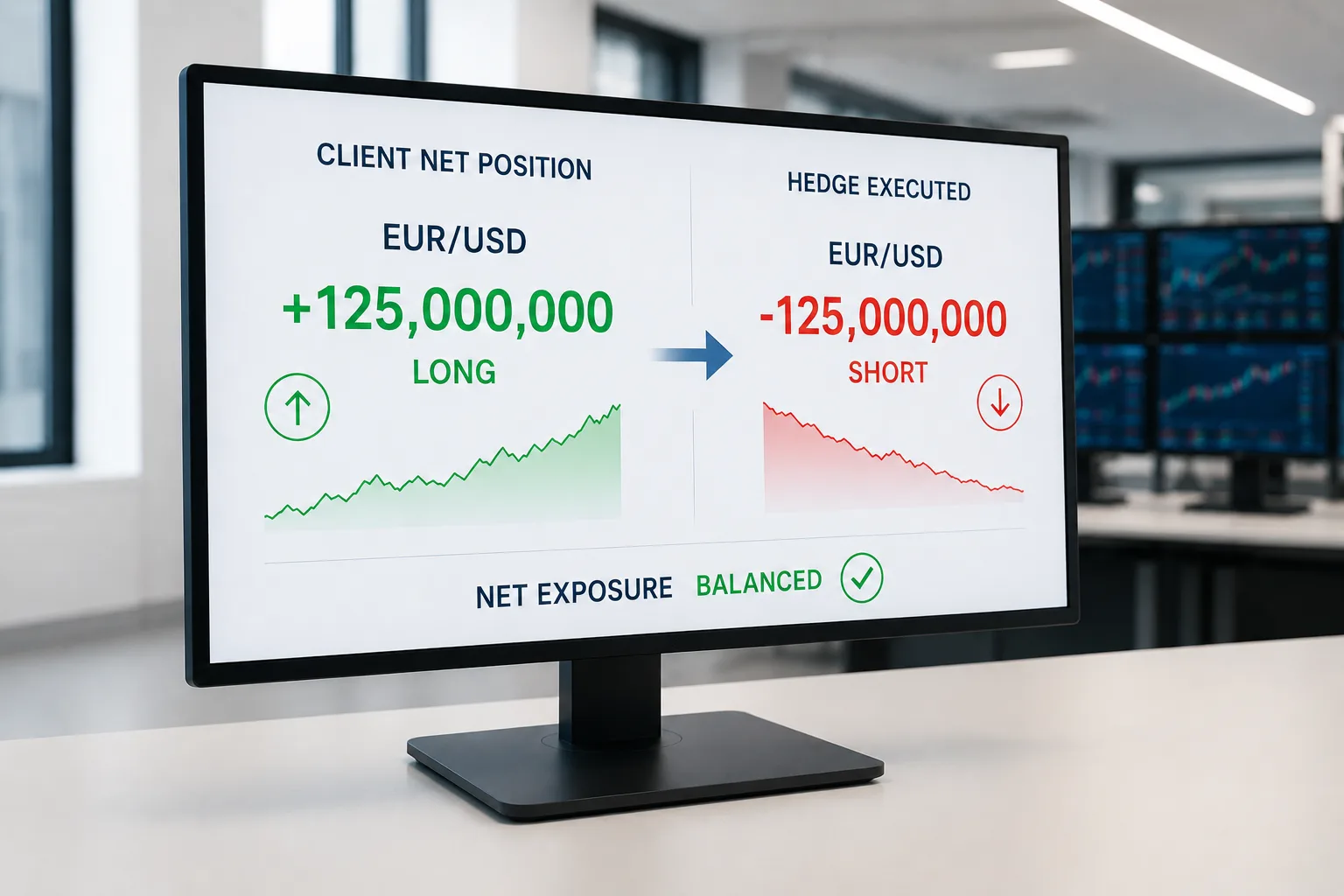
When broker exposure exceeds the acceptable risk level, the broker must engage in hedging activities.
Brokers use hedging activities to balance their total risk by taking offsetting positions on the opposite side of their clients’ positions. For example, if clients are all buying a specific currency, the broker may approach a liquidity provider to sell that currency to offset the risk to the clients.
The broker's goal is not to stop clients from trading, but to ensure the broker maintains balanced risk at the end of the day.
Many brokers that have implemented automated systems for managing and executing hedging transactions do so based on predetermined limits for the type of risk exposure they will accept.
Technology Solutions for Broker Risk Management
Brokers today rely heavily on technology to monitor their clients' exposures.
Through real-time monitoring, brokers use technology to manage the entire client portfolio of open positions and calculate clients' overall net exposure across a variety of originating financial instruments, including stocks, currencies, options, and futures.
Technology is also used to evaluate trading activity and assess directional bias across thousands of accounts simultaneously.
When the aggregate exposure of the broker’s clients reaches predetermined levels for the type of risk, automated trading systems will route side-trading orders to liquidity providers on the broker's behalf.
Using these systems helps brokers remain operational during high-volume, volatile market periods and provides some benefit to their customers and to participants in the marketplace as a whole.
How Important Hedging is for the Stability of the Markets
Hedging is an effective risk management tool for both brokers and traders. The broker has the advantage of hedging their own business operations. This allows for an orderly, financially sound broker business operation while also enabling the broker to limit his or her risk from a volatile market.
Traders will benefit from a broker who has their risk under control and can deliver consistent execution, providing access to reliable liquidity and a stable environment in which to trade.
As brokers implement appropriate risk management tools, they may struggle to handle uncontrolled price movements, be forced to suspend trading, or be unable to process trades as they wish. Therefore, having proper risk management tools in place will help ensure the broker can provide a stable trading environment.
The Impact of Regulation on Broker Risk Management
Brokers operating in a regulated environment must comply with regulatory requirements and implement sound risk management practices.
Specifically, regulatory relationships encompass all aspects of the broker, including requirements for capital reserves, liquidity, and maintaining transparency in the collection of trader commissions.
All regulated brokers have a fiduciary relationship with their clients, but they must follow sound operational practices designed to protect traders and segregate clients' funds.
Regulatory oversight of brokers will help ensure that they have established sound risk management practices, as outlined in How Regulators Protect Forex Traders.
Conclusion
Understanding how brokers hedge client risk provides insight into how trading platforms operate behind the scenes.
Brokers use risk management models such as A-Book, B-Book, or hybrid systems to manage exposure created by client trades. When risk becomes too high, they hedge positions through liquidity providers to maintain balance.
Modern technology plays a key role by allowing brokers to monitor positions in real time and react quickly to market changes.
Overall, effective risk management enables brokers to provide a stable trading environment while controlling their exposure, as emphasized by The Broker Reference. By understanding these processes, traders can better understand how their trades are handled and how brokers manage risk.