
When entering the forex market, many traders assume their trades will be executed at the price displayed on the trading platform. However, FX markets move quickly. The price shown when you enter may change slightly from the price executed when your order is filled. This phenomenon, known as slippage, is common in all financial markets.
Slippage can occur in any fast-moving market, including forex, stocks, commodities, and cryptocurrencies. Traders who rely on entering and exiting trades at set prices, such as day traders or scalpers, must understand how slippage occurs.
Even though slippage is often viewed as a negative event for traders, slippage can also be positive (i.e., when a trade is executed at a better price than the trader requested).
Understanding how and why slippage occurs helps traders manage its effects. This, in turn, improves overall trading performance and helps control risk. Within this guide, we will look at:
How Slippage Happens in Forex - The main causes of slippage and practical ways for traders to reduce its effects.
Related Articles: What Is Margin Call in Forex?
What is Slippage in Forex Trading?
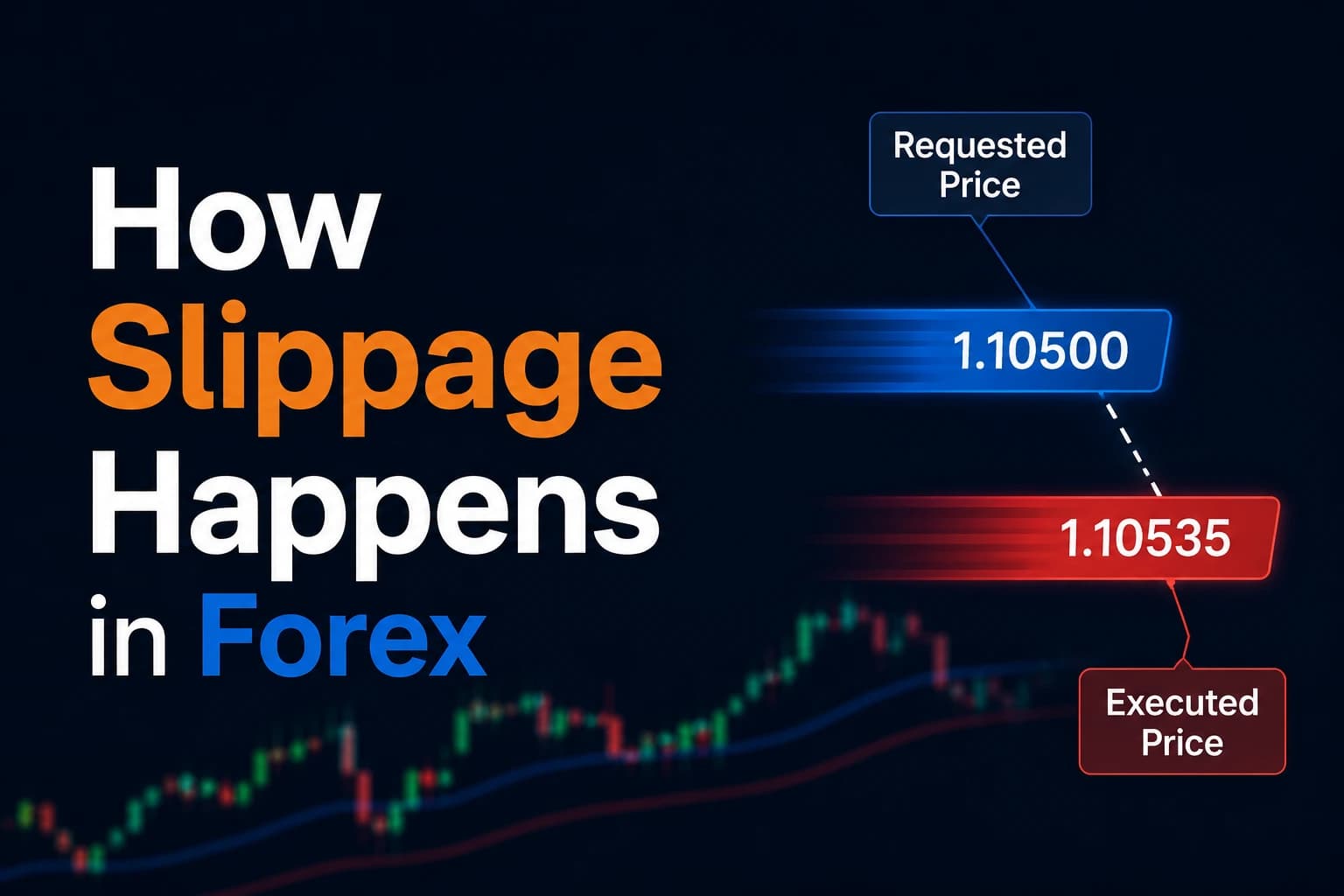
Slippage is the difference between the price expected at the time an order is placed and the price at which it is executed.
For exFor example, if a trader wants to buy an order placed at 1.2000 but it is executed at 1.2003, there is a 3-pip slippage (the market price changed between the time the order was entered and when it was filled).e are many types of orders that can result in slippage (market, stop, and at times limit), and slippage does not always involve broker manipulation, as it is simply the essence of what happens to prices in a fast-moving market.
Types of Slippage
Slippage can happen in different ways, depending on market conditions and execution speed. Traders usually face three main types of slippage.
Type of Slippage | Description | Example |
Negative Slippage | Order executed at a worse price than expected | Buying at a higher price than requested |
Positive Slippage | Order executed at a better price than expected | Selling at a higher price than expected |
Zero Slippage | Order executed exactly at requested price | No difference between expected and executed price |
While negative slippage is more commonly discussed, positive slippage can also occur when market conditions move in favor of the trader during execution.
Why Slippage Happens in Forex
Slippage in foreign exchange trading can occur for many reasons, but it's typically due to market volatility, liquidity, or execution timing/technology.
Volatility in the Market
When a central bank announces or geopolitical events occur, Forex markets can move very quickly. If the price changes rapidly while entering your order, slippage can happen. You may have requested your order at a certain price, but before it is executed, the market may move enough to cause slippage.
Liquidity in the Market
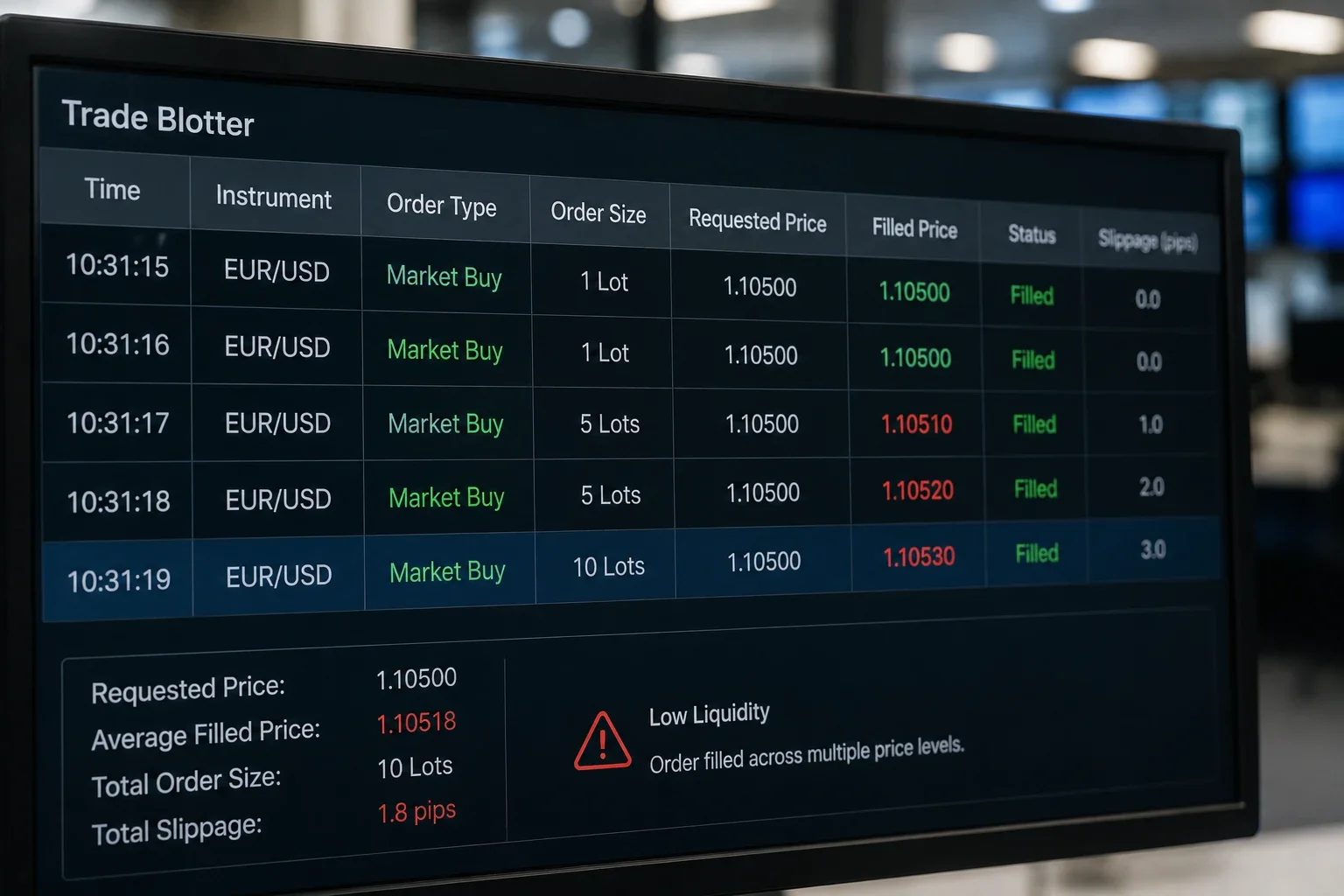
Liquidity refers to how liquid the market is; that is, how many buyers there are to sell to or how many sellers there are to buy from. When liquidity is high, it will be easy to fill your orders at the price you expect. However, when liquidity is low (which often occurs during holidays or after the market closes), it may not be possible to enter your order at the expected price because there may not be enough orders to fill it. When liquidity is limited, you may be required to fill your order at the next available price.
Related Articles: Daily Drawdown vs Maximum Drawdown Explained
Order Size
When you enter a large order into the market, it is likely that you will require many liquidity providers to fill your total position. If the liquidity at your requested price is insufficient to fill your order, or your total order cannot be filled at that price, your order will be filled in separate pieces at different prices.
Speed of Execution
The speed at which your trader enters your order into their system and sends it to the broker for execution can cause slippage, even if the delay is just a few seconds. When markets are highly volatile, price movements can occur rapidly.
When Slippage is Most Likely to Occur
Although slippage can occur at any time during trading, there are specific periods when it is more likely. One common time is during major economic announcements, such as interest rate decisions, employment numbers, and inflation data. When these announcements are made, price movements can happen almost instantly, within seconds.
Another time would be during the reopening of markets after weekends or holidays; there is a good chance that, when markets reopen, there are price gaps, and orders would not be at the expected level due to them.
Another time slippage can occur is when other traders' activity increases and there is a HUGE number of orders across the globe.
The Role of Broker Execution Models
Depending on the execution model a trader uses, slippage can occur. With direct market access or ECN models, the broker may send the trade straight to the market. There, you get the best available prices. In this case, slippage may occur because your order fills at the current best price.
Market Makers use a different execution type because they operate an internal order-matching system. As such, it can cause visible slippage for traders under certain circumstances. Execution quality ultimately depends on the broker’s infrastructure and liquidity management, regardless of execution type, which is why guides like How to Compare Forex Brokers: Full Checklist are essential.
Regardless of the execution model used, slippage is a natural consequence of trading in rapidly changing markets.
How to Reduce Slippage During Trading
Traders cannot completely prevent slippage; however, several steps can help reduce its impact.
Trade When There Is High Liquidity
Liquidity levels in the Forex market are much higher during the major Centers. London and New York are major Trading Centers. Therefore, there is typically a very tight spread and stable executions.
Trade Outside of Major News Releases
Economic News releases usually cause the most volatility. When volatility is high, slippage can occur during trade execution. Typically, many traders wait until volatility has stabilized before executing trades.
Use Limit Orders
Limit orders allow traders to define the price at which they wish to enter a trade, as well as the price at which they will exit. Limit orders do not guarantee that you will execute at your desired price, but they will greatly reduce the probability that you will execute at a less favorable price.
Select a Quality Broker
Brokers with solid liquidity relationships and high-quality execution capabilities will process trades more quickly, especially those listed among the Best ECN Forex Brokers in 2026.
Slippage and Trading Strategy
Slippage is common among traders using all types of strategies. Traders who use scalping or high-frequency trading (HFT) are most affected by slippage, as they focus on multiple small trades and small price movements. Even a few pips of slippage can significantly impact their bottom line. In contrast, long-term traders experience slippage less often than scalpers or HFTs, as they trade over longer time frames and seek larger price changes.
All traders should consider how slippage affects their chosen strategy when managing expectations and risk procedures.
Related Articles: Spread vs Commission: Which Costs Less?
Technological Advances & The Future of Execution
New technological advances in financial markets have improved the quality of order execution for all traders.
Advanced electronic trading platforms have been created using order-routing systems that enable traders to connect to multiple liquidity sources simultaneously. This allows traders to ensure they receive the best available price when completing a trade.
Improved server infrastructure and data transmission speeds have led most traders' environments to experience lower latency than before. While it is true that there will always be slippage in fast-moving markets, advances in technology should decrease its occurrence & magnitude.
Conclusion
Understanding slippage in Forex is critical to understanding Forex itself. Slippage occurs when the anticipated price level of a trade differs from the price at execution. This can occur as a result of trading in a rapidly moving &/or highly volatile marketplace and/or because of inadequate liquidity when executing a trade.
Even though slippage results in worse prices than the trader anticipated, it is a normal part of a dynamic financial marketplace, not an unusual occurrence.
Traders may take steps to lessen the impact/slippage on their trades by trading during periods of high liquidity, avoiding major reports or news events, using limit orders, and utilizing reputable brokers, as often highlighted in Wikilix Broker Reviews.
A successful trader understands how the marketplace operates and uses that knowledge to develop a comprehensive trading plan. A trader who understands how slippage works will be better able to adjust to the erratic, fast-paced FX trading market.