
The forex market is sometimes referred to as the round-the-clock market. In contrast to stock exchanges, which have specific trading hours, Forex is open 24 hours a day, 5 days a week.
At first glance, learning to trade in the Forex market might seem to enable you to place trades at any time with the same trading conditions. But actually, market behaviour varies widely across different times of day.
As you might well imagine, all the global financial centres that transact with one another open and close their operations according to their own time zones. Traders refer to this activity as Forex trading sessions. Each Forex trading session offers different characteristics, liquidity levels, and volatility standards. There will be sessions characterised by very little activity, while others will be filled with very active market movements.
Learning the differences of these trading sessions can help all types of traders (beginner and veteran). For many trading strategies, volatility is a key factor that varies across trading sessions.
Whether you’re new to Forex or have years of experience, understanding these sessions and how they function is very important for making successful trading decisions. The following guide will teach you about Forex trading sessions, when they occur, and how traders can use their timing to improve their trading decisions.
What are Forex Trading Sessions?
Forex trading sessions define the times of day when the world's major financial centres are open for business. As Banks and other institutions trade from their different locations, the Forex market effectively moves around the globe.
As one financial centre closes, another financial centre opens its trading day. This allows the Forex market to operate 24 hours a day, 7 days a week.
The four primary Forex trading sessions are:
• Sydney Session
• Tokyo Session
• London Session
• New York Session
Each of these four sessions corresponds to the primary trading hours of its associated financial centre.
Four Major Trading Sessions of Forex Trading
The Forex Market operates 24 hours a day; however, most trades take place during the four most important sessions.
Sydney Trading Session (Sunday Open):
The Sydney trading session marks the opening of the week’s trades after a weekend break, when trades had been closed. This session is considered relatively quiet on the forex market, as liquidity is lower than in later sessions. Price moves during this time are usually smaller than those later. Traders of pairs linked to the Australian and New Zealand economies will also closely monitor activity during this session.
Tokyo Trading Session (Asian Trading Session):
The Tokyo trading session, also known as the Asian trading session, is the first major financial center to become active during the day’s trading.
During the Tokyo trading session, Asian currencies become increasingly active. Currencies associated with Asia, including:
• JPY - Japanese Yen
• AUD - Australian Dollar
• NZD - New Zealand Dollar
The volatility associated with this trading session is usually moderate; however, there may be important economic releases from Japan and China that could trigger significant market movement.
New York Trading Session:
The New York Forex Market opens the U.S. Financial Markets. Therefore, this session plays an essential role in forex trading by providing the opportunity to trade currencies during one of the highest-volume, fast-moving periods of each trading day. In fact, there is a three-hour overlap between the closing of the London Forex Market and the opening of the New York Forex market; this gives traders the best opportunity to take advantage of both markets.
In addition to having high volume, the New York Session is also known for being extremely volatile due to the significant release of "high-impact" economic indicators in the U.S. by various agencies (e.g., Federal Reserve Bank). These economic indicators can significantly influence the price of currencies during this period; for example, interest rate decisions, employment levels, and inflation data all help to shape trader sentiment about future market conditions, thereby influencing their decisions on how to trade currency pairs with the U.S. dollar (EUR/USD, GBP/USD, and USD/JPY).
Many day traders and scalpers seek to identify trading opportunities during the New York Session, given its high volume and rapid price movements across various currency pairs against the U.S. Dollar, often working with the Best Brokers for Day Trading. Many traders also look for trend continuation and breakout opportunities from previous session or day levels during this time, specifically using short-term trading strategies such as breakout traders that capitalize on rapid price appreciation or depreciation through technical analysis and/or fundamental analysis.
London Trading Session:
The London trading session is regarded as the most important Forex session, as London is internationally recognized as one of the largest financial centers in the world for trading and accounts for a large share of overall trading volume in this session.
Opening the London trading session will see increased trading activity compared to the Sydney or Tokyo sessions. Overall, liquidity will increase, spreads will narrow, and price movements will be much more dynamic as the London market opens. Trading during the London trading session is driven by increased volume of market participants and the overall level of trading activity.
This will all be included in your new responses:
The New York and London sessions overlap for a few hours, making this one of the busiest times to trade in the forex market.
Generally, major economic data from the USA are released at this time, often leading to significant volatility, particularly in USD-denominated currency pairs.
Once the London session is closed, the volume of trades tends to significantly drop off as the New York session draws to a close.
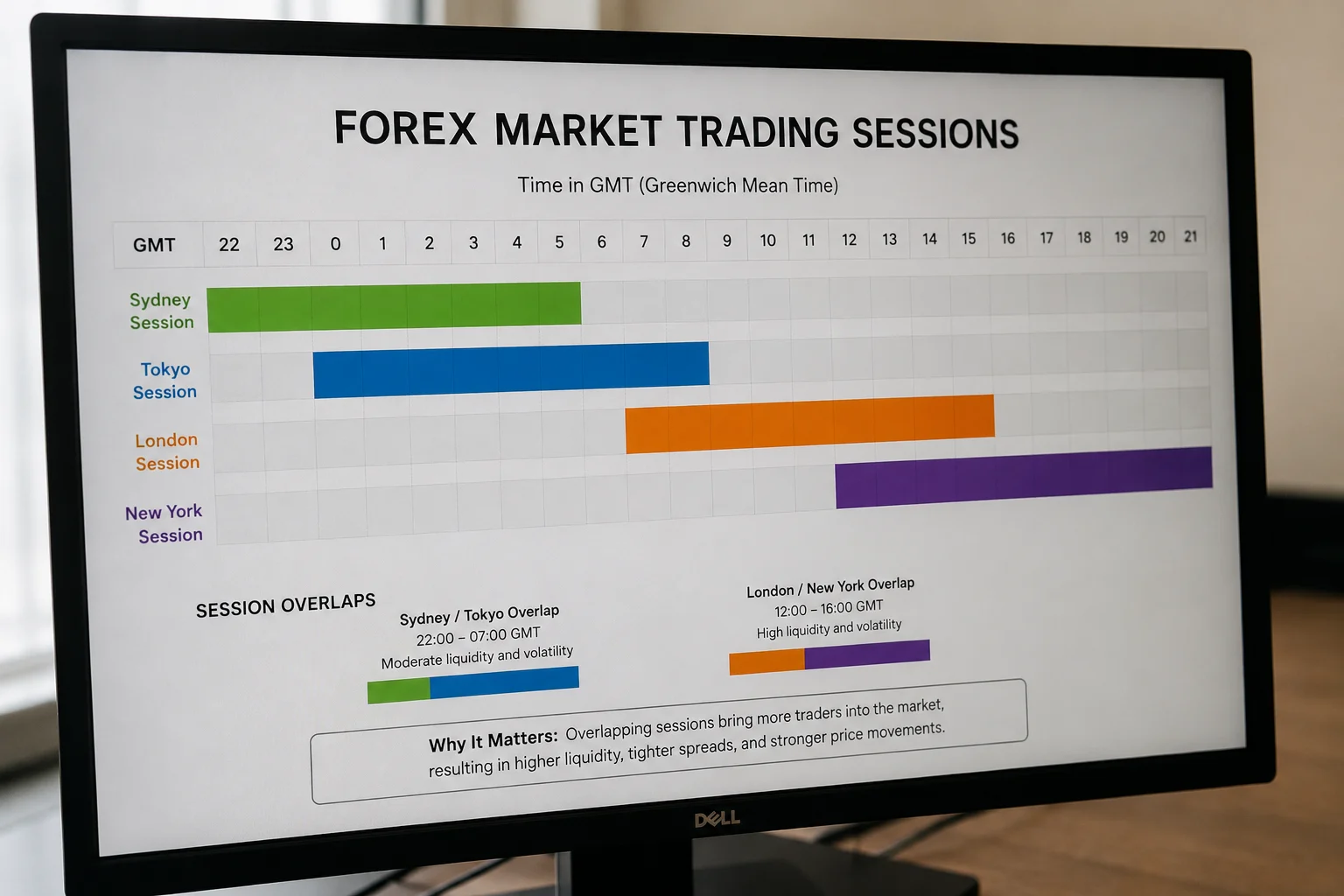
Forex Trading Sessions Overview
The following table summarizes the approximate opening hours of each trading session in Coordinated Universal Time (UTC).
Trading Session | Major Financial Center | Typical Opening Hours (UTC) | Market Characteristics |
Sydney | Australia | 21:00 – 06:00 | Lower liquidity, slower price movement |
Tokyo | Japan | 00:00 – 09:00 | Moderate activity, Asian currency pairs active |
London | United Kingdom | 08:00 – 17:00 | High liquidity, strong market movement |
New York | United States | 13:00 – 22:00 | High volatility, major economic news releases |
These times may shift slightly depending on daylight saving adjustments.
Session Overlaps and Why They Matter
In forex trading sessions, session overlap is one of the most critical concepts. Session overlap occurs when two of the world’s most significant financial markets are open at the same time. The primary example of this is the overlap between the London and New York sessions.
During the London/New York overlap, you’ll typically notice a substantial spike in trading volume, as both European and American participants are active at the same time. As a result, you’re likely to experience stronger trends and greater volatility than during other hours.
A second example of session overlap occurs between the Sydney and Tokyo sessions, but is generally characterised by much less intensity than the London and New York sessions. Therefore, traders who prefer to trade during session overlaps will generally be able to execute their strategy more consistently and achieve more predictable price movements due to the higher liquidity during this period.
Related Articles: Best Brokers for Scalping Strategies
What is the Best Forex Session to Trade?
There is no single best forex trading session; the ideal session depends on your strategy and the currency pairs you prefer to trade. For example, if you prefer less volatile currencies, you might focus on the Asian session, where price movements are usually more stable than in other sessions.
If you are looking for stronger price trends and greater volatility, focus on currencies traded during the London session and the London-New York overlap. If your interest is in economic calendar trading, concentrate primarily on the New York session, since that is when most major global economic data releases occur.
Traders who take the time to determine when the various markets are most liquid will be better positioned to align their strategies with trading conditions that are in their favour.
Currency Pair Trading and Session Activity
Currency pairs exhibit different levels of activity at different times of day and during their associated trading sessions.
For example, JPY pairs tend to experience increased trading activity during the Tokyo trading session, while EUR pairs generally experience more activity in the London trading session than in the New York trading session, and USD/JPY pairs generally experience the greatest trading activity during the New York trading session.
By trading those currency pairs that are the most active during the specific trading sessions, your ability to execute a successful trading strategy may be more effective than if trading other currency pairs.
Common Mistakes Beginners Make with Trading Sessions
People who have never traded forex before often think that the forex market acts similarly throughout the day. Trading within an individual session, however, can create significantly different trading conditions.
A mistake many traders make is trading during very low-volume, low-liquidity periods. During periods of low market liquidity, the spread can widen, leading to very erratic price movements.
Another common mistake among new traders is failing to pay attention to economic news announcements. The release of economic news can lead to sudden increases or decreases in market volatility; many of these announcements are made during the London or New York trading sessions.
When Business Hours Are Best To Trade
Profitable traders who are successful when they begin trading are always aware of how to adapt their trading strategies to suit the trading characteristics of the trading session they are trading in.
Range traders, for example, may find their range-trading strategies perform better when the market is in lower volume and lower volatility, while breakout strategies may perform better during high-volume, high-volatility periods.
Also, evaluate your personal schedule, as the forex market is global; you can likely find a session matching your preferred time.
It is also important to monitor an economic calendar and track session overlaps, as these will help you prepare for the market's most active periods.
Conclusion
A trader who wants to be successful in their forex trading journey must learn about the different trading sessions of the forex market. The forex market trades 24 hours every day; however, different financial centers have different trading conditions and levels of activity during their respective trading hours, making resources like Wikilix Broker Reviews especially useful for understanding broker performance across sessions.
The four forex sessions are Sydney, Tokyo, London, and New York. All offer distinct opportunities, volatility, and liquidity.
When a trader understands how all the trading sessions work together and the most active times in each of the four trading sessions, they can make better decisions and time their trades more effectively.
Although no single trading session guarantees success, once traders learn the rhythm of the forex market, they can develop a trading method that works well during periods of low trading volume and high volatility.