

Choosing a Forex broker is one of the most important decisions you will make as an investor during your trading career. Your broker choice affects spreads, execution speed, platform options, and how well you can implement trading strategies. IC Markets and Pepperstone are top-rated brokers because they offer competitive pricing and exceptional liquidity. Both are respected locally and globally by retail and professional traders.
Although IC Markets and Pepperstone share many similarities, each broker offers distinct features that may suit different types of traders. For example, IC Markets may appeal more to traders who prioritize ultra-tight spreads and raw pricing, while Pepperstone may attract those who value a wider choice of trading platforms and technology-driven services. These differences can influence which broker is more beneficial for individual trading strategies.
This detailed comparison highlights the key differences between IC Markets and Pepperstone across regulatory status, trading costs, available platforms, trading instruments, and user experience. By focusing on these distinctions, investors can make a well-informed decision about which broker—IC Markets or Pepperstone—best suits their trading needs.
IC Markets vs. Pepperstone Overview
IC Markets and Pepperstone are Australian-based online brokers. They have become prominent in retail foreign exchange and CFD business by providing institutional-quality liquidity to traders.
Since its founding in 2007, IC Markets has built a reputation as one of the best brokers for tight spreads by providing raw pricing, deep pools of liquidity, and very fast order execution to investors on its trading platform.
Founded in 2010, Pepperstone is a technology-based FX broker. Many traders value its superior technology, with access to over eight trading platforms. Pepperstone’s rapid growth has allowed it to open offices worldwide to serve both retail and professional clients from different regions.
Both brokers offer various execution types and are popular with traders using scalping, algorithmic trading, or other methods that require fast execution and competitive pricing.
Broker Regulation & Security
One of the first things traders check when comparing brokers is regulation. Regulations give traders confidence and provide enough information to understand broker operations, client fund security, and the broker's status.
IC Markets operates under multiple regulatory licenses. Its main regulator is the Australian Securities Investment Commission (ASIC). IC Markets also holds licenses from several international bodies.
Pepperstone holds regulatory licenses from various bodies worldwide. For example, it is regulated by the Financial Conduct Authority (FCA) in Great Britain. Pepperstone also has other international regulatory licenses.
Both brokers follow industry standards. They segregate client funds, report to regulatory authorities, and ensure security and safety per international broker qualifications. Peer review indicates both have similar or identical safety levels.
Related Articles: Best ECN Brokers in 2026
Trading Platforms and Technology
Advanced platforms and advancements in trading systems are two aspects that modern traders rely on heavily. IC Markets & Pepperstone provide access to superior platforms, whether they're used for manual or automated trading.
IC Markets has three types of platforms — all of which are well regarded for their algorithmic capabilities, custom indicators, and the ability to support automated trading via expert advisers:
•>MetaTrader 4
•>MetaTrader 5
•>cTrader
Pepperstone also has three types of platforms:
•>MetaTrader 4
•>MetaTrader 5
•>cTrader
•>In some areas, the ability to use linking into TradingView
Pepperstone has heavily invested in developing a diverse offering of platforms and systems and has also added numerous trading tools. For traders who rely on advanced charting and technical analysis, linking to TradingView can be particularly beneficial.
Both brokers utilise low-latency infrastructure and offer virtual private server (VPS) hosting, which is crucial for high-frequency trading and algorithmic strategies.
Spreads, Commissions, and Trading Costs
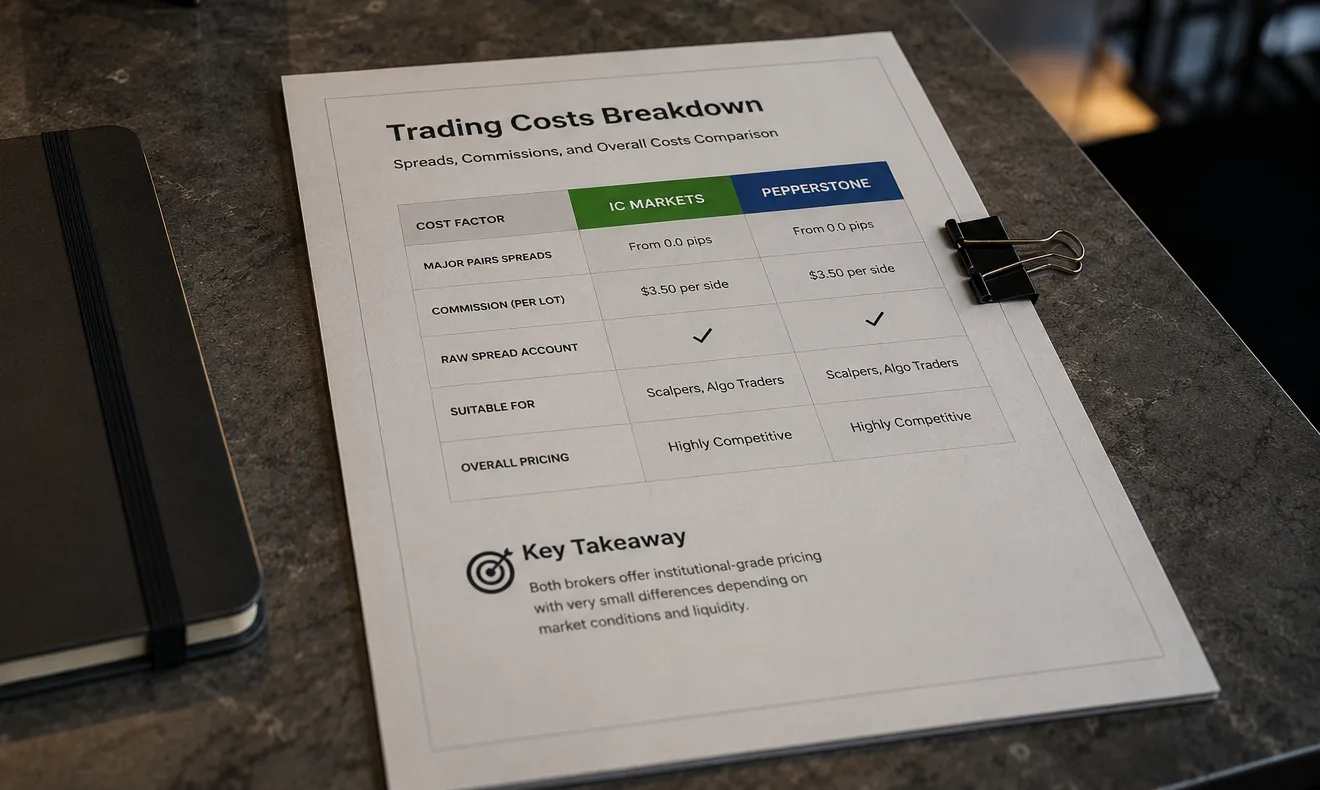
For active traders, trading costs are among the largest considerations in their decision-making, which directly relates to Spread vs Commission: Which Costs Less. Both brokers have very competitive pricing structures - especially when you look at their raw spread accounts.
Spreads on major currency pairs at IC Markets start from close to 0 with a commission applied to each lot traded, making this attractive to scalpers and algorithmic traders who require very tight spreads.
Pepperstone takes a similar approach to pricing with its Razor account, which offers tight spreads and commission-based pricing.
While pricing differences between these two brokers are often very small, there can be minor differences due to market conditions and available liquidity.
Key Comparison Table
Feature | IC Markets | Pepperstone |
Founded | 2007 | 2010 |
Headquarters | Australia | Australia |
Regulation | ASIC and international entities | ASIC, FCA, and other regulators |
Platforms | MT4, MT5, cTrader | MT4, MT5, cTrader, TradingView |
Minimum Deposit | Typically around $200 | Typically around $200 |
Spreads | Raw spreads from ~0.0 pips | Razor spreads from ~0.0 pips |
Execution Speed | Very fast low-latency execution | Fast execution with strong infrastructure |
Trading Style Support | Scalping, EA trading | Scalping, EA trading |
Available Markets and Instruments
Another key element when selecting a broker is the markets they offer to trade on.
At IC Markets, there are numerous available instruments for the trader:
• FX currency pairs
• Indices
• Commodities
• Cryptocurrencies
• Bonds
• CFDs on Stocks
Likewise, Pepperstone offers a wide range of trading instruments. Traders can trade forex, indices, commodities, shares, and cryptocurrencies using CFDs.
When it comes to product variety, these brokers have considerable overlap, as both cover most major global markets. However, some differences exist: depending on the trader's geographical region, Pepperstone may offer a broader selection of stock CFDs.
Generally speaking, the difference in the number of instruments available to traders across brokers is typically small.
Execution Quality and Liquidity
For traders who depend on speed and accuracy to enter, such as scalpers and high-frequency traders, quality execution is critical, which is why many compare the Best Brokers for Scalping Strategies. Markets has established itself as the 'go to' from a liquidity perspective by connecting retail traders to deep pools of liquidity via multiple institutional providers, thereby reducing slippage and enabling execution for large volumes of orders with contrasting sizes.
Pepperstone also prides itself on respect for execution technology. They utilise low-latency trading infrastructure to enable fast order entry and reduce fill time.
Both Brokers offer market execution without dealing desk intervention. Thus, trades are executed directly with liquidity providers rather than handled manually by the Broker's team.
For most retail traders, either broker can provide high-quality execution and an overall professional trading environment.
Related Articles: Spread vs Commission: Which Costs Less?
Trading Conditions and Account Types
The two main account types at IC Markets are:
• Standard account (with a spread-based pricing model)
• Raw spread account (with commissions).
Similarly, Pepperstone has two main account types:
• Standard account
• Razor account (with raw spreads and commissions).
Both brokers support a variety of trading strategies, including scalping, hedging, and automated trading.
The amount of leverage available depends on the trader’s country of residence and the applicable regulations. Leverage is generally limited in countries with strict regulations; however, higher leverage options may be available for offshore entities.
Related Articles: What Is an ECN Broker?
Education, Customer Support, and Tool
Pepperstone places a greater focus on trading tools and educational resources. They offer webinars, market analysis, and resources to help traders improve their trading strategies.
While IC Markets offers educational material as well, its primary focus over the years has been on providing trading infrastructure and execution.
Customers of both brokers can find customer support via email, live chat, or phone, with response times being generally fast at both companies. Additionally, both brokers offer multilingual support for their respective customers.
Summary of IC Markets vs. Pepperstone
IC Markets and Pepperstone are both considered to be among the top brokers in the global forex and CFD industry, a comparison often featured in Wikilix Broker Analysis. They are both well respected and offer their traders highly competitive spreads, powerful trading platforms, and a dependable execution environment that appeals to both beginner and advanced traders.
IC Markets would be attractive to traders who care about ultra-tight spreads and abundant liquidity; the platform's infrastructure is designed for algorithmic traders and scalpers.
Pepperstone is more attractive to customers who are concerned with greater regulatory coverage, more platform choices, and better educational resources.
Ultimately, the final decision regarding which broker is more comparable will be based on each trader’s priorities; traders looking for raw pricing and the fastest execution will likely prefer IC Markets, while traders who want more flexibility in their trading platform and better research tools will prefer Pepperstone.
Both brokers can provide their traders with high-quality trading environments when seeking a trustworthy and reliable partner in the forex and CFD markets.