

Entering online trading starts with a crucial decision: choosing your trading platform or brokerage. Among many choices, two platforms stand out: MT4 and MT5, both widely recognized as the standard for forex and CFD trading.
Initially, you will notice that both platforms look similar. Both share the same parent company, MetaQuotes, and offer advanced charting capabilities for precise market analysis and trading. However, after using each platform for a while, you will notice clear differences.
Some traders prefer MT4 for its long history, forex focus, and straightforward functionality. MT5, on the other hand, appeals to those needing access to more markets, newer technology, and additional analytics and order types.
Which platform suits you best? It depends on your trading style, preferred markets, and necessary tools. This guide outlines the differences between MT4 and MT5 to help you decide for 2026.
What is MetaTrader 4?
MetaTrader 4 (MT4) was first released in 2005 and has become the most popular forex trading platform. It was designed for forex trading and gained popularity due to its stability, user-friendly interface, and advanced technical analysis features. MT4's automated trading systems (Expert Advisors, or EAs) allow traders to create algorithms that execute trades and analyze markets based on predefined rules.
MT4 also thrived due to the vast library of user-created indicators and automated strategies.
Brokers are still supporting MT4 today because of the sheer number of users who continue to use it.
Related Articles: Best Brokers for Algorithmic Trading
What is MetaTrader 5?
MetaTrader 5 (MT5) was released in 2010 as the successor to MetaTrader 4 (MT4). While MT4 focused largely on forex, MT5 was created to enable trading beyond currencies, including stocks, futures, commodities, options, and indices. MT5 offers several upgrades: more time periods, additional order types, and faster data processing. It also features an economic calendar and better market depth information than MT4.
MT5 uses the updated MQL5 programming language, which is more flexible and powerful for developing automated trading systems.
With these new features, many brokers are now using MT5 as their primary trading platform.
Key Differences Between MT4 and MT5
Despite their visual similarities, there are many substantial distinctions between the two platforms.
Access to Markets
While MT4 was developed primarily for currency trading, MT5 supports many more market types — meaning a trader can be exposed to more asset classes via the brokers they select when working with MT5.
The Number and Type of Orders Available
The number of order types available to trade on the MT5 platform is much greater than those available on the MT4 platform. Therefore, the opportunity for traders to determine how they want to manage their positions via order types is expanded on MT5.
Number of Timeframes and Indicators
MT5 offers many additional timeframes and built-in indicators, providing more opportunities for traders who base their technical analysis on charting tools.
Language of Programming
The MQL4 programming language is used on the MT4 platform, whereas MQL5 is used on the MT5 platform. With a more contemporary programming language, traders can back-test their systems faster and create more complex algorithmic trading systems.
Speed and Performance
MT5 has been designed with a multi-threaded architecture to achieve faster processing and greater platform performance.
Related Articles: Can You Use EAs in Prop Firms?
MT4 vs MT5 Comparison Table
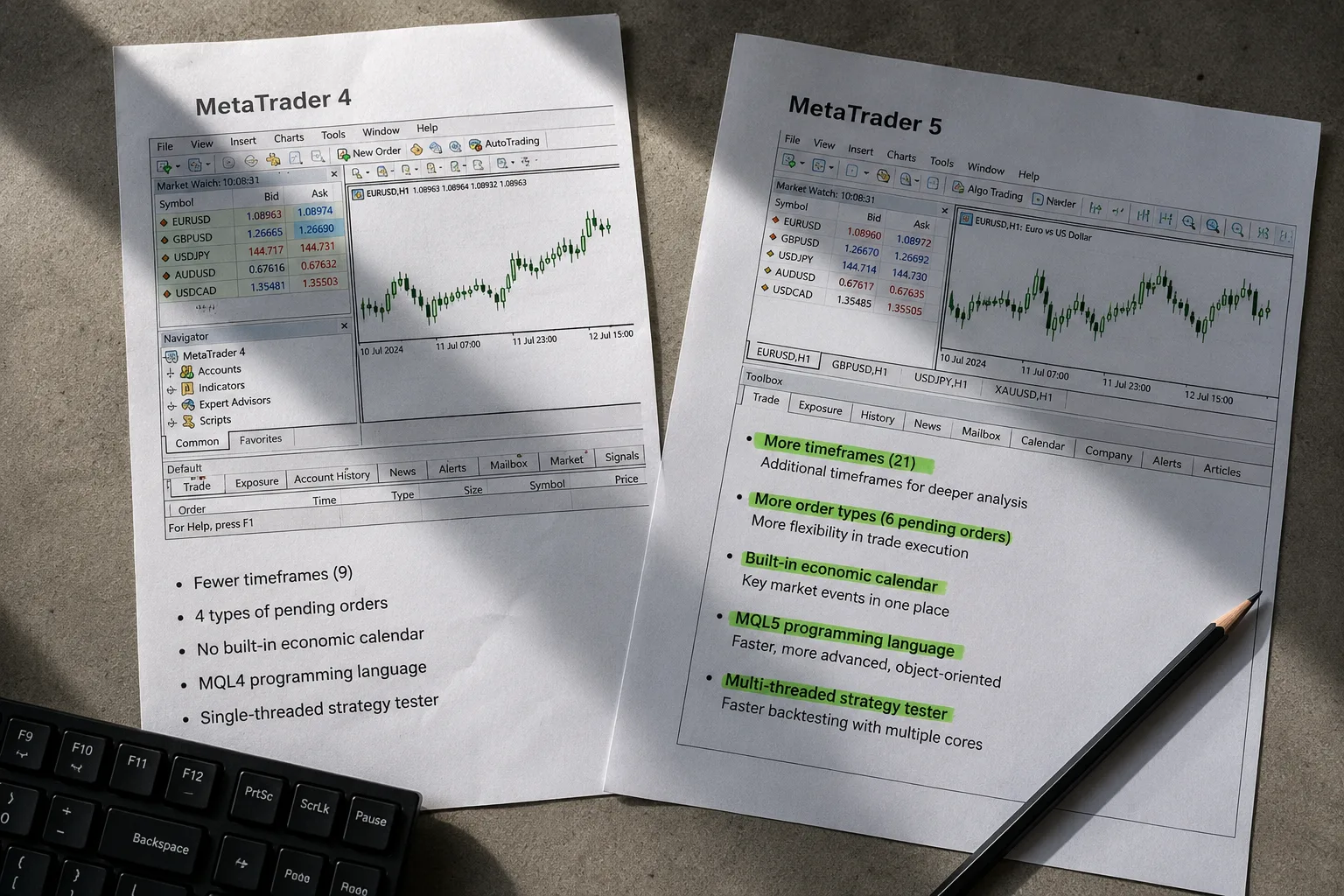
The following table highlights some of the key differences between the two platforms.
Feature | MetaTrader 4 (MT4) | MetaTrader 5 (MT5) |
Release Year | 2005 | 2010 |
Primary Focus | Forex trading | Multi-asset trading |
Programming Language | MQL4 | MQL5 |
Timeframes | 9 | 21 |
Order Types | 4 pending orders | 6 pending orders |
Market Depth | Not available | Available |
Economic Calendar | No | Yes |
Performance | Single-thread | Multi-thread |
This comparison shows that while MT4 remains highly capable, MT5 introduces several technological improvements.
MT4's Advantageous Quality
MT4 continues to be highly regarded among many traders, even with so many modern-day platforms available, due to its ease of use. The basis of this popularity is that the platform is very user-friendly and includes all the tools you need for successful forex trading.
Another great aspect of MT4 is the nearly infinite choice of indicators and automated trading strategies that have developed over time. Many professional traders use EAs (Expert Advisors) created specifically for the MT4 platform. and has a long track record of reliability; therefore, many traders are familiar with how the system works and the platform's layout.
If a trader's primary focus is forex trading and they do not require any additional, sophisticated, multi-asset trading capabilities, MT4 meets their needs extremely well.
MT5's Advantageous Qualities
MT5 has made great strides in its offerings, compared to the older MT4 trading platform, making it very desirable for the new-age trader, with its multi-asset capability being the most significant. Traders can now trade from a variety of markets, not just forex.
MT5 also offers some incredible charting capabilities that enable traders to conduct more in-depth analysis than ever before. MT5's added benefit of offering all these time frame options provides even more ways to analyze the technical aspects of trading.
Another benefit of MT5 is the numerous upgrades to the platform's "back end," which will, in turn, significantly increase backtest speed and improve trade execution speed.
For those traders (algorithmic traders) who depend significantly on algorithms to trade and want to access more than one asset class, they will find that MT5 offers significant advantages over trading on MT4.
Related Articles: What Is an ECN Broker?
Which Platform Is Better for Different Types of Traders?
Choosing between the MT4 and MT5 platforms is largely based on a trader's strategy.
Forex Trader Preference
Forex traders are generally more likely to use the MT4 platform due to its ease of use and a wider range of trading tools.
Algorithmic Trader Preference
Algorithmic traders typically use the MT5 platform because the MQL5 programming language enables greater sophistication in their automated systems.
Multi-Asset Trader Preference
Traders who elect to trade various asset classes, such as commodities or stocks, will often prefer the broader access to market participants on the MT5 platform.
Newbie Trader Preference
Many beginner traders will opt for the MT4 platform because it is easier for them to learn and because broker support is so prevalent.
The Future of MT4 and MT5
You may find that, while MT4 has been used for many years, we are now seeing a shift towards MT5 in today's market. Many of the brokers that work with retail forex traders are encouraging their new clients to use MT5 or considering offering it to their existing client base because it is a newer technology with advanced features, functions, and capabilities.
Although MT4 and MT5 are both currently operational, I would not expect MT4 to go away for a while, as there are still many active MT4 users and many retail brokers continue to provide services based on MT4.
In the coming years, it is expected that both MT4 and MT5 will coexist, and that traders will use the platform that best fits their trading style, strategy, and asset type.
Related Articles: Broker Execution Models Compared
Final words
There is no one platform that will be the best choice for all forex traders when comparing MT4 and MT5. There are aspects to both platforms that allow for different trader styles (both platforms are designed to work with different trader styles), which allows traders to use one or the other depending on their individual needs.
MT4 is a solid platform that can provide many forex traders with an excellent experience, especially for those who prefer simplicity and have a large selection of trading tools. MT5 offers a newer, more technically advanced platform than MT4, with faster speeds and the ability to trade multiple instrument types, which is why many traders turn to The Broker Authority when comparing platform performance across brokers.
The right platform for any trader will differ based on that trader's trading plan, technical needs, and the instruments they plan to use for their trades. A trader who carefully evaluates their trading style and tests the different platforms to see which one works best for them will have the best chance of finding the platform that will fit their long-term trading objectives.