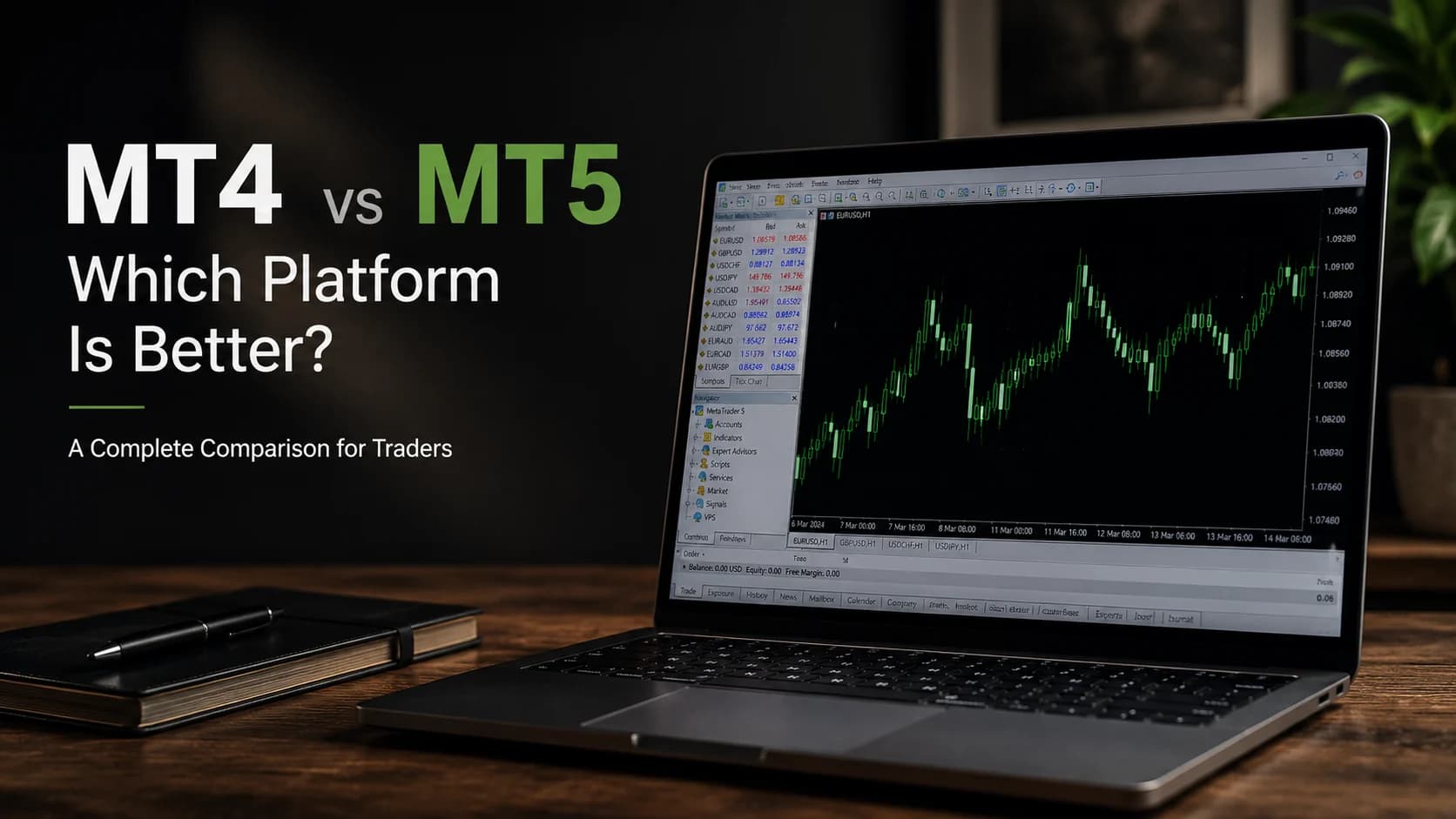


Automated trading has recently revolutionized the way many traders operate and engage with global financial markets. Rather than investing hours a day analysing charts, many traders now program their own algorithms to execute trades automatically based on market conditions. These technologies have become mainstream in the forex industry and are commonly referred to as Expert Advisors (or EAs). Most EAs are purchased on either MetaTrader 4, MetaTrader 5, or other automated trading platforms.
At the same time, proprietary trading firms that provide traders with relatively easy access to their funding (generally large amounts) while keeping the majority of their capital exposed have grown increasingly popular with traders looking to trade. These firms allow traders to trade a funded trader account after they have successfully completed an evaluation or challenge period.
As automated trading systems have attracted many traders to the proprietary trading environment, several factors determine whether each firm will permit their use, which is often part of the broader discussion around Are Prop Firms Worth It in 2026.
While some prop firms broadly support automated trading systems, others enforce restrictions on certain strategies. Thus, before using EAs with a funded trader account, traders must fully understand each firm's rules regarding automated trading systems, as outlined in Prop Firm Rules Explained: What You Must Know.
The following guide addresses critical questions about EAs and their use at prop firms. The guide will explain the operation of Expert Advisors within the proprietary trading environment and outline the rules and policies that traders must understand before using an automated trading system.
What is An Expert Advisor (or EA)?
An Expert Advisor (or EA) is a data-oriented software tool used to automate the decision-making process for executing trades. Typically, EAs are used with trading platforms such as MetaTrader 4 or MetaTrader 5 to execute trades according to predefined algorithms.
Rather than manually entering or exiting trades, once the trader programs an EA with specific conditions, the EA will continue analysing the market until those conditions are met.
Most traders who use EAs do so primarily for rapid order execution or continual monitoring of multiple markets for potential trades. Automated trading systems can quickly scan multiple currency pairs and analyze technical indicators. The increased speed with which an EA executes trades significantly impacts a trader’s ability to compete in global financial markets.
Will Proprietary Trading Firms Allow Automated Trading?
Most proprietary trading firms allow Expert Advisors, but require traders to meet certain conditions.
Some prop firms welcome the utilisation of automated trading as it provides a basis for establishing a systematic approach to logic and a level of discipline in executing a trading strategy. There are, however, a number of prop firms that place restrictions on the types of trading strategies (i.e., automated trading strategies) that may be used due to the inherent technical and operational risks associated with those strategies.
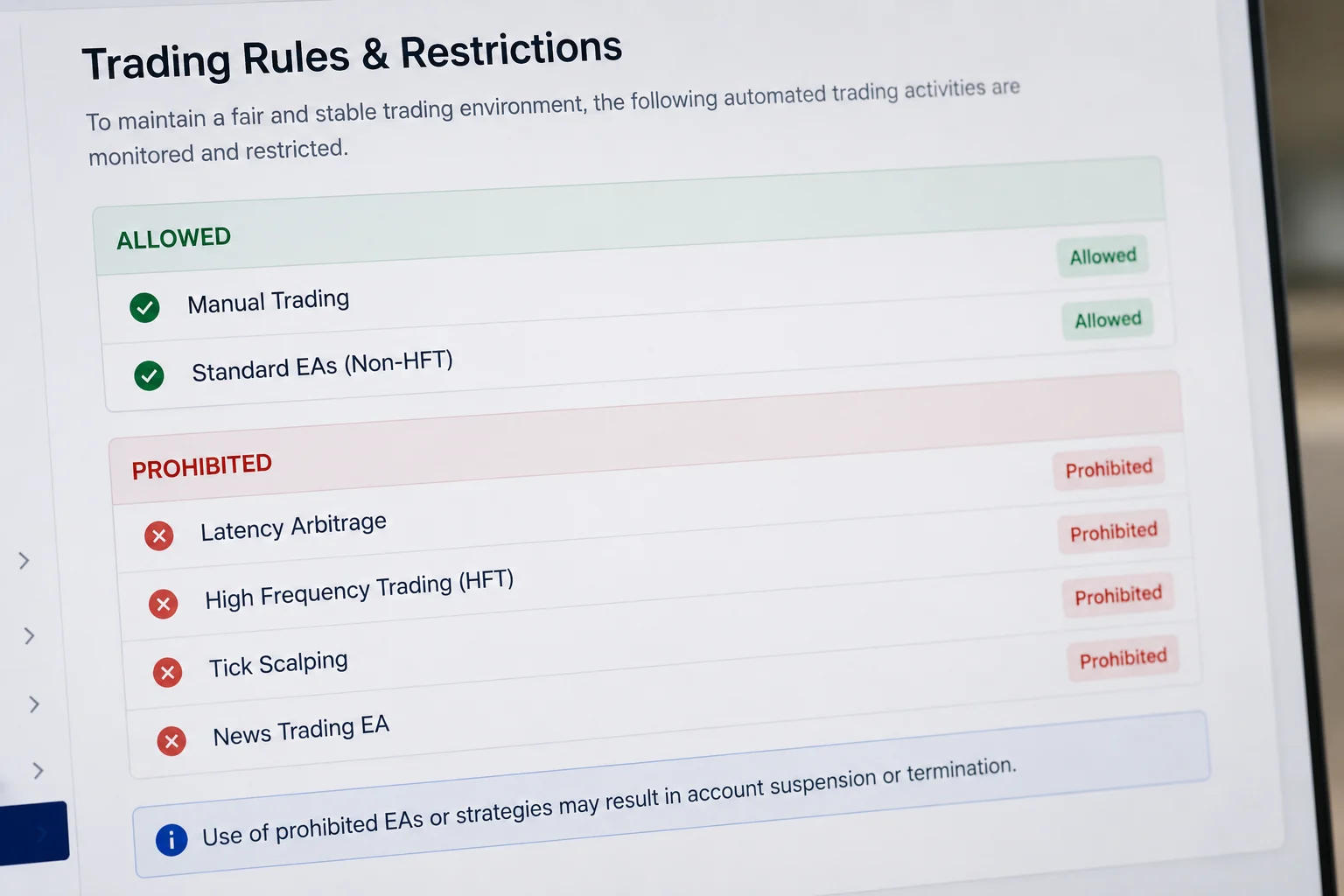
For example, some automated systems exploit price slippage and the time delay between a broker's execution and a trader's execution. The use of such trading strategies is typically prohibited by the more respected firms in the industry.
Traders who want to use EAs at California Prop Firm must review each firm’s rules before trading a funded account and ensure they understand key concerns such as Are Prop Firms Legit? Red Flags to Watch.
Related Articles: Are Prop Firms Worth It in 2026?
Common EA Policies in Prop Firms
Different prop firms apply different rules regarding automated trading, which highlights the importance of knowing How to Choose the Right Prop Firm for Your Style. The table below summarizes common policy types traders may encounter.
Policy Type | Description | Typical Rule |
Fully Allowed | EAs permitted without major restrictions | Strategy must respect risk limits |
Allowed with Conditions | Automation permitted but certain techniques banned | No latency arbitrage or system abuse |
Limited Use | Some EAs allowed but high-frequency trading restricted | Minimum holding times may apply |
Prohibited | Automated trading not allowed | Manual trading only |
Understanding these policies helps traders avoid violations that could result in disqualification from a prop firm program.
Why Prop Firms Restrict Certain EAs
There are valid reasons why firms prohibit automated trading at proprietary trading companies. Many restrictions placed on automated trading are related to risk management and operational stability. One of the main concerns regarding automated trading is latency arbitrage: a strategy that exploits small time gaps between price updates. Although exploiting such an opportunity is technically possible, it could disrupt liquidity and give traders an unfair advantage.
Another risk of automated trading is high-frequency trading (HFT). Numerous automated algorithms can execute thousands of trades in a matter of seconds. These algorithms place significant strain on the trading environment's infrastructure. Additionally, prop firms seek traders who develop sustainable trading strategies rather than those who exploit technical loopholes.
For all these reasons, prop firms are usually amenable to algorithmic trading but often impose restrictions on strategies that exploit inefficiencies within the trading platform.
Advantages of EAs in Prop Firms
When used responsibly, EAs offer numerous benefits to traders engaged in prop trading. One benefit that EAs offer is discipline. Automated systems adhere to predefined rules and remove emotion from the decision-making process, thereby enhancing consistency.
Another advantage of using EA technology is speed. Trading can move rapidly, especially during volatile periods. When conditions are fulfilled, EAs can execute trades instantly.
Another advantage of automation is the ability to monitor numerous global markets simultaneously, which can be advantageous for a trader utilising a strategy that requires scanning many currency pairs.
Lastly, EAs can trade 24/7. Consequently, there is no need for a trader to remain glued to the charts for extended periods of time, and the algorithm completes that task.
Risks Associated with Automated Trading in Prop Firms
While there are certain advantages to EAs, there are also potential risks that all traders need to be aware of when using automated trading strategies in prop firms. One significant risk of using EAs is that the strategy could fail. As markets change, a strategy may perform exceptionally well at one point in time and then cease to perform adequately later.
Another risk associated with using EAs is that they may contain programming errors or fail to properly interface with the trading platform, resulting in the execution of unintended trades. In a prop trading environment, this is especially important because violating a firm’s drawdown limits could result in termination of the trading account, as discussed in Daily Drawdown vs Maximum Drawdown Explained.
Additionally, an EA that trades too frequently may violate the firm’s rules on positioning limits or risk limits. Therefore, due to these factors, all automated trading strategies should be thoroughly tested prior to being used on a funded account.
Proprietary trading firms (prop firms) will increase their chances for success and profitability by adhering to the following four best practices:
1) Always look at the prop firm's terms and conditions prior to using an EA. Prop firms all have different policies around the use of automated systems, so it is crucial to be well-informed to avoid wasting time and effort searching for or testing an EA.
2) Complete thorough back-testing and forward-testing of the EA utilizing both historical data and a demo environment. Using both methods for testing will provide you with the data needed to identify any weaknesses, or "bugs," within the EA.
3) Monitor your EA while it trades, even if it seems fully automated. Regular checks ensure it runs correctly.
4) Set risk management rules in your EA, such as position size, trade limits, and stop-loss levels.
By following the four suggested guidelines, traders can use EAs responsibly within the framework of the prop firm programs.
The Future of Algorithmic Trading in Prop Firms
The role of algorithmic trading within prop trading will continue to increase. As financial markets become increasingly technologically oriented, many of today's trading strategies rely on advanced algorithms and large volumes of data.
As prop firms continue to grow, we may soon see them offer specialized environments for algorithmic traders. A few examples of these specialized environments may include providing a more efficient execution infrastructure, improved data feed services, and enhanced performance analytics.
Although firms will generally be willing to develop new and innovative algorithmic trading strategies, they will still impose limits on strategies that attempt to exploit shortcomings in technology-based trading systems.
The blending of new idea generation with fairness to all market participants will be key to how automated trading evolves in prop firms going forward.
Conclusion
WhEA use in prop firms depends primarily on each firm's policies. Although many prop firms allow automated trading and support traders using algorithmic strategies, they may limit or prohibit certain types of trades (e.g., latency arbitrage and high-frequency trading).
Success with EAs depends on thorough testing and robust risk management to guard against failures and rule violations.
Traders looking to successfully integrate EAs into their prop trading methodologies must familiarize themselves with their prop firm's policies, thoroughly test their fully automated systems, and develop a solid trading plan prior to executing each trading opportunity presented to them, as often highlighted in Wikilix Broker Reviews.
As technology advances, automated trading systems will offer valuable resources for prop traders.