
If you are new to the forex trade, then you will no doubt have heard the term “pip” before. At first glance, the pip seems like a minor detail; however, knowing what it is can significantly alter your perspective on the Forex market. For instance, every single trade, loss, and profit in forex trading is measured in pips.
When you observe a currency pair on the chart, and it appears as if it’s moving in one direction or another, the actual movement in price has occurred in a number of pips. Therefore, all Forex traders use pips to determine how the market has moved and how much money has been made or lost with each trade.
Therefore, an essential part of learning about pips for new traders is how trades are calculated, how to manage risk, and how to assess market trends. Once you understand the concept of pips, then many other aspects of trading, such as determining spreads, finding levels of stop-losses, calculating profit targets, etc., will be far easier.
In this guide, you’ll learn what a pip is in forex, how the pip works, how to determine the pip value of various currency pairs, and why pips are vital to every trading decision made.
What’s a pip in Forex?
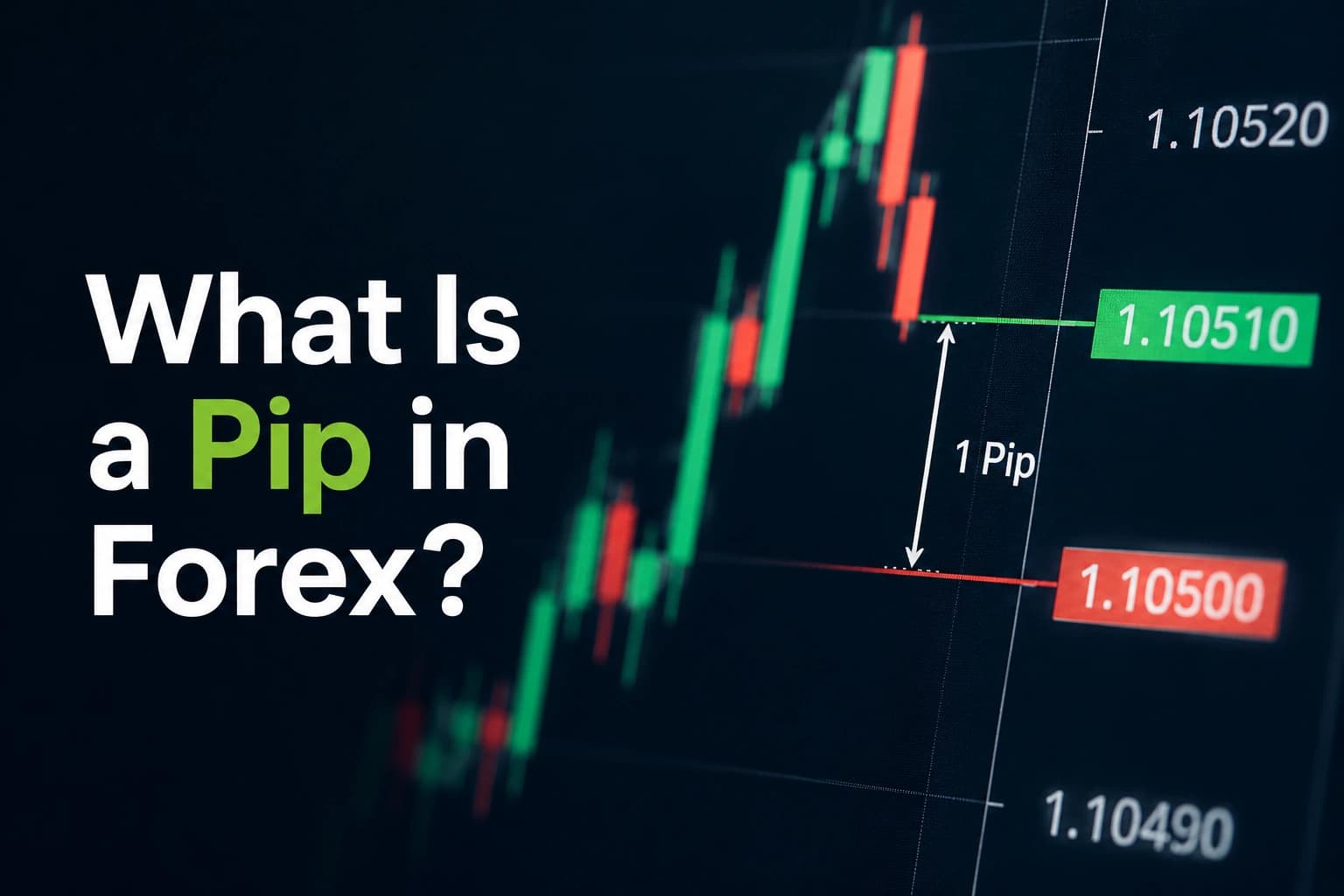
A pip means either a percentage in points or a price interest point; it refers to the smallest standardized price change for most currency pairs. In the forex market, most currency pairs are quoted to four decimal places. Therefore, a pip is typically a change in the last (fourth) decimal place. For example:
EUR/USD = 1.1050
If the new price is,
EUR/USD = 1.1051
Then the price difference is one pip.
This tiny measurement allows traders to precisely gauge how prices have changed. So instead of telling a trader the price changed from 1.1050 to 1.1060, the trader would say that the price changed by 10 pips.
Why Pips Matter in Forex Trading
Pips are important because they serve as a standard unit for traders to track price changes in the forex market.
Pips affect all trading decisions made by traders. For example, if a trader is looking to place a stop-loss or take profit, they will generally predefine the distance in pips between the current price and the stop-loss/take-profit.
This could be set at:
Stop-loss: 30 pips
Take-profit: 60 pips
This means a trader is willing to risk $30 in price movement to potentially gain $60, while relying on safeguards such as Negative Balance Protection Explained.
Not only do Pips provide a common currency standard for traders to communicate about trades, but they also help them understand the volatility of currency pairs. Volatility can vary greatly between currency pairs, with some, like GBP/JPY, showing 20 pips of movement per day, while others, like AUD/USD, may show over 100 pips of movement per day.
By understanding pip movement, traders can better manage their individual risk levels and calculate investment returns with greater accuracy.
Sample of pip movement
As a simple example, using EUR/USD.
If you buy EUR/USD at 1.1000 and then the price moves to 1.1015, there is a 15-pip difference between the two prices.
If the price then moves even further to 1.1030, there will be a total of 30 pips of movement from the entry to the price.
Traders use pip movement to measure the performance of their trades.
What is a pipette?
On today’s trading platforms, most brokers quote prices with 4 digits instead of 5. The 5th digit is called the pipette.
For example, EUR/USD is equal to 1.10505, where the 4th digit represents the pip and the 5th digit represents the pipette. A pipette = 1/10 of a pip, allowing traders to accurately price the currency being traded.
Pip Values and Trade Size
The value of a pip depends on the size of the trading position, also known as the lot size.
Forex trading typically uses three main lot sizes:
· Standard lot
· Mini lot
· Micro lot
The pip value changes depending on the lot size being traded.
Example Pip Values
Lot Size | Units of Currency | Approximate Value of 1 Pip |
Standard Lot | 100,000 units | $10 |
Mini Lot | 10,000 units | $1 |
Micro Lot | 1,000 units | $0.10 |
For example, if you trade one standard lot of EUR/USD and the market moves 10 pips in your favor, your profit would be approximately $100.
Understanding pip value is essential for managing risk and determining the correct position size.
How to Calculate Pip Value
The value of a pip varies depending on the currency you're trading.
When trading currency pairs that quote the US Dollar (for example, EUR/USD or GBP/USD), calculating pip value is simple.
Pip Value = (Pip Size ÷ Exchange Rate) × Lot Size.
However, most online trading platforms automatically calculate pip values for their users.
Most people who trade primarily need to know how pip movement affects their trades.
Currency Pair Pip Calculation Variances
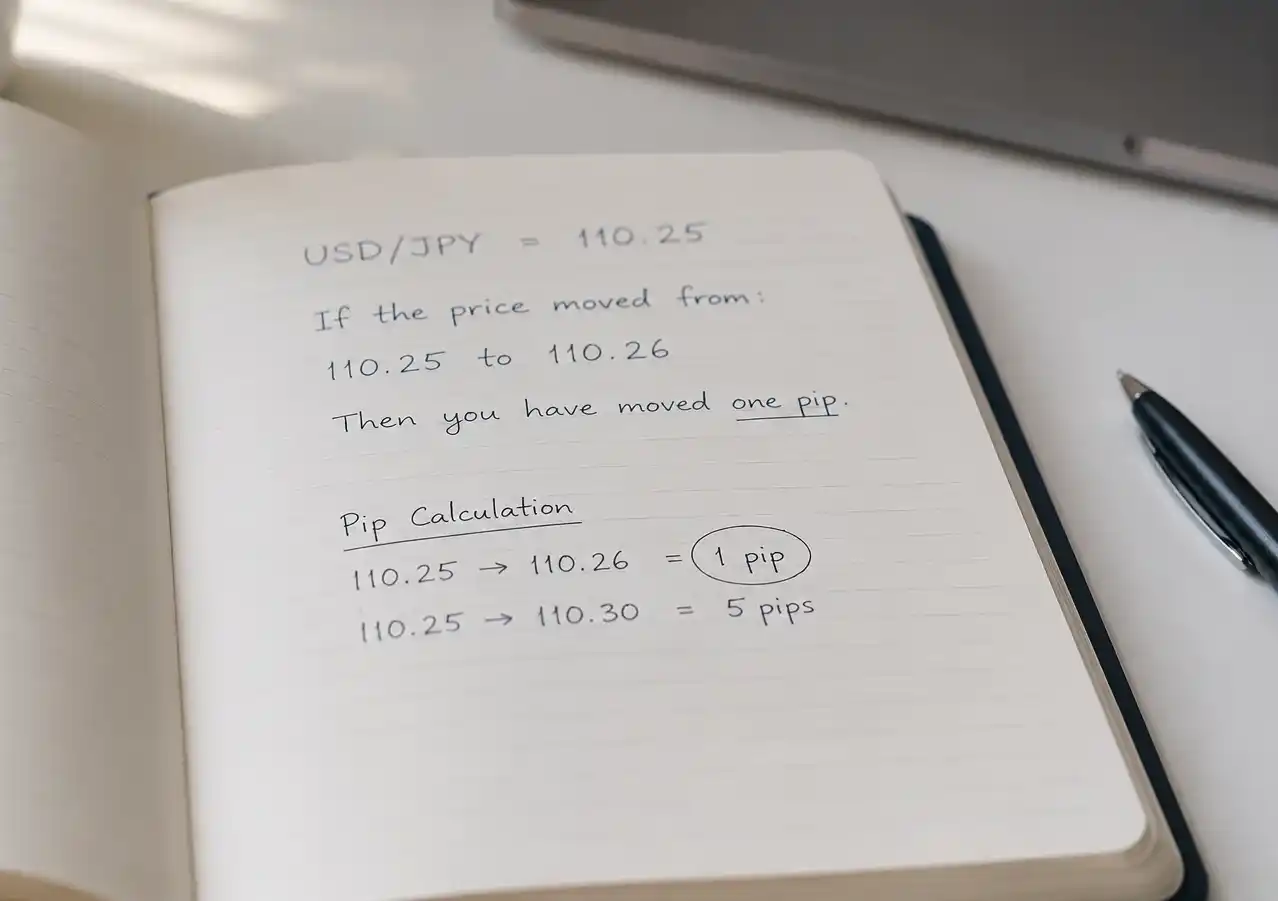
Some Currency Pairs use different pip measurements or conventions. For example, when trading Currency Pairs that include the Japanese Yen, you typically see two digits after the decimal, rather than four, which is how you normally calculate pips.
Example USD/JPY = 110.25
If the price moved from:
110.25 to 110.26,
Then you have moved one pip.
Pip Value & Spread Relationship
The Bid-Ask difference is called the ‘spread.’
In Forex Trading, the difference in bid and ask is also measured in pips.
Example:
Bid: 1.1050
Ask: 1.1052
The spread is 2 pips.
The spread is the cost to enter a trade. A smaller spread is less costly to execute a trade, which becomes clearer when comparing Spread vs Commission: Which Costs Less?
Knowing how to calculate the pip spread enables a trader to assess trading cost-effectiveness by comparing brokers.
Using Pips in Risk Management
Risk management is perhaps the primary use of pips in financial markets today. Potential profits and losses can be calculated using pips, defined as units that represent price movements: for example, a trader may set their acceptable risk to 20 pips before entering the market; once an entry has been identified, their stop-loss will be placed 20 pips away from that entry.
By setting a limit on the number of pips they are willing to risk, traders can better manage their overall potential losses and avoid situations such as What Is Margin Call in Forex.
Many professional traders also use percentages of their overall account balance to determine their per-trade risk; however, the vast majority of traders do not do so when trading forex.
Common Mistakes by New Traders When Using Pips
Many novice traders misunderstand pip values and make serious mistakes as a result.
For instance, simply ignoring how much the lot size impacts the total account equity on each trade can be a big mistake; you can make large changes to your finances based on a small number of pips when you have a large position.
The other common error is setting their stop-loss only a few pips away from their entry point. Markets are naturally volatile, and when you set your stop loss so close to your entry point, it will be triggered frequently.
Another problem is that some novice traders focus solely on target pips rather than managing their overall risk.
To trade responsibly, traders need to understand how pip value and position size relate to volatility.
Tips for Understanding Pips
The best way for new traders to learn about pips is to get some real experience.
Using a demo account will give traders an opportunity to watch price movements in real time and see how pip movements affect profit and loss. Starting with smaller lot sizes is also a way for new traders to learn to trade without taking huge risks with their accounts.
Over time, many traders naturally develop a habit of thinking in terms of pips instead of just looking at the raw price.
Conclusion
Every trader (new or experienced) must learn about the pip in the forex market. Pips are the unit used to measure price changes in the forex market, so they have a significant impact on how traders calculate their returns, losses, and transaction costs.
As a novice trader, understanding how to use pips properly is one of the most important concepts you should learn immediately, as pips are fundamental across all trading activities, from establishing stop-loss orders to calculating broker spreads to evaluating trading strategies to managing risk, which is why many traders rely on Wikilix Broker Analysis to better understand trading conditions.
A comprehensive understanding of pips enables traders to interpret charts more accurately and enhance strategic trade planning.
Just as with many other components of trading, learning to use this concept requires time and effort to become proficient with pips, but a solid understanding of how pip values work will help new traders establish a firmer foundation for trading confidently in the foreign exchange market.