

The online trading industry has drastically changed since its inception. Today, a trader has many opportunities to access the financial markets, primarily through a retail broker or a proprietary trading firm (also known as a “prop” firm). At first glance, both options will look very similar to a trader, as they use a trading platform to send and receive orders, conduct technical or fundamental market analysis, and aim to generate profits. However, these two business models have distinctly different business structures.
A retail broker offers a trader the ability to trade using the trader’s own rollover funds or directly deposited funds provided by the trader; on the other hand, a proprietary trading firm offers the trader a chance to do the same trade as before, but with larger amounts of money using the company's funds at each trading firm. Because of this difference, retail brokers and proprietary trading firms use different methods of:
• Managing risk associated with trading
• Distributing profits among traders
• Providing trading freedom to traders
• Providing career opportunities for their traders in the long term
Understanding the differences between prop firms and retail brokers is vital for traders selecting the business model that best fits their trading style and financial goals. This article will provide a detailed explanation of how each model works and, within those explanations, the most important differences each trader should know.
What Is a Retail Broker?
A retail broker is a financial intermediary that allows individuals to access the financial markets, such as Forex, stocks, commodities, and indices, which is why many traders compare options like the Best ECN Brokers in 2026. In this model, traders first open an account with their selected retail broker and deposit their own funds, which serve as a backer, providing the trader with the necessary infrastructure to trade, including trading platforms, clearing and execution services, and liquidity providers.
Retail brokers generally earn revenue through:
• Commissions and/or spreads on trades.
• Swap fees on trades where the trade is open over midnight.
• Various other trading services.
Traders are entitled to 100% of the profits generated by trading; when trading an account with a retail broker, they also sustain 100% of the losses. Retail brokerage trading is typically the first type of trading a beginner does before becoming a more experienced trader, either with a proprietary trading firm or their own capital.
What Is a Prop Trading Firm
Proprietary trading firms operate under a different structure than the retail brokerage model, which is why understanding How Prop Firms Make Money is essential. Unlike retail brokers, which require large capital commitments from traders to open an account, proprietary trading firms allow traders to demonstrate their ability to trade (risk management and discipline) by entering the firm’s testing program.
If the trader successfully completes the firm’s testing program, they will be provided access to the firm’s capital through a funded trading account. The key difference between the two models is that, with the retail broker model, a trader keeps 100% of their trading profits from their own capital, whereas with a prop trading firm, a trader shares the profits they generate with the firm. Most prop trading firms will provide their traders with 70% to 90% of their trading profits.
This type of trading model provides a trader with access to capital they would not be able to obtain if they traded independently. However, prop trading firms also enforce strict risk management practices that traders must adhere to in exchange for the opportunity to manage the prop trading account.
Core Differences Between Prop Firms and Retail Brokers
Although both models involve trading financial markets, their structure and objectives are very different.
Feature | Prop Trading Firm | Retail Broker |
Trading Capital | Firm provides capital | Trader uses personal funds |
Profit Distribution | Profit split (70–90% trader share) | Trader keeps 100% |
Risk Exposure | Limited by firm rules | Trader bears full risk |
Entry Requirement | Must pass evaluation | Simple account registration |
Risk Management Rules | Strict daily loss and drawdown limits | Flexible risk management |
Capital Growth | Scaling plans possible | Depends on trader deposits |
This table highlights one of the biggest contrasts: prop firms emphasize risk control, while retail brokers emphasize market access.
Related Articles: Spread vs Commission: Which Costs Less?
Capital Access and Trading Opportunities
The main reason traders look to prop firms is the greater capital they can access. Retail Accounts often start with smaller amounts (hundreds or thousands of dollars). The amount of capital limits how much profit is made from successful trading strategies.
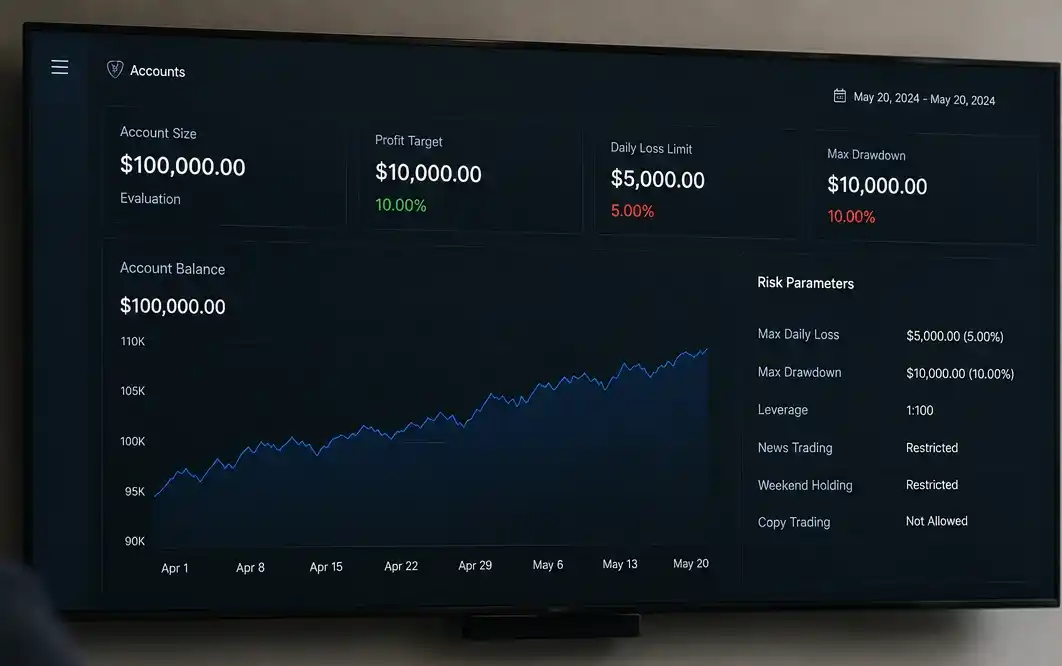
Prop firms allow traders to manage accounts with $100,000 or more, greatly expanding the potential income for skilled traders. This can be amplified significantly compared to what they would have if they only had their own small account. However, with this opportunity for higher income comes strict limits on how much risk they can take. Traders cannot take excessive risks to maximize their profits, as breaking the drawdown rules may result in their account being terminated.
Risk Management and Trading Limitations
Retail brokers give traders complete autonomy in controlling their risk. Traders can choose their own position size, leverage, and strategy.
On the other hand, prop firms have in place rules designed to protect the firm's capital.
For example, prop firms commonly set rules such as: a) Limit on the amount of loss per day b) Overall maximum drawdown limit c) Limits on the amount of position size d) Limitations on the strategies traders can use
These rules force the traders to demonstrate disciplined trading. Many traders see these restrictions as limiting their ability to maximize profits; however, the structure helps others develop habits like those of professional traders.
Profit to the Firm and Potential Income
Distributing profits between traders differs between prop firms and retail brokers. Retail traders keep 100 percent of the profit from their trades; in doing so, they must use their own funds to generate that profit. However, prop traders share their profits in exchange for using larger amounts of capital.
For example, if a prop trader has access to a $100,000 account and earned a profit of 5 percent for the month (which would create $5,000 in profits), the firm would take its portion (for example, 80 percent) of that profit, which would leave the trader with $4,000. Therefore, to earn $250 with a $5,000 retail account, the trader would have needed to achieve the same 5 percent return on their investment. This is why experienced traders consider prop trading as a viable option.
Psychological Differences Between the Two Models
Trading For Prop Firms Is Different Than Working With National Brokerages
Traders who trade with retail brokers and those who trade at prop firms experience different types of psychological pressure in their activities, due to differences in the type of capital they have access to and the profit they generate from their trading. Retail traders experience pressure because they risk their own funds; however, prop firm traders face a different pressure: they must comply with stringent operating rules and demonstrate consistent profitability to keep their funded trading accounts. Because prop traders work in a structured environment, they often focus more on discipline and risk control. Many traders believe that conducting their trading at prop firms helps them develop a professional mindset when trading the markets.
Which Trading Option Is Better For You?
Whether prop firms or retail brokers are generally better is not easily answered and will vary based on each trader’s goals, level of experience, and risk tolerance. Retail brokers may be suitable for traders who:
• Prefer complete control over their trading decisions,
• Desire unlimited freedom to create trading strategies, and
• Are comfortable risking their own funds.
Prop firms may be more suitable for traders who:
• Desire access to significantly larger amounts of trading capital,
• Are comfortable trading under the constraints of a structured set of operating procedures and,
• Focus on maintaining disciplined risk management.
In any case, both retail and prop firms can be profitable trading models if utilized in conjunction with a compatible trading strategy and mindset.
Conclusion
The difference between prop trading firms and retail brokers goes beyond access to a trading platform; they represent two very different ways to participate in the financial markets, a distinction often highlighted in Wikilix Broker Analysis. Retail brokerages offer traders independence and flexibility, but in return require them to risk their own funds. Prop trading firms provide access to substantially larger fund allocations but impose strict risk-management rules governing their use.
Retail brokerages are typically the preferred choice for traders who value independence and flexibility when trading the financial markets. For traders who wish to scale their trading success without committing large amounts of personal capital, prop trading firms are likely a more favorable alternative. Ultimately, success with either type of trading will depend upon the same basic trading principles: discipline, risk management, and consistently profitable trading.