

Among the many advantages it offers traders, one is the ability to trade with large amounts of capital without risking their own money. Some traders begin with a funded small trading account, but as they demonstrate consistent performance, they may be able to manage much larger trading capital over time. This is where scaling plans become crucial.
Scaling plans are programs offered by proprietary trading companies that allow traders to gradually increase the capital they manage as they meet defined performance criteria. Traders generally start their careers with very little trading capital, gradually increasing their allocation as they prove they can consistently make money and manage their risks appropriately.
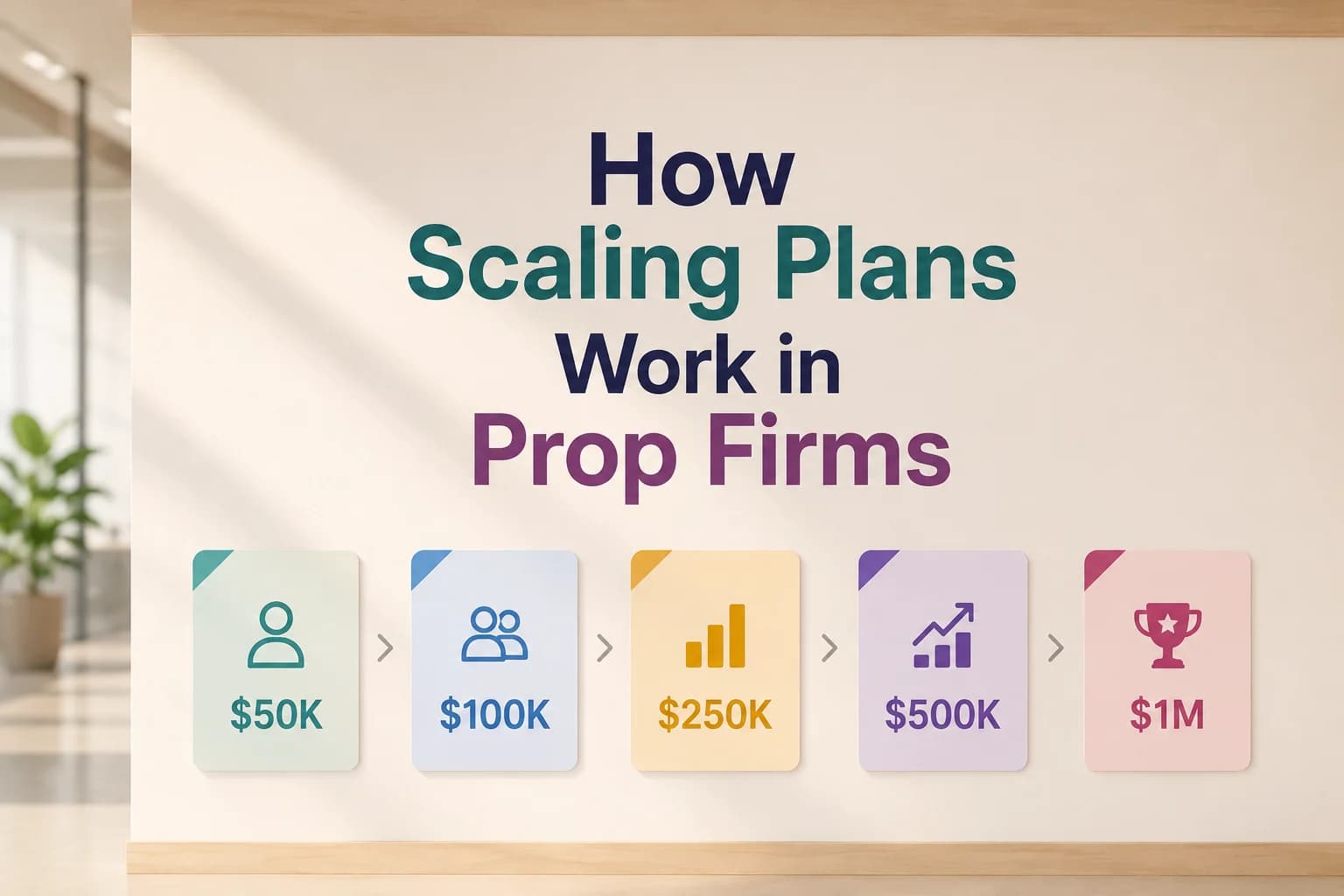
For many traders who want to build a long-term trading career, scaling plans are very attractive. A trader who starts with a $50,000 funded account may find that, through a scaling plan, he or she can eventually trade with $100,000, $500,000, or even $1,000,000 in trading capital.
Scaling plans, however, can vary widely across proprietary trading companies. Each proprietary trading company has its own set of rules for defining performance targets, payout structures, and capital-increase schedules, as outlined in Prop Firm Rules Explained: What You Must Know. Understanding how scaling plans work can help traders select the right proprietary trading company and develop a realistic growth plan.
In this article, we will explain what scaling plans are, discuss their key features, and explain how traders may benefit from them.
What is a Scaling Plan in Prop Trading?
A scaling plan is a predetermined framework that enables traders to increase the size of their funded accounts after they meet certain performance criteria.
Rather than remaining at the same funded account size for a long time, a trader who has consistently demonstrated a profit or loss will receive incremental increases in their funding until they reach the desired funding level. These incremental increases may be provided monthly, quarterly, or based on various profit criteria, while adhering to prescribed risk limits.
The main objective of a scaling plan is to reward traders who are disciplined in their risk management and consistently generate profits.
In addition, scaling programs enable proprietary trading firms to find traders who can responsibly manage large amounts of trading capital.
Why Prop Firms Offer Scaling Programs
To encourage long-term results and build lasting relationships with their successful traders, prop firms have developed scaling plans.
When a trader consistently generates profits and follows the firm’s risk rules, the prop firm benefits from the profit-sharing split between the trader and the firm, as explained in How Prop Firms Make Money. Therefore, as the trader is given a larger capital allocation, both the trader and the prop firm benefit.
Additionally, scaling programs help prop firms manage their risk by allowing new traders to prove themselves with smaller accounts before allocating them to very large accounts.
By doing so, the firm decreases its risk and provides the trader an opportunity to grow their capital over time.
How Does A Scaling Plan Work?
While scaling plans vary from company to company, the basic structure is essentially the same. A trader is funded with an initial account and must then achieve predetermined performance metrics to qualify for additional capital, which is part of what happens after you pass a prop firm challenge. Common milestones include:
• A minimum profit percentage is achieved
• The trader respected maximum drawdown limits
• The trader displayed consistent trading behavior
• A specific time trading period is completed
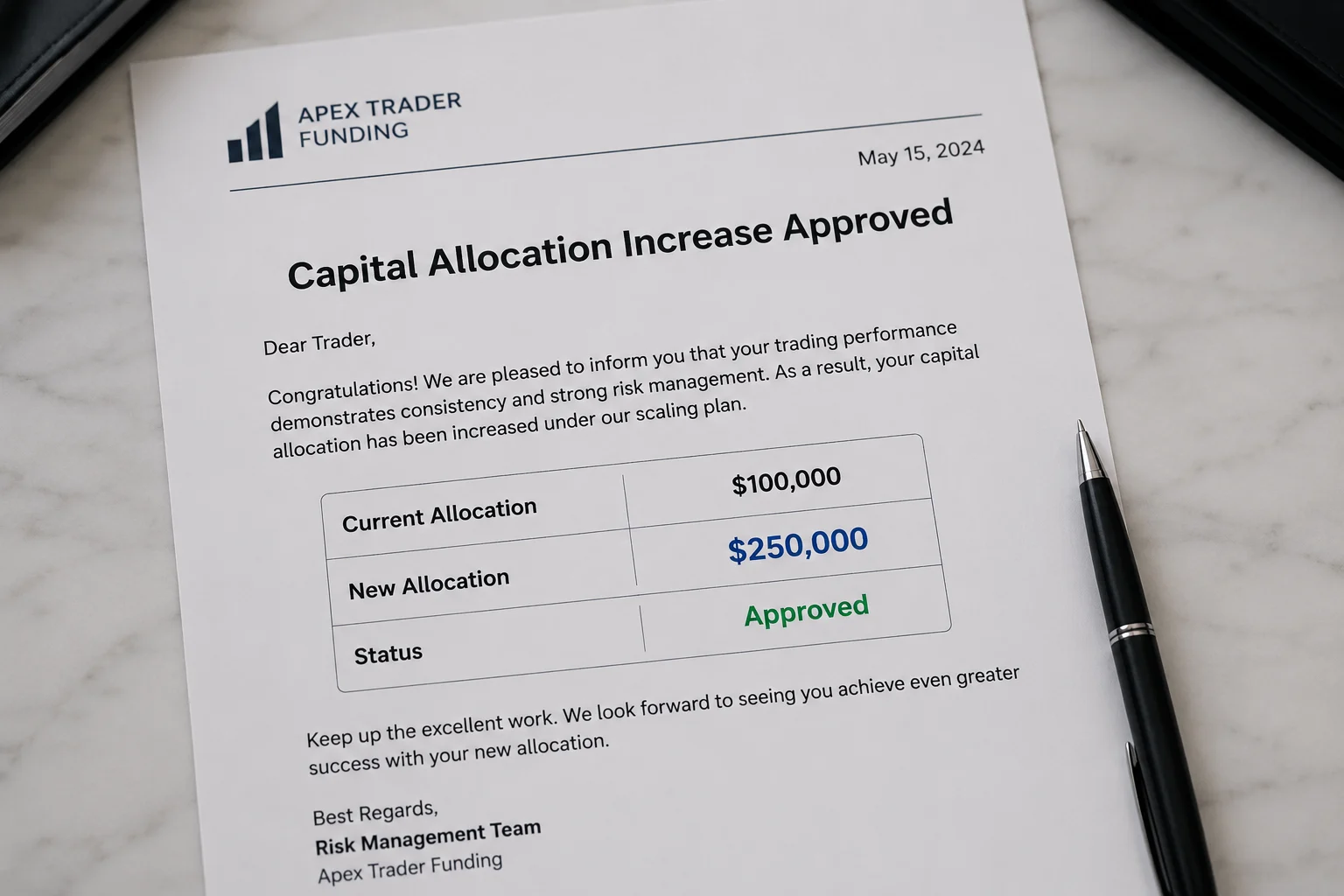
When the trader completes the milestones set by the prop firm, the firm will increase the trader’s account by either a predetermined dollar amount or a fixed percentage of the trader's total account size, depending on how the program is set up. increase their capital, as illustrated below.
Trading Stage | Account Size | Performance Requirement |
Initial Funded Account | $50,000 | Pass evaluation |
First Scaling Level | $75,000 | Consistent profit over several months |
Second Scaling Level | $100,000 | Continued risk management and profit targets |
Advanced Level | $200,000+ | Long-term profitable performance |
This gradual process allows traders to scale their capital while maintaining disciplined trading practices.
Related Articles: Are Prop Firms Worth It in 2026?
Scaling in Prop Trading
Many prop firms have scaling guidelines that must be met before a trader's account can be scaled.
The most common scaling criteria are usually profit percentage over an extended period (e.g., 10% profit over 3 months for a $10K example).
Following risk management rules is essential. Adhere to daily loss limits and overall drawdown limits, as discussed in Daily Drawdown vs Maximum Drawdown Explained.
Other prop firms will evaluate trading patterns for signs of excessive risk-taking.
Most prop firms prioritize consistency over aggressive profit targets. Typically, traders who generate consistent returns are preferred over traders who generate large returns in high-risk situations.
Scaling Plans: The Benefits to the Trader
Scaling plans offer considerable advantages to the trader.
First of all, they allow traders to access significantly more capital without having to contribute any additional funds. This can significantly increase the potential of making more money.
Second, they reward disciplined/trading behavior: traders who focus on consistency and risk management are generally going to qualify for increasing their trading account size.
Finally, they offer a defined career path in the prop trading environment, with a transition from small-stakes accounts to much larger ones.
For many traders, growing their capital based on performance is one of the biggest appeals of trading at proprietary trading firms.
Challenges and Limitations of Scaling Plans
While there are plenty of advantages to scaling trading programs, there are also challenges.
The first of these challenges is the time required to secure sufficient funding to continue trading. Since scaling typically happens over time, traders need to maintain their consistency and continue trading for an extended period before reaching higher funding levels.
A second challenge is how disciplined traders remain as their accounts become larger. As accounts grow larger, there can be greater psychological pressure on traders as their positions become substantially larger.
Lastly, as funding levels increase, some prop firms require additional conditions for their traders (such as stricter risk controls or changes to profit-sharing arrangements).
Understanding these limitations of scaling programs sets traders up with more realistic expectations for their ability to participate in such programs.
Managing Risk for Scaled Accounts at Prop Firms
The size of your account affects both the potential for profit and your associated risk. Therefore, it is especially important to manage risks correctly when trading large accounts, since both profit potential and risk increase with account size. Protecting your capital should involve maintaining proper risk levels on each trade by keeping a certain percentage of your overall account at risk, rather than increasing your position size.
In addition, even small mistakes on larger accounts can result in significant financial losses. Therefore, it is very important for you to stick to your drawdown limits and use a pre-determined risk management plan if you really wish to succeed long-term in the market.
Furthermore, maintaining emotional discipline and staying consistent with your method of managing large accounts is essential. When you use only proven trading strategies and avoid over-trading, you are then capable of continuing to grow your account over time by using scaling programs. Successful traders focus their efforts on providing a stable foundation for continued performance and reducing the risk they take during losing trades, which in turn provides them with a continuous stream of performance to create future scaling opportunities.
Final Thoughts
For any trader wishing long-term success within the proprietary trading industry, it is vital to understand how scaling plans work with prop firms, as emphasized by Your Trusted Broker Resource.
Prop Firm scaling plans are a way for traders to build their funded accounts by demonstrating their ability to consistently make profits and manage risk effectively. Although very rewarding, both patience and self-discipline are required for a trader to build and manage extremely large long-term capital.
With prop firms, the purpose of scaling plans is to find talented traders who can navigate larger capital amounts while maintaining stable performance. consistently will have the most success from scaling opportunities. As the prop trading industry grows, scaling plans will be essential for traders looking to advance their careers by increasing their trading capacity, managing larger portfolios, or accessing new markets.