
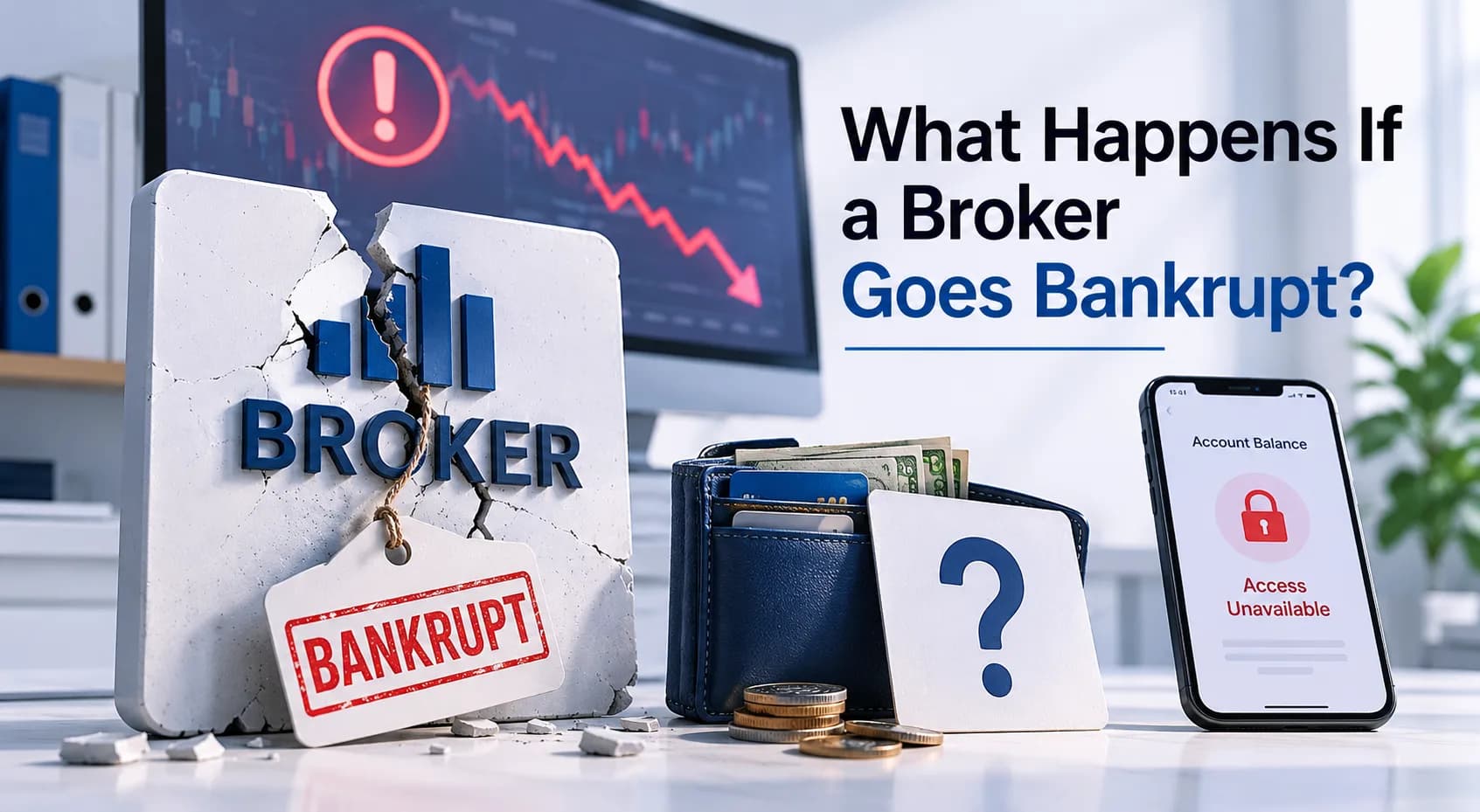
If your broker suddenly went out of business tomorrow, would your money be safe? It is a question that many traders choose to ignore. We all put in long hours looking at market charts, developing a buying/selling strategy, and managing our risk while trading, but we hardly ever consider the risks involved when our brokers go out of business.
Most regulated brokers are required to adhere strictly to capital requirements and financial compliance regulations. However, history shows that brokerage firms do sometimes go broke, so the main problem is not whether you will lose your money if your broker goes out of business… It’s whether you will be protected from losing your money if your broker goes out of business.
In this article, we will discuss what generally happens if a broker goes out of business, how client account funds are treated, what investor protection schemes may cover you, and how to protect yourself.
Can you lose your money if your broker goes out of business?
The simple answer is: sometimes yes, sometimes no. Whether you lose your money or are protected depends mainly on which regulatory protections your broker follows and the specific structure of your brokerage. This is due to two major factors:
Whether you have properly segregated your funds
Whether you are covered under an investor protection scheme
If your broker meets the basic regulatory requirements for operating in a well-regulated jurisdiction, then your funds should be segregated from your broker’s operating capital. This means that, in the event something bad happens to your broker, your funds (deposits) should not be used to pay his debts.
If your broker mismanaged your funds, failed to properly segregate them from his operating capital, or is not regulated by a regulatory agency, then recovering your funds will be much more difficult and complex.
How Client Funds Are Protected in Broker Insolvency
With that foundation, let’s look at what specifically happens to your trading account if your broker goes bankrupt. When a broker goes into bankruptcy, the regulatory authority typically intervenes immediately. The main regulatory agencies involved have taken certain actions, including:
• Suspending trading (of all securities) on the broker’s trading platform
• Freezing all client trading account withdrawals
• Appointing an administrator or liquidator to take over and manage the assets of the business
• Reviewing and reconciling the financial assets and liabilities of the trading firm
Once the regulatory agencies have taken the above steps and the broker has been placed into Bankruptcy, all open trading positions held by traders will automatically be closed (without any notice) to protect against potential trading losses due to further deterioration in the broker’s financial condition.
The Trading Regulator will verify the trades with the brokers and will then reconcile the funds within the brokerage account. The time it takes for the administrator to reconcile funds across all trading accounts can range from making funds available to clients within two weeks to many months or even a year or more for complex bankruptcies.
Related Articles: Warning Signs of Fake Brokers
How are client funds protected upon a broker’s Insolvency?
When a trader opens an account and deposits funds with a broker, the most important safeguard to protect the client’s funds is proper client fund segregation. Regulated brokers are required to keep their clients’ money in separate trust accounts at AAA-rated banks, meaning these accounts will be legally distinct from the brokerage's operating capital.
If a broker becomes insolvent, client funds that are segregated are not considered assets of the broker. Creditors of the failed broker cannot claim these segregated funds, and the administrator will return them to clients, in line with regulatory requirements. Although client fund segregation reduces the risk an investor faces when dealing with a broker, the risk of incurring an administrative cost or a discrepancy in client fund reconciliation may still affect the final amount of funds returned to each client.
Segregated Accounts Explained
Here is a simplified comparison, as outlined in Segregated Accounts Explained:
Feature | Segregated Funds | Non-Segregated Funds |
Ownership | Held in trust for clients | Mixed with company capital |
Creditor Access | Typically protected | May be claimed by creditors |
Regulatory Requirement | Required in strict jurisdictions | Often absent in offshore setups |
Recovery Likelihood | Higher | Significantly lower |
If your broker cannot clearly explain its segregation policy, consider that a red flag.
Compensation Schemes and Investor Protection
Investors in developed capital markets receive extra security from compensation schemes, as detailed in Investor Compensation Schemes Explained.
For example, some jurisdictions pay compensation to each investor up to a set limit. Compensation covers shortages in segregated client money. Some places set higher liability limits than others.
All compensation schemes are funded by contributions from regulated firms.
However, the size of compensation limits varies with the size of the investor, so professional traders who maintain sizeable cash balances in their accounts should know their local compensation limits.
SIPC, FSCS and Other Investor Protection Schemes
Investor compensation schemes vary widely. Each country has specific rules about qualification and the total amount of protection. are:
• Investor Compensation Fund (Germany, Ireland, Spain, etc.)
• Financial Services Compensation Scheme - FSCS (U.K.)
• Securities Investor Protection Corporation - SIPC (United States)
These systems all differ from one another.
In general, though, Generally, these systems compensate you only if the broker or dealer fails. This is different from losing money while trading. Open Trades if My Broker Fails?
What Happens to Open Positions During Broker Collapse?
If your broker fails while you are still using live trading accounts, Regulators will focus on limiting the risk posed by the broker's insolvency.Possible outcomes include:
• The closing of your position at the current market value,
• Transferring all of your positions to another broker,
• Temporarily halting your account until you can balance your sheet,
If you are trading during volatile markets, forcing liquidation will likely create substantial slippage for your account.
Professional traders regularly check their brokers’ stability as part of risk management.
How Does the Regulator React to Broker Failure?
When a successful broker shows signs of financial difficulties, regulators will respond as follows:
• Restricting the opening of new accounts,
• Restricting the trader’s activity,
• Increasing the amount of required capital,
• Conducting emergency audits,
If the broker is unable to become solvent, then the Regulators will typically appoint an administrator to:
• Review all client accounts,
• Balance all segregated accounts,
• Release any remaining funds to clients,
• Handle all claims for compensation.
Each jurisdiction outlines a different procedure for handling failures by regulatory license holders. The market will likely adopt a more structured approach to resolving broker failures.
What are the Warning Signs of an Impending Broker Failure?
The failure of a broker does not happen suddenly.
There are generally some warning signs that can be seen before the point of failure. Some of these indicators are:
• Requests for withdrawals take an unreasonable period of time,
• Changes in trading terms occur suddenly,
• Systems outages happen frequently,
• Regulators have taken actions against the broker,
• The broker experienced sudden losses,
• The broker’s use of aggressive sales techniques is designed to attract deposits.
Even if no operational problems indicate that the broker has entered insolvency proceedings, a broker with a consistent history of operational problems is not a good bet.
Offshore v Tier 1 Regulation: Does it Matter?
Yes, it makes a considerable difference, especially when viewed through a Global Forex Regulation Overview. Brokers that are Tier 1 regulated are subject to higher minimum capital levels, regular financial reporting, plus strict segregation of client funds, and participation in compensation schemes; whereas, brokers that are not Tier 1 regulated usually operate under lower capital requirements, along with a lack of supervision; therefore, there are minimal possible recovery methods available if that type of broker were to fail. Selecting a brokerage in a strong regulatory jurisdiction minimizes the counterparty risk.
Ways to Minimize Counterparty Risk
Even though brokers are regulated, smart traders continue taking preventive measures: 1. Don’t keep a lot of idle capital in your trading account, 2. Withdraw profits frequently; 3. Evaluate your broker’s financial strength and regulatory status; 4. If you are trading substantial amounts of capital, use more than one broker to reduce risk; 5. Follow regulatory news reports relative to enforcement actions. The management of counterparty risk is a part of any professional trader’s trading discipline.
In Real Life
Throughout the history of brokerage firms, financial failures have occurred due to factors such as extreme market volatility, poor risk management, fraud or internal misconduct, and, in some cases, liquidation. While these events are relatively rare among well-capitalized and properly regulated brokers, they highlight the importance of fund segregation and strict regulatory oversight.
It is also important to understand that counterparty risk does not appear on trading charts—it exists behind the scenes, within a broker’s financial stability and operational integrity.
Conclusion
If you have selected a properly regulated broker and your funds are segregated, you will generally be able to recover your capital through a structured insolvency process—something often explained across Wikilix Broker Analysis.
In some cases, additional compensation schemes may cover account shortfalls. However, with unregulated brokers or weak jurisdictions, recovery can be uncertain and significantly delayed.
Trading always involves risk, but counterparty risk can be managed. By choosing a strong, regulated broker, understanding compensation limits, and monitoring financial stability, you can reduce the impact of broker failure. Effective risk management starts before any trade—it begins with selecting the right broker.