
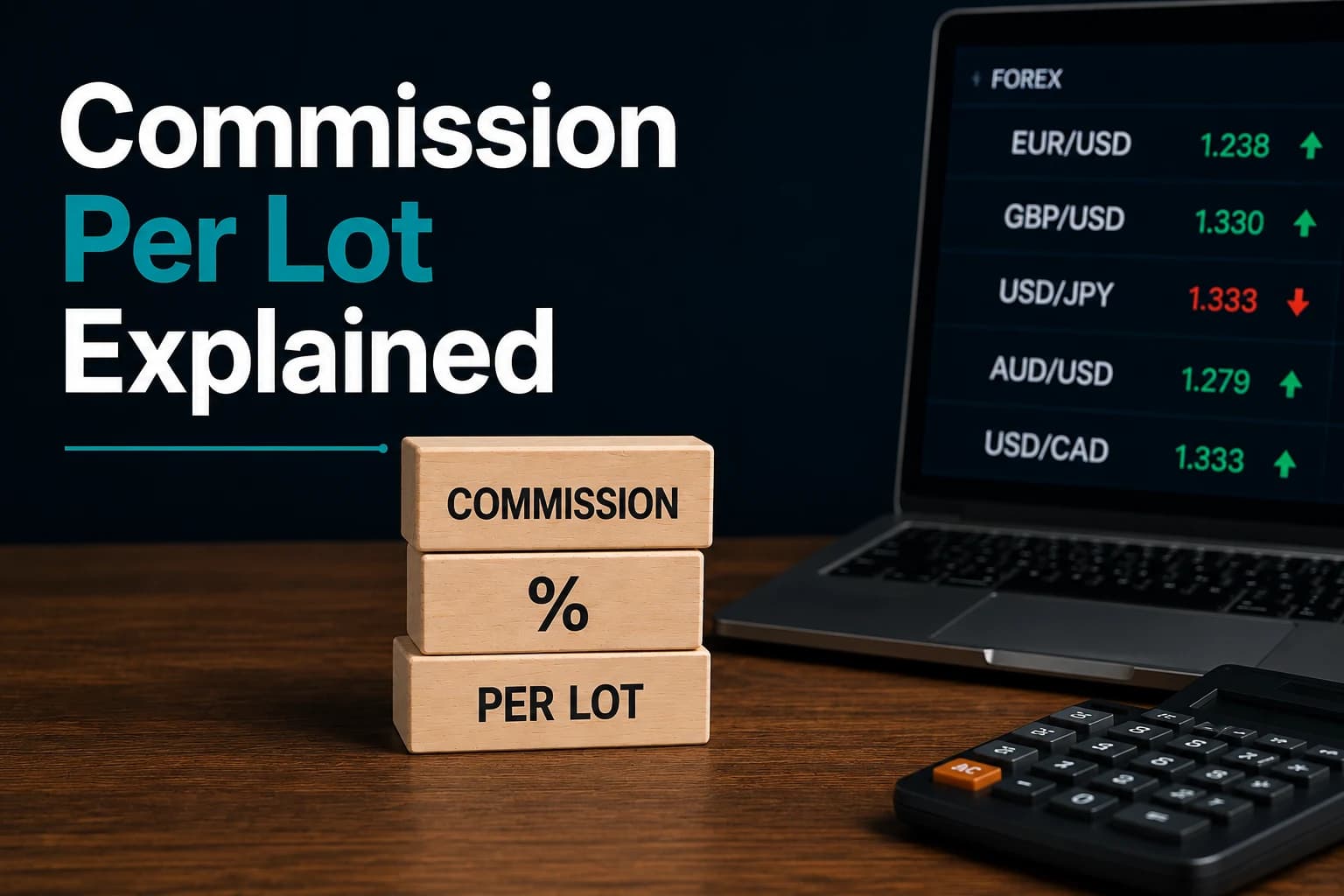
The most common question traders ask when they are going to start trading forex is what the commission per lot is and how brokers charge for executing a trade. Some brokers include execution costs in their spread, as they are charged against your order, while others charge an additional trading or commission fee per lot. If you have never been exposed to this pricing model, then Commission fees can be difficult to understand at first.
Knowing your trade commissions is important because they impact profits, especially if you trade frequently. Ignoring commissions may make a strategy seem profitable when fees actually reduce your gains.
The Commission per Lot pricing model has become more common in forex and CFD trading as more professional traders switch to commission-based account types, due to the reduced costs of these accounts. These accounts usually have very tight spreads and a clear commission amount you will be charged when you execute a trade.
This guide explains Commission per Lot, outlines how it works, and provides examples of how this pricing model can raise or lower your overall trading costs. We will also tell you when this pricing model is advantageous to traders.
Commissions Per Lot Explained
Commissions per Lot refer to the fee the broker charges for trading a position, based on the size of the position the trader is executing. In the forex market, positions are traded based on "lots", which are standardized units of measure (for example, 100,000 units of currency are a standard lot).
If a trader opens or closes a position equal to a standard lot, the broker will likely charge a fixed commission.
For example, a trader would pay a total of $7 in commission per lot for trading one complete standard lot (both opening and closing the position).
In summary, no matter which direction the market goes, when you execute one standard lot, you will pay a total of $7 in commission. The reason you pay a total of $7 for that trade is that the commission will be charged in conjunction with very narrow spreads (i.e., usually starting at or near 0 pips) in ECN-type accounts.
Related Articles: Best Brokers for Beginners 2026
Understanding Lot Sizes in Forex Trading
To understand commission costs, traders must first understand how lot sizes work. Different lot sizes correspond to different trade volumes.
Lot Type | Trade Size | Typical Commission Impact |
Standard Lot | 100,000 units | Full commission applied |
Mini Lot | 10,000 units | One-tenth of standard commission |
Micro Lot | 1,000 units | One-hundredth of standard commission |
Nano Lot | 100 units | Very small commission portion |
If a broker charges $7 per standard lot, a mini lot would typically incur about $0.70 in commission.
This proportional structure ensures that trading costs scale according to the size of the position.
How Commission-Based Accounts Operate
Brokers who operate commission-based accounts provide their services through a dual-pricing mechanism that separates the total transaction price into two components: the spread and the commission. The market price for one unit of currency is made up of a bid price and an ask price. The difference between the two prices is called the spread. In a raw spread account, the spread can be extremely narrow, at times as low as 0.00.
The commission is charged separately and is considered the broker's cost of executing the trade. This pricing structure provides greater transparency, as traders can determine the individual costs associated with executing a particular trade rather than relying on the total trade price, which includes these costs within a wider spread. This pricing structure is used by many ECNs and other professional trading accounts, including those featured in Best ECN Forex Brokers in 2026.
Commission vs. Spread-Based Pricing
Most forex brokers operate under two basic fee structures: the spread-based and commission-based. Spread-only fee structures include the broker's cost of executing your order in the spread; therefore, you will not see an individual commission charge, but the spread will likely be a bit wider. Commission-based fee structures will have a narrower spread; however, you will see a separate commission charged for each trade. Here's a simplified comparison:
Pricing Model | Spread | Commission | Typical Users |
Spread-Based Account | Wider spreads | No separate fee | Beginner traders |
Commission-Based Account | Raw spreads | Fixed commission per lot | Active traders |
Neither model is inherently better. The best option depends on the trader’s strategy and trading frequency.
Why Many Professional Traders Prefer Commission Accounts
Commission-based accounts are preferred by many professional traders, in part, because they offer more accurate pricing based on the interbank market. Additionally, by setting raw spreads, traders can see prices that are much closer to those in the interbank market, and, more importantly, these prices will aid in developing a precise entry or exit point for their specific trading strategy.
Traders who are also scalpers or high-frequency traders benefit from tighter spreads, as their strategies rely on a reliable method for generating small profits from multiple trades. Therefore, even a minor difference between spread sizes can impact profitable trading results.
Commission-based accounts also provide transparency, as traders can easily calculate the commissions they pay for each trade executed through their chosen broker.
How Commission Affects Trading Costs
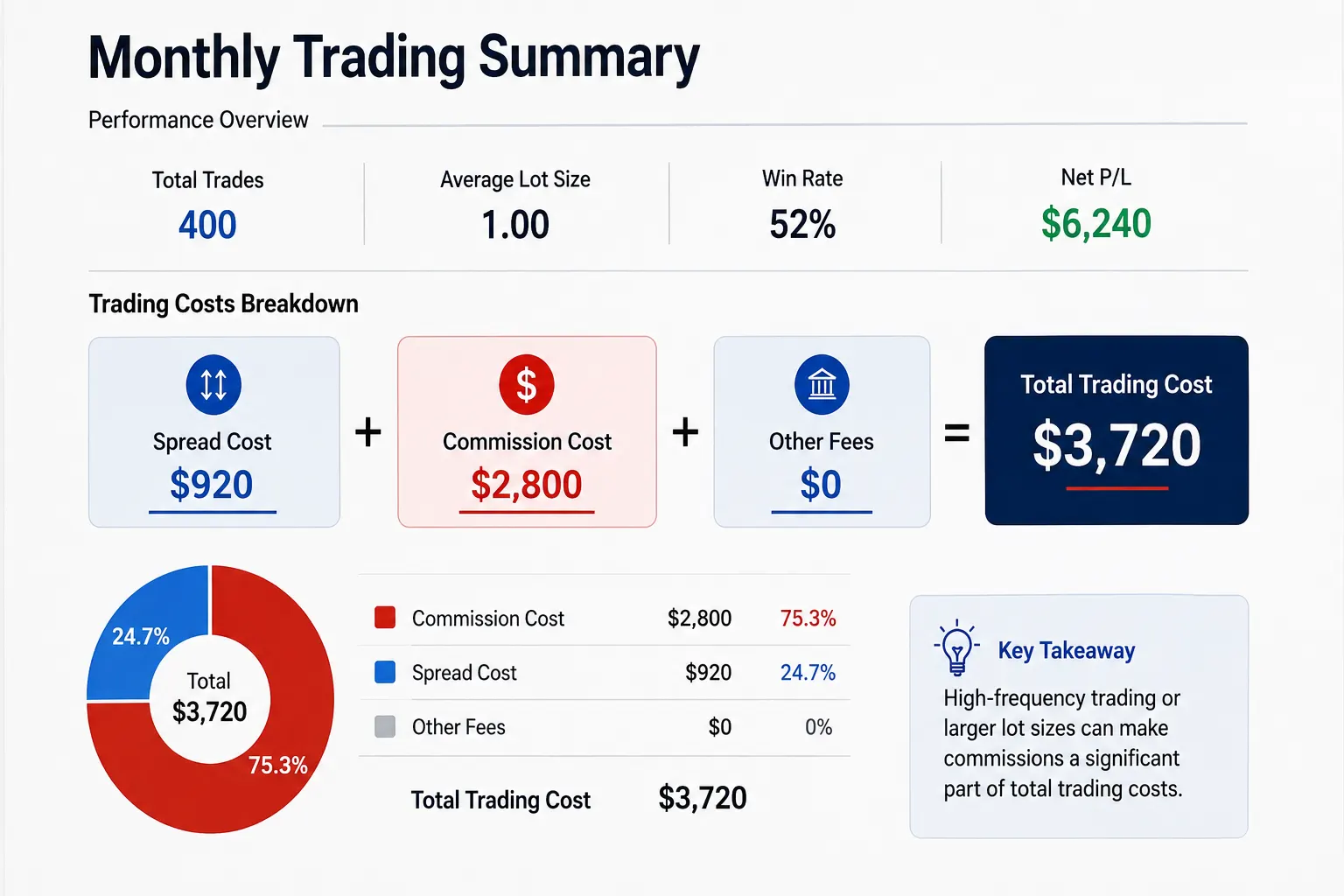
While commissions may seem to be relatively insignificant, their cumulative impact on traders can be dramatic over time.
For instance, let’s say a trader executes 20 trades a day with an average lot size of 1000, and the broker charges $7 per lot (rounded turn). The total commission paid by that trader each day would be $140.
Over time, the total commissions paid by that trader can increase significantly. However, when spreads become extremely tight, the total cost of trading (including commissions) may be lower than it would have been if traded solely on a spread basis.
When evaluating the total cost of trading with a broker, it is important to understand the spread and commission, as discussed in Spread vs Commission: Which Costs Less.
Commission Rate Factors
The commission rate at which traders are charged varies based on numerous factors.
One major influence on the commission structure is the broker’s overall liquidity structure. Brokers with access to multiple liquidity providers may be able to offer their customers better pricing due to increased market competition.
Additionally, the broker used for trading, as well as the type of trading account opened by the trader, will determine the commission structure.
Finally, another factor that affects the commission structure is the volume of trading the trader does. Some brokers offer reduced commissions to traders who trade a higher volume of contracts.
Because of these variables, all traders should review all commission structures before opening an account with any broker, as outlined in How to Compare Forex Brokers: Full Checklist.
Technology’s Role in Commission-Based Trading
Recent advancements in trading technology have enabled retail traders to access commission-based pricing through electronic communication networks (ECNs) and liquidity aggregation systems, which allow brokers to provide direct market access and raw spreads.
In simple terms, the price of an asset from an ECN or liquidity aggregator is determined by aggregating pricing from multiple financial institutions and displaying the best available bid and ask prices for each asset.
As competition among brokers has increased, the competition among their commission structures has mirrored it, similarly benefiting retail traders.
Modern trading platforms also provide transparency into commission charges, enabling traders to more accurately determine their trading costs over an extended period by tracking their activity on the platform.
Pricing Model Checklist
When selecting a commission or spread pricing model, traders need to consider their trading style.
For example, long-term traders who hold positions for days or weeks are unlikely to be greatly affected by minor differences in spreads. However, short-term traders may benefit greatly from the tighter spreads available with commission-style accounts.
The level of transparency is also an important factor to consider. Commission-style accounts outline trading costs separately, allowing traders to accurately calculate their performance.
Ultimately, the best pricing model is based on a trader's trade frequency and the extent to which their trading strategy is affected by trading costs.
Final Thoughts
Having a good understanding of the total cost of trading is essential for a trader to evaluate the true cost of trading. The commission per lot is the commission a broker charges for executing trades based on the size of the position. This pricing model is most commonly used in ECN-style trading accounts, which offer very tight spreads and charge commissions separately.
For most active traders, commission-based accounts provide transparent execution costs and access to competitive market pricing, as highlighted in Wikilix Broker Analysis.
Traders should always consider total trading costs, including spreads and commissions, when comparing brokers, such as in the Forex Broker Comparison Hub – 2026 Edition. Understanding commission structures helps traders decide which pricing model best fits their trading approach.