

For many traders, proprietary trading companies have provided a different way to trade in the financial markets. Rather than risking a large amount of their own capital, traders can access a funded account that provides much greater buying power. While this may sound simple at first: pass the challenge, get funded, and begin trading, experienced traders often find that each prop firm operates differently. In fact, the way a prop firm operates may make it perfect for one trader but completely unsuited for another.
By choosing an inappropriate prop firm, a trader may experience numerous challenges, including unnecessary frustration, failed challenges, and wasted evaluation fees, which is why many traders compare options like the Best Prop Firms for Beginners. Conversely, by selecting a prop firm that aligns with their trading style, they can substantially increase their long-term success potential.
One of the most critical things a trader can do when deciding to join a prop trading firm’s evaluation program is to fully understand how they will be assessed, including their trading strategies, risk tolerance, and trading habits.
Understanding What a Prop Trading Firm Has To Offer
Before selecting a proprietary trading firm, it is important to understand what the prop firms provide and how they operate.
Proprietary trading firms provide traders with access to company-operated capital following the successful completion of an evaluation process designed to assess their discipline, consistency, and risk management skills, without requiring them to invest large sums of their own capital. In most cases, traders pay a fee to take the challenge and must meet specific trading performance levels to receive the company account.o the following four characteristics. They usually include:
1. Profit Target During Evaluation Phase
2. Maximum Daily Drawdown Level
3. Maximum Overall Drawdown Level
4. Profit Share After Company-Funded
If a trader passes the evaluation successfully, he/she will receive a funded account and keep a portion of the profit generated.
While the above-described structure is typical, the rules vary from one prop firm to another, which is why traders need to thoroughly analyze them before making commitments.
Related Articles: Daily Drawdown vs Maximum Drawdown Explained
Identify Your Trading Style First
The trading style you prefer is the primary factor in selecting a proprietary firm. Many traders mistakenly select a trading firm first, then adjust their trading strategy to fit the firm’s policies and procedures. Successful traders do the opposite.
Examples of trading styles include:
• Scalping - opening multiple positions for very short periods, usually minutes; these traders want tight spreads, quick executions of trades, and few restrictions on trades.
• Day Trading - complete all trades prior to the end of the trading session; traders utilizing this form of trading will generally execute multiple trades in a single day, relying on intraday price action to do so.
• Swing Trading - holding trades for multiple days or weeks, relying on broader market movement versus short-term fluctuations. Swing traders should avoid proprietary firms that impose restrictions on overnight trades because of their account termination policy.
Your trading methodology should always dictate the selection of a trading firm before deciding on one.
Evaluation Models: One-Step vs. Two-Step Challenges
One of the biggest differences between proprietary trading firms is their process for evaluating traders. For the most part, firms utilize a one-step or two-step challenge model for development and funding.
One-Step Evaluation
One-step evaluation programs require a trader to meet a single drawdown limit while also achieving a single profit target. However, firms offering one-step evaluations usually charge higher fees than those offering two-step evaluations, and one-step programs generally have shorter adherence periods, during which traders are actively trading to reach their profit targets.
Two-Step Evaluation
A two-step evaluation consists of two phases:
A trader must meet a profit target during the first phase.
But once this target is met, the trader must demonstrate their ability to trade and consistently achieve long-term profits during phase two.
Although a two-step evaluation takes longer than a one-step evaluation, traders often prefer it because firms’ rules tend to be a little looser than those required for one-step evaluations.
Traders who prefer to fund their trading accounts quickly may opt for a one-step evaluation program, while those who want to keep their trading costs low may choose a two-step evaluation program.
Risk Management Rules & Drawdown Limits
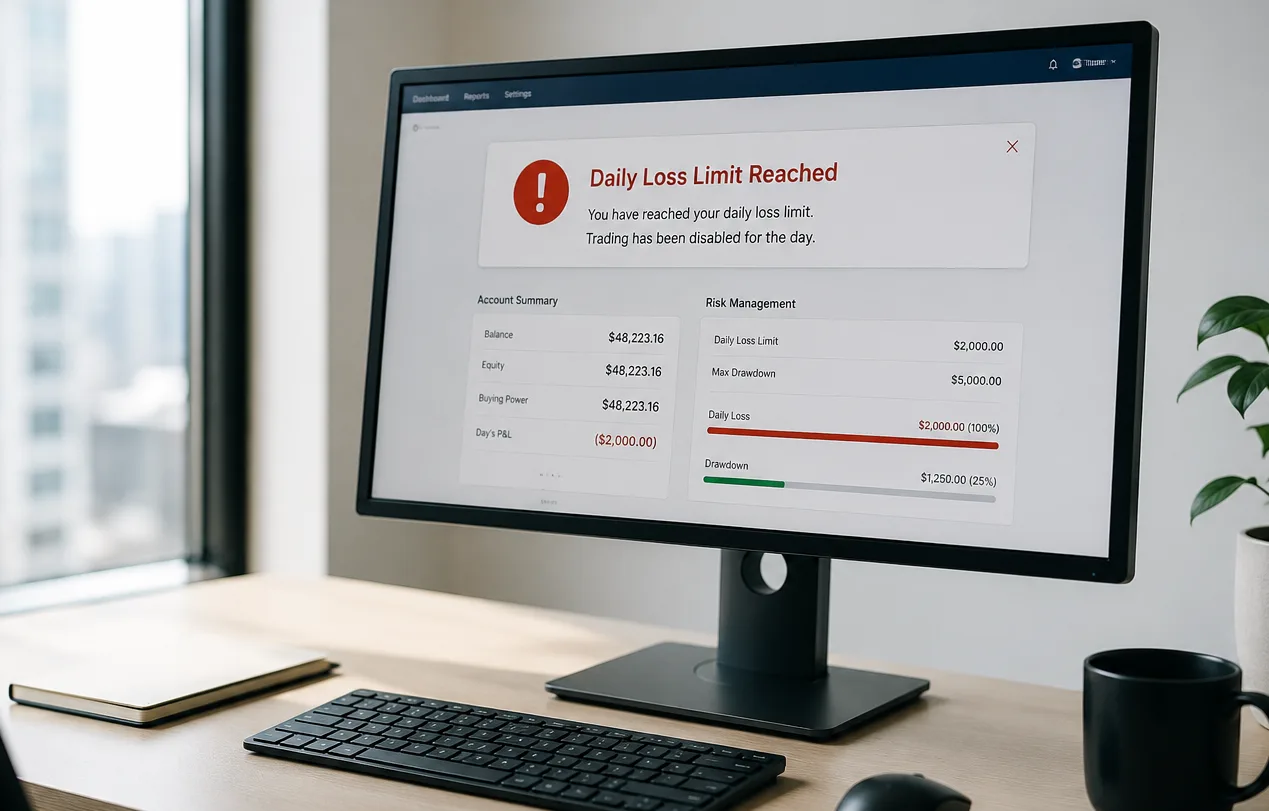
Risk limits are the key to all proprietary firms’ programs. Even profitable traders can fail a challenge if they violate a proprietary firm’s risk management rules. The two most critical limits that traders need to manage are:
Maximum Daily Loss
This is the maximum loss a trader can sustain in a single trading day.
Maximum Overall Drawdown
This is the maximum total loss a trader can incur before the trading account is closed.
Aggressive traders need to be more cautious about selecting proprietary firms that impose strict daily loss limits when using aggressive trading strategies. For instance, if a trader trades news or trades in an environment with high volatility, they have the potential to experience drawdown levels that exceed a proprietary firm’s daily loss limits.
As such, it is essential to obtain funding from proprietary firms whose trading rules are consistent with your risk profile.
Profit Split and Payout Policies
The profit split, which determines the portion traders retain from their trading profits, is the most important factor in a substantial evaluation, as detailed in Prop Firm Payout Structures Explained, since the majority of prop firms offer profit splits between 70% and 90%. Payout policies and approaches will differ across firms.
Some other critical factors that should be evaluated are:
- Frequency and method of payout
- Minimum withdrawal requirement
- Payout rules (i.e., must have x number of successful trades before payout)
Some firms may allow traders to withdraw every other week, while others may require a full month's worth of trading before the first withdrawal. Being aware of these policies can prevent unpleasant surprises for traders once they are funded.
Do you Know Your Trading Restrictions?
Another very important factor in selecting a prop firm is determining which trading restrictions will apply to you as a trader.
Some common restrictions include:
- No trading within a week of major economic news
- No weekend trading or overnight positions
- No copy trading or algorithm trading
- Limits on the size of the no position allowed
For example, if you are a swing trader, you should be careful to choose a firm that allows no overnight positions. Also, if you are using an algorithm to trade automated strategies, make sure that algorithmic strategies are permissible. These restrictions may make it difficult to comfortably execute your strategy.
Related Articles: Why Traders Fail Prop Firm Challenges
Comparing Key Factors When Choosing a Prop Firm
The following table highlights the most important elements traders should evaluate before selecting a prop firm.
Factor | Why It Matters | Best For |
Evaluation Model | Determines difficulty and timeline | One-step for faster funding |
Drawdown Limits | Defines risk tolerance | Conservative traders |
Profit Split | Affects long-term earnings | Professional traders |
Trading Restrictions | Impacts strategy flexibility | Swing or algorithmic traders |
Payout Schedule | Determines cash flow frequency | Full-time traders |
By comparing these factors carefully, traders can narrow down the prop firms that best match their trading style.
Reputation and Transparency of the Firm
The rapid growth in the prop trading sector has produced numerous questionable companies. Some of the companies have ambiguous payout policies and marketing that can mislead traders. Consequently, before becoming part of an evaluation program, traders need to do their homework on the company’s reputation. In particular, there are four areas for inquiry: Trader Reviews, Success Stories/Proof of Payouts, Transparency and Confidence in Leader(s), and Firm Longevity in the Marketplace.
Typically, companies that publicly publish rules of conduct, have clearly defined risk management methods, and provide superior means of communicating with traders are safer options for traders.
A reputable prop trading company will ensure that its relationships with the trading community are transparent and that communication channels are clear, supported by established policies.
Technology and Trading Platforms
Another commonly overlooked consideration by traders is execution. Most prop trading firms use one or more of the following platforms:
• MetaTrader 4
• MetaTrader 5
• cTrader
• Proprietary trading platforms
Execution speed, quality of spreads, and overall platform reliability may significantly impact total trading results. Therefore, scalpers and high-frequency traders should favour firms that offer low latency and tight spreads, while swing traders will typically evaluate firms based on the reliability of their data and platform stability.
Conclusion
Traders looking for the right prop trading firm should consider factors such as the type of challenge, the profit split/payout schedule, and how a firm’s rules align with their trading style, an approach often emphasized across Wikilix Broker Reviews. However, successful traders put the most effort into finding a firm whose trading rules naturally align with theirs.
Traders can greatly improve their chances of passing evaluation challenges and maintaining funded trading accounts by evaluating the following criteria: Evaluation Model, Risk Limits, Trading Restrictions, Payout Policies, and Company Reputation.
When choosing a prop firm, view it as a partner in your trading career rather than an obstacle. When the firm’s trading rules align with the trader’s strategy and risk profile, it enables more consistent, sustainable, and profitable trading.
Investing the time to research and compare prop firms carefully prior to joining the funded trading industry is the best investment a trader can make.