
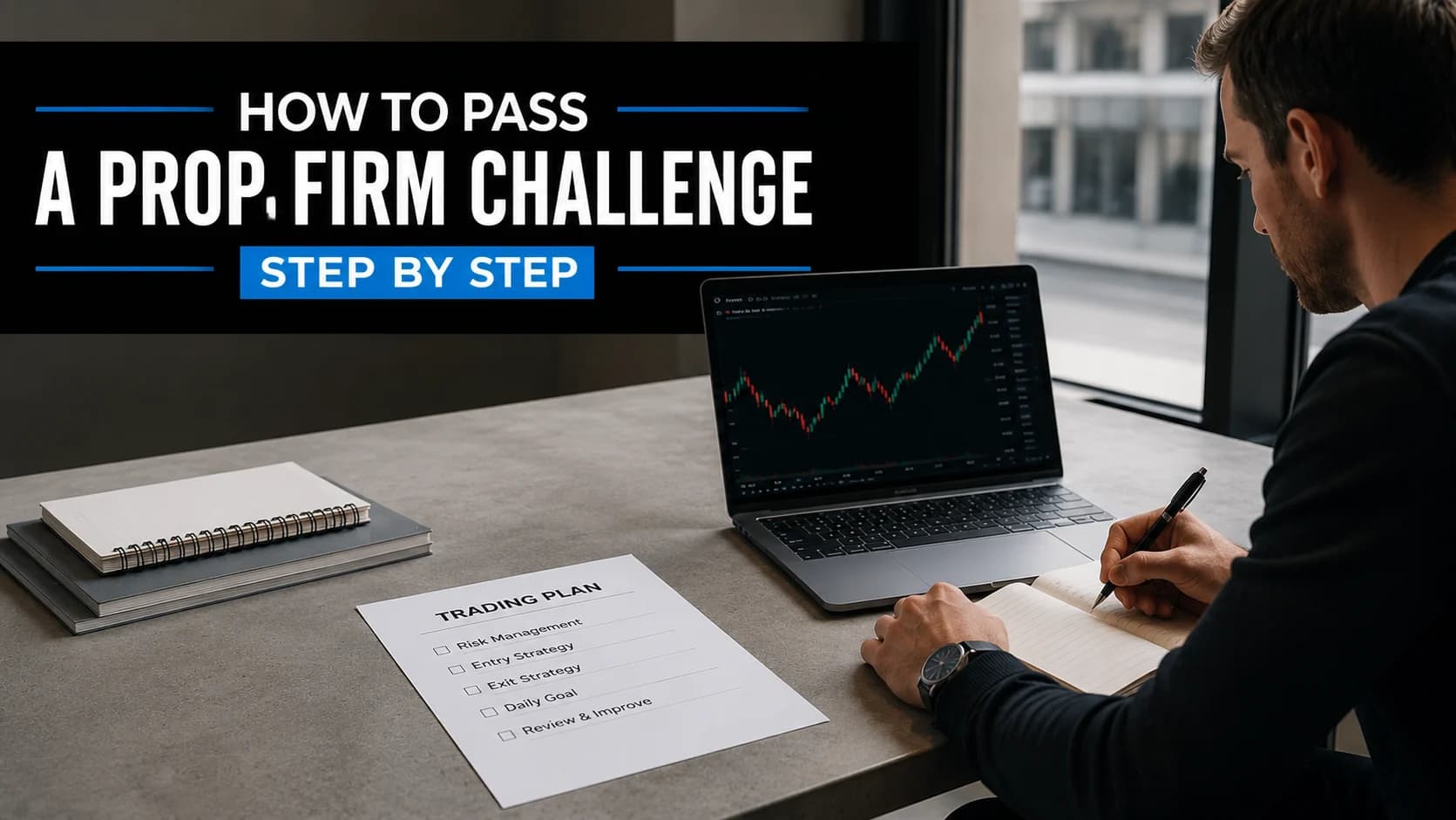
Every month, many traders apply to proprietary trading firm challenges to access potential funded accounts worth tens of thousands or even hundreds of thousands of dollars. Even so, a large percentage of these traders will fail in the first few days for reasons beyond their trading strategy. The primary reason many retail traders fail in the first few days of a prop firm challenge is that they underestimate the level of discipline required to trade in accordance with strict risk rules, which clearly explains Why Traders Fail Prop Firm Challenges.
The prop firm challenge criteria are not strictly based on profit generation but also contain some degree of risk management — can the trader generate a sufficient level of return without violating the prop firm's strict trading regulations? Prop firm traders must be able to demonstrate consistency in the following areas:
- Drawdown limits
- Maximum daily loss limit
- Trading behavior
The good news is that passing a prop firm challenge is entirely possible if the right mindset and organization are in place. Pro traders do not focus on profit; they focus first on surviving and second on generating profits by following an established process.
This article explains how to pass a prop firm challenge step by step, including strategies, risk management rules, and the psychology of consistently winning traders, to help you prepare for the challenge ahead.
Understanding How Prop Firm Challenges Work
You need to understand how different prop firm challenges work before you can successfully pass one of their prop firm challenges.
Most prop firms will have a two-stage evaluation:
- Phase One: Attaining a specific profit target (usually in the 8 to 10% range)
- Phase Two: Confirming your ability to continue generating profits while also demonstrating that you can maintain consistency by generating a lower level of profit than during Phase One.
In addition to these two phases, all prop firm traders must also abide by the prescribed risk limits of the prop firm, such as:
- Maximum daily drawdown amount.
- Maximum cumulative drawdown amount.
- Minimum number of trading days that a trader must complete.
If any of these risk limit rules are broken, the prop firm challenge will automatically fail.
Due to these restrictions, trading with a prop firm differs in many respects from your own personal trading account.
Choose the Right Prop Firm
Different prop firms have different rules and challenges that must be understood before choosing a company to work with. Traders need to carefully assess each company’s:
* Targets for Profit
* Limits for Drawdown
* Time Limits to Evaluate
* Platforms Available To Trade
* Opportunities For Scaling
Working with a firm that has realistic risk rules and flexible parameters directly impacts your chances of success.
With this in mind, choosing the firm you wish to work with becomes one of the most important decisions in successfully passing the evaluation.
Know The Risk Rules Inside And Out
The most common reason for failed evaluations is a misunderstanding of the drawdown rules, highlighting the importance of understanding Daily Drawdown vs Maximum Drawdown Explained. Most prop firms have two key limitations.
* Daily Loss Limit: This is usually set at approximately 5% of your account size.
* Maximum Overall Drawdown: This limit is typically around 10 % of your account size.
Traders who do not fully understand these limits often risk too much on a trade, which can lead them to fail the evaluation.
Understanding your firm's rules is critical to passing the evaluation.
Related Articles: Prop Firm Risk Management Rules
Why Risk Management Matters More Than Profit in Prop Firm Challenges
Now, let's shift focus to risk management, which should take priority over profit.
Most traders begin their evaluations thinking about all the profits that they’re going to be making, while professional traders think differently. Professional traders first look to preserve their capital.
A trader who can preserve their capital will typically give themselves enough time to reach their profit goal.
A basic rule of thumb many professional traders follow is to risk between 0.5% and 1% of their trading capital on each trade. By doing this, a trader will ensure that several losses will not ruin their trading account.
Only Take High Probability Setups
Most unsuccessful traders who are trying to pass the evaluation tend to overtrade because they feel they have to hurry to reach their profit targets. Consequently, they will begin to take trades that do not meet the rules of their trading plan.
Successful prop traders do the exact opposite, typically reducing their trading frequency to only those trades with a high probability of success. This will improve both the trader’s accuracy and psychological stability.
Adopt an Entrepreneurial Approach to Overcome Challenges
An efficient way to work through a prop firm challenge is to bring a business-like, professional mentality to it. Rather than just "gambling" on where the market moves, you want to create a plan or a project with clear risk management policies.
For example, you can create yourself an easy-to-follow, daily framework, including:
• Your pre-market analysis
• Your trade preparation
• Your risk computations
• Your post-trade journal/log
This structured framework helps you stay in control of your emotions and provides you with the best opportunity for good decision-making.
Example Risk Plan for Passing a Challenge
Below is a simple example of how a trader might structure their risk during a prop firm challenge.
Account Size | Max Daily Loss | Risk Per Trade | Maximum Trades Per Day |
$50,000 | $2,500 (5%) | $250 (0.5%) | 3–4 trades |
$100,000 | $5,000 (5%) | $500 (0.5%) | 3–4 trades |
$200,000 | $10,000 (5%) | $1,000 (0.5%) | 3–4 trades |
This type of structured risk plan allows traders to stay well within the prop firm’s limits while still working toward the profit target.
Don’t Let Emotions Ruin Your Trading
Psychology is an important factor to consider when participating in prop firm challenges. Pressure from the challenge’s strictness and deadlines can cause traders to make many of the same emotional mistakes, including:
• Revenge trading
• Increasing position sizes after a loss
• Overtrading after a losing streak
Successful traders remain composed and apply their strategies regardless of short-term results. Discipline outweighs excitement.
Think Long-Term, Not Fast Money
Another misconception about prop firm challenges is that they should be completed quickly; the truth is, taking your time may lead you to complete them faster than if you rush.
Instead, achieve consistent results daily over time, possibly a 0.5-1% average daily return, and target a 10% return, as opposed to rushing and hitting your drawdown. Consistency will always beat speed.
Related Articles: Best Prop Firms for Beginners
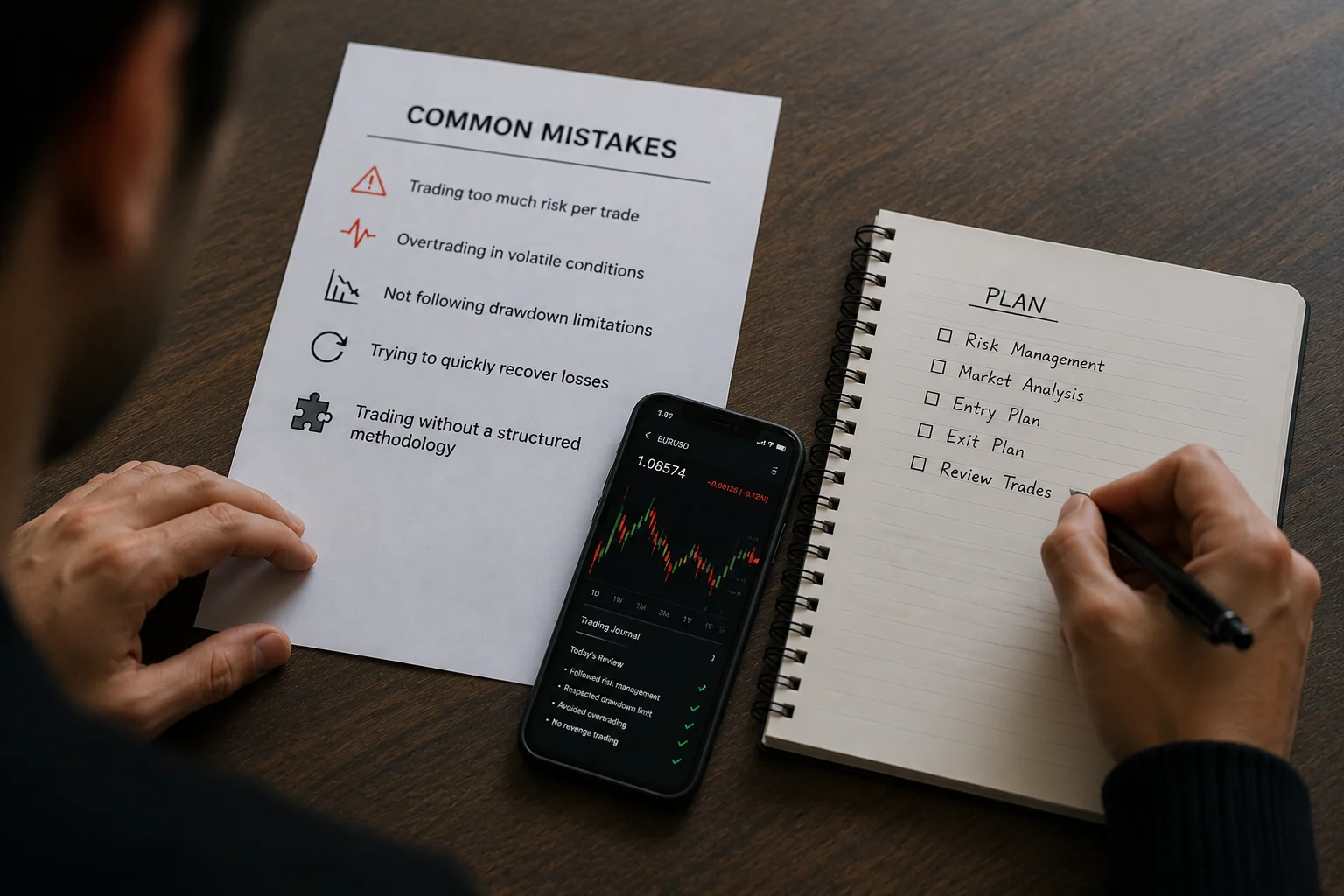
Common Mistakes That Can Lead To Failure
Despite being very good traders, many still have difficulty successfully completing a prop firm evaluation due to poor decision-making because of several common mistakes, including:
• Trading too much risk per trade
• Overtrading in volatile conditions
• Not following drawdown limitations
• Trying to quickly recover losses
• Trading without a structured methodology
If you focus on reducing these mistakes, you will greatly increase your chance of passing the evaluation.
Mindset of Traders Who Pass Prop Firm Challenges
Traders who can consistently pass prop firm evaluations have some common characteristics, including:
• They are patient, respect the risk rules, and are protecting their money. The key mindset for these traders is to view the evaluation purely as a risk-management activity, not as an opportunity for gambling. Therefore, when they develop this mindset, they are much more likely to pass.
Summary
Prop traders are increasingly using prop firm challenges to gain access to significant trading capital without risking their own money. As highlighted by The Broker Authority, the evaluation process within these firms applies strict criteria designed to filter out traders who lack strong risk management skills.
To extract real value from a prop firm challenge, traders cannot rely on aggressive strategies aimed at generating quick profits. Instead, success comes from demonstrating consistency, discipline, and a structured approach to decision-making.
Traders who choose a prop firm that aligns with their trading style, fully understand its risk rules, manage position sizing effectively, and focus on high-quality trade setups are far more likely to succeed.
Ultimately, the traders most likely to pass a prop firm challenge and manage a funded account are those who treat the evaluation as a disciplined risk management process rather than a race to make profits.