

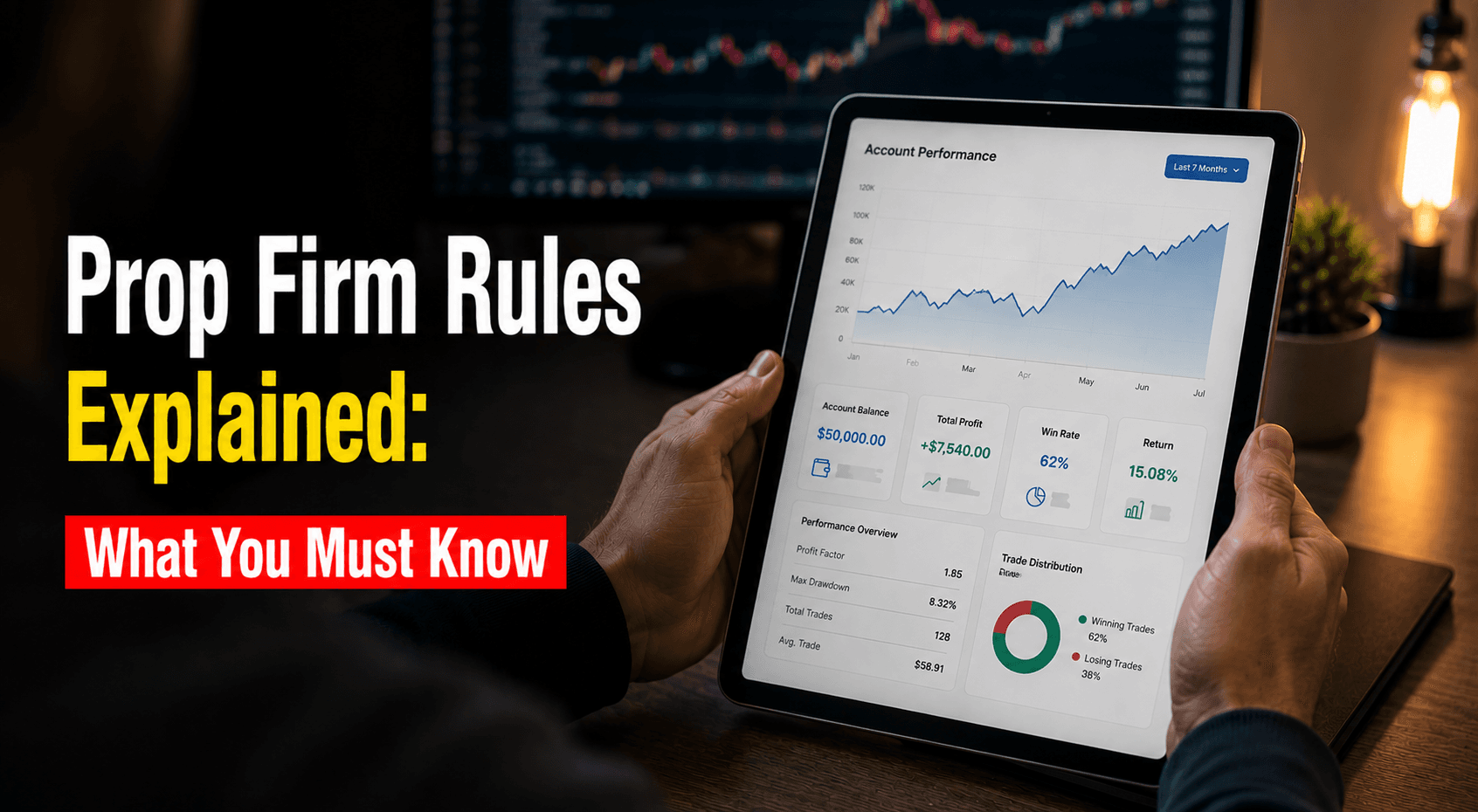
For many traders worldwide, proprietary trading firms offer access to significant trading capital without risking personal capital. Instead of funding thousands of dollars of personal capital, a trader can participate in evaluation programs and, if successful, manage accounts with funding of up to 6 figures. While the opportunity is very enticing, many traders do not take into account one key factor: the rules.
The rules of a proprietary trading firm are not merely administrative guidelines to be marked as read; they are designed to manage risk and protect that firm's capital. Every trader who participates in a challenge must operate within defined limits for drawdown, daily loss, trading behavior, and consistency. One reason traders fail a challenge is that they have either ignored or not fully understood the rules.
A trader may make a profit; however, he/she can fail the challenge by breaking just one rule. This is why understanding the rules of a prop firm is essential prior to entering a single trade. In this comprehensive guide to the rules governing proprietary trading firms, we will break them down by importance and explain how a trader can work through each.
What Are The Proprietary Trading Firm Trading Rules?
The rules of the prop trading firm are the risk management criteria and guidelines that a trader must abide by to participate in the firm's evaluation program (challenge) and receive a funded account, as outlined in Prop Firm Risk Management Rules.
The prop firm rules are structured to answer one question only: 'Will this trader be able to manage risk in a prudent manner while producing a consistent return on their capital?'
Unlike retail traders, who can assume virtually any level of risk, prop traders are subject to defined risk limits. Thus, to receive a funded account through a prop firm, a trader must demonstrate discipline and long-term consistency in their trading.
While the prop firm rules may vary slightly from firm to firm, the structure utilized is similar among all proprietary trading firms.
The Most Common Rules Used by Prop Trading Firms
Below are some of the most common rules that traders will encounter when participating in a prop firm challenge.
Rule | Typical Limit | Purpose |
Profit Target | 8–10% | Demonstrates trading ability |
Maximum Daily Loss | 4–5% | Prevents excessive risk |
Maximum Drawdown | 8–10% | Protects firm capital |
Minimum Trading Days | 5–10 days | Ensures consistency |
Profit Split | 70–90% | Determines trader payout |
These rules work together to create a structured environment where traders must focus on controlled, disciplined performance rather than aggressive speculation.
Related Articles: Daily Drawdown vs Maximum Drawdown Explained
Max Daily Loss Limit
The max daily loss limit is the most important rule in prop firm challenges.
Every trader must adhere to the maximum daily loss limit to participate in the challenge.
The maximum daily loss limit sets the maximum loss a trader can sustain in any given trading day.
If the trader's total losses exceed the maximum daily loss limit, the trader's challenge account will be terminated immediately.
For instance, if you are a trader participating in a challenge with a $100,000 evaluation account with a maximum daily loss of 5%, the maximum amount you can lose in any given trading day is $5,000.
The purpose of this rule is to prevent the trader from making emotional decisions and to ensure consistency in their decisions.
Professional traders set a maximum daily loss limit by managing their risk to 1% per trade, so they can lose multiple trades without exceeding the limit.

Max Overall Drawdown
The next important rule in a prop firm challenge is the maximum overall drawdown, also known as the maximum loss. The max overall drawdown limit is the total dollar amount a trader can lose during the challenge.
If your equity falls below this limit, you fail the challenge.
For example: Account size $100,000; max drawdown 10%; max total loss $10,000.
The max overall drawdown limit protects the firm from traders who may experience an extended losing streak.
By understanding max overall drawdown limits, traders can develop strategies that prioritize capital preservation rather than risky trading.
Related Articles: Can You Use EAs in Prop Firms?
Profit Targets in Prop Firm Challenges
Evaluations are used to determine if a trader will pass the evaluation phase by achieving profit targets. Most prop firms implement a two-phase assessment structure to ensure the trader delivers consistent results within the firm's risk parameters.
In phase 1, the usual profit target is 8%-10% of the trading account balance, and in phase 2, it is normally 4%-5%. While inexperienced traders frequently attempt to aggressively pursue profits, which leads to rule violations, experienced traders instead pursue daily returns of 0.3%-0.5%, which, compounded over time, will achieve both phases of the profit target without taking too great a risk.
Minimum Number of Trading Days
Most prop firms require a minimum number of trading days to pass the challenge. This rule is designed to keep traders from passing the challenge on “luck” or merely through one successful trade. Most prop firms require you to have completed a minimum of five days of trading to pass phase 1 of the evaluation process. The minimum number of trading days requirements ensures a trader will develop consistent trading habits and reduce any excessive risk-taking through their trading strategies. Secondly, when evaluating traders based on risk, prop firms view traders who generate consistent profits over several days as more reliable than those with a single trade that yields the entire profit.
Restrictions on Strategies
Many prop firms also place restrictions on the strategies a trader can utilize. The limitations that companies place on traders differ from company to company. Common restrictions you may find are as follows:
• High-frequency trading limits
• Latency arbitrage restrictions
• News’ trading rules
• Holding trades over the weekend limits
These companies impose restrictions to limit the risk associated with certain trading strategies that exploit pricing inefficiencies.
Traders should carefully review the rules of their respective prop firms before starting their challenges to ensure their strategies comply with those rules. If any of these rules are completely disregarded, the trader will be seriously penalized, even if they are generating large profits.
The Real Challenge of Risk Control
While many focus on profit targets, a prop trader is best evaluated by risk management.
A prop firm is not merely looking for a trader who can produce a profit quickly and with little time from when they start trading, but rather for a consistent trader who can protect their capital even under duress.
When a trader shows a good return with a low drawdown, it is much more valuable to a prop company than somebody who takes large risks for a small profit within a short period.
Successful traders understand these priorities and shape their trading plans to fit.
The common ways to manage risk are: limit risk per trade to 0.5% to 1%; avoid emotional decisions; use consistent position sizes across all trades; and set strict stop-loss rules.
By focusing on the safety of their capital, traders significantly increase their chances of passing the test.
Related Articles: How Prop Firms Make Money
Final Thoughts
The prop firm's trading rules are not meant to hamper your ability to trade; rather, they establish the boundaries of a responsible and disciplined trading environment. Understanding the rules of each company before you start a challenge can tremendously improve your likelihood of passing, which is why many traders turn to The Broker Authority for deeper insights. All maximum daily loss, maximum drawdown, profit target, and trading restriction limits are designed to weed out traders who cannot balance profitability with responsible risk management.
Many traders will fail prop firm challenges simply because they put too much emphasis on profits and not enough emphasis on the challenge’s structure. In fact, the successful trader approaches these challenges with a long-term mindset, placing greater emphasis on preserving capital than on immediate profits.
Take action now—learn how these rules work to dramatically increase your chances of passing a prop firm challenge.