


Lack of access to larger capital has historically been one of the most significant challenges that retail traders have encountered on their trading journeys. Limited account size can even prevent successful traders from scaling strategies that consistently produce tradable results. This is where proprietary trading firms, also known as prop firms, have changed the face of trading as it is practiced today.
By utilizing evaluation programs (rather than putting up their own capital), traders can demonstrate their capabilities and secure funding by meeting predefined performance conditions. Among the many evaluation program variations available today, the 2-step prop firm evaluation challenge is the most common evaluation structure used by firms.
While it might seem like the 2-step challenge is a considerable burden to overcome, it provides an even playing field that rewards traders who exhibit discipline in managing both their risk and their trading.
In this article, we will discuss how the 2-step process works, why it has become so popular with prop firms, and identify some of the firms that currently offer the best available conditions for traders, especially when compared to the Best One-Step Prop Firm Challenges.
What Is A Two-Step Proprietary Firm Challenge?
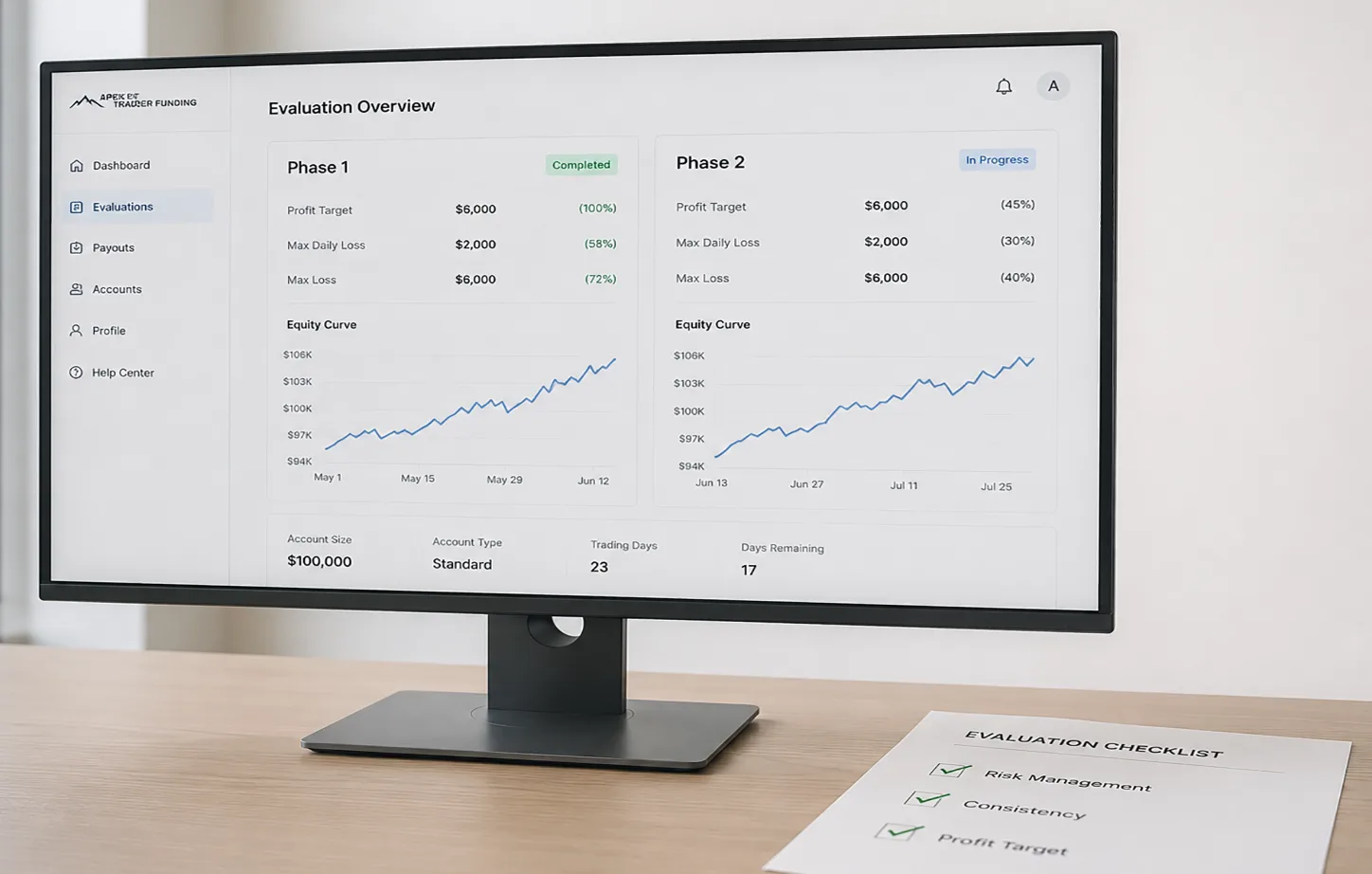
The 2-step prop firm challenge is a process. Proprietary trading companies use it to see if a trader is successful enough for a funded account.
There are typically two phases to the process. The prop firm's 2-step evaluation usually has two phases:
1. Phase 1 - Profit Target: Achieve a set profit target and keep within acceptable risk limits. This includes staying below a maximum drawdown or daily loss as set by the prop firm. Successfully completing Phase 1, there will be a smaller profit target set through which you must demonstrate that you can continually maintain stable performance in order to receive your funded trading account.
After successfully completing both phases of the evaluation process, you will receive your funded trading account, where you will trade using the prop firm’s capital and keep a percentage of the profits generated from trading. By filtering through this evaluation process, prop firms can detect and eliminate traders who rely heavily on high-risk strategies, and reward those who exhibit stable performance through disciplined risk management and trading.
Why Two-Step Challenges Are the Industry Standard
Two-step challenges have been implemented in the prop trading industry for more than 2 years now as the primary structure for evaluating traders.
There are multiple reasons for this shift, and one of the biggest advantages of the two-step evaluation system is that it allows for a balanced evaluation process for traders, as both profitability and discipline must be demonstrated for firms to minimize their risk.
Another advantage of two-step models is that they allow firms to identify traders who maintain a consistent level of risk management over longer periods, rather than relying solely on short-term performance, which can be influenced by luck.
Finally, traders also like using two-step evaluations because there are very clearly defined rules that can be predicted. The risk parameters are also similar across firms, allowing traders to easily compare firms using common risk parameters rather than trading under parameters that vary from firm to firm.
This structure has elevated professionalism within the prop trading ecosystem.
Key Rules for All Traders
While each prop firm has its own rules, most of the rules for the two-step challenges are similar.
Here, common evaluation rules include: Phase 1 profit targets of 8% to 10%, Phase 2 profit targets of 4% to 5%, daily maximum drawdowns of 4% to 5%, and overall maximum drawdowns of 8% to 10%. traders will also need to abide by other restrictions, such as maximum lot sizes, the times of day they can trade (during news events), or whether they can hold their position over weekends, depending on the firm’s policy.
The purpose of these rules is to provide traders with realistic risk-management conditions similar to those they would experience as professional traders.
Best Two-Step Prop Firm Challenges (Comparison)
Several prop firms currently dominate the industry with competitive two-step evaluation models.
Below is a simplified comparison of some well-known firms offering two-step challenges.
Prop Firm | Phase 1 Target | Phase 2 Target | Max Drawdown | Profit Split | Notable Features |
FTMO | 10% | 5% | 10% | Up to 90% | One of the most reputable prop firms |
MyForexFunds (model widely used before closure) | 8% | 5% | 12% | Up to 85% | Popular evaluation model |
The5ers | 8% | 5% | 10% | Up to 100% scaling | Long-term capital growth model |
E8 Funding | 8% | 5% | 8% | Up to 90% | Modern platform and fast payouts |
FundedNext | 10% | 5% | 10% | Up to 90% | Flexible trading rules |
Each firm has unique advantages, including different scaling plans, payout cycles, and trading conditions.
Choosing the right prop firm depends heavily on a trader’s strategy and preferred risk tolerance.
Related Articles: Daily Drawdown vs Maximum Drawdown Explained
Advantages of Two-Step Prop Firm Evaluations
The increasing popularity of two-step evaluations is no accident! Traders and prop (proprietary) firms alike benefit from this type of evaluation.
Key Advantages to Two-Step Evaluations:
1. Balanced Risk Assessment
Designed in two phases, the evaluation criteria span a longer period, allowing firms to assess potential traders who use a structured trading plan rather than an aggressive (short-term) one.
2. More Realistic Trading Environment
Traders are required to manage drawdowns and achieve consistent prorate (profit) targets; therefore, the evaluation process is similar to how a trader would trade in a professional environment.
3. Increased Trust in Industry
Prop firms use structured evaluations that are widely recognized and found in most evaluation programs across the industry, thereby providing transparency and credibility to the prop industry. Traders can now compare firms with confidence using similar evaluation criteria.
Reevaluation Challenges: A Common Mistake That Traders Make
Even though they are structured, many traders fail at the two-step challenge because they underestimate the psychological aspect of the evaluations.
Some of the most common mistakes traders make include the following:
1. Overtrading. Traders will try to reach the profit target more quickly, which often results in greater-than-anticipated drawdowns.
2. Lack of Risk Control. Several oversized trades can quickly exceed one's daily loss limit.
3. Lack of Discipline near Profit Target. Many traders increase risk as they near the profit target, rather than attempting to preserve their profits.
Successful traders approach trading challenges as if they were managing their professional trading account.
How to Increase Your Chances of Passing
Completing a prop firm two-step challenge requires more than just a combination of profitable strategies. Several key principles are generally observed by traders.
Consistency as opposed to speed
Most often, there are no set time limits requiring the trader to reach their profit target quickly. Therefore, steady, slow growth is usually the safest approach.Always adhere to drawdown limits.
Many challenge failures occur when traders complete a challenge but exceed the daily drawdown guidelines. The recommended way to mitigate this risk is by maintaining smaller position sizes.Avoid trading with emotions.
Emotional evaluation programs assess both discipline and individual trading performance.Trade only your ideal trade setups
Trading selected trades improves your chances of winning and helps keep your risk within limits.
By integrating these principles—consistency, risk management, emotional control, and selective trading—traders significantly increase their chances of finishing both stages of their evaluation successfully.
The Future of Prop Firm Evaluations
The future of prop firm evaluations continues to evolve quickly. As the number of firms in the prop trading industry grows, other evaluation methods will emerge.
Some prop trading firms have one-step challenges, while some instantly fund accounts without requiring an evaluation phase, which is a key feature of the Best Instant Funding Prop Firms.
However, most prop trading firms provide a clear path for skilled traders to obtain the capital they need, making the two-step evaluation model the preferred approach in the prop trading industry.
In the next few years, we can expect the following advances:
• Most firms will implement faster payout systems
• Most firms are likely to expand their scaling plans
• Most firms will create more flexible and defined trading conditions
• Most firms will improve transparency regarding evaluation requirements
These advances will likely bring more traders into the prop trading industry.
Conclusion
Prop trading has become a significant part of the trading industry and is generally regarded as a two-step process. As outlined in Wikilix Broker List, in addition to testing a trader’s ability to remain consistent in their trading results, these evaluation systems create a structured path for experienced traders to access significantly larger amounts of capital.
Prop trading firms provide an opportunity for traders without substantial personal accounts to develop profitable trading programs with considerably lower personal financial risk. However, to succeed in these evaluations, traders must demonstrate sound risk management, discipline, and, more importantly, patience.
Traders who maintain a consistent, professional approach to their challenges are far more likely to complete them successfully than those focused on generating quick profits.
As the prop trading industry continues to grow and evolve, two-step evaluation models will remain one of the most effective methods for traders to prove their ability and gain access to institutional-level trading capital.