
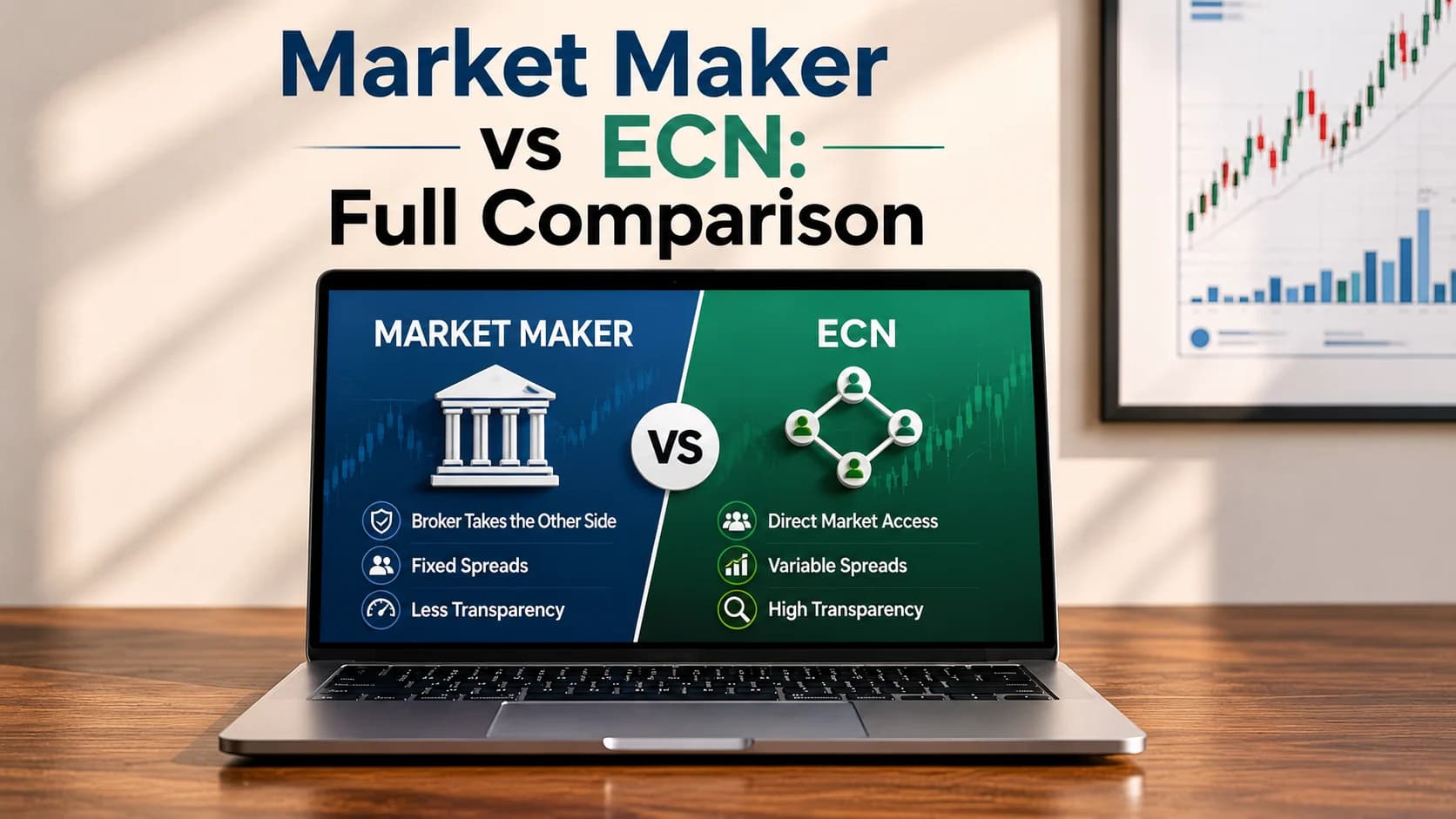
New traders often find broker execution models confusing. The two most common types in forex and CFD trading are market makers and ECN brokers. Both give market access, but differ in trade execution and liquidity sources.
New traders should realize that broker execution models matter. Your trading can be affected in several ways: spreads vary across models, order speed, trading costs, and trade-matching methods also change. Some traders like the consistency of market-maker brokers, while others want ECN transparency and market access.
If you are new to trading, you will see these two terms often. It helps to know what they mean. Both models process orders differently. The main difference is in the source of liquidity.
This article will clearly outline the key differences between market makers and ECN brokers. It will compare how trades are executed, explain the pros and cons of each model, and help you decide which model best suits your trading style.
What is a market maker broker?
A market maker broker creates its own internal liquidity. It does this by matching client orders in-house. It can also send orders to outside liquidity providers.
When you trade, the broker acts as the counterparty. For example, if you buy a currency pair, your broker may take the other side of the transaction.
Market maker brokers usually offer fixed or stable spreads and a simple pricing structure. This gives traders consistent liquidity, even when market volume is low.
With market maker brokers, spreads remain predictable because the broker controls the trading environment. This stability continues even when prices fluctuate. However, one concern is a potential conflict of interest—since the broker can take the other side of your trade.
In contrast, an ECN broker does not hold client trades in its own account, as explained in What Is an ECN Broker. Instead, clients trade directly with other participants through the ECN, accessing prices from multiple market makers or liquidity providers. In regulated markets, brokers must comply with strict rules to protect traders from unfair practices.
ECN systems collect price quotes from many sources. They show traders only the best bid and ask prices. When you place an order on an ECN, it is matched with the available liquidity in the network at that time. ECN prices may differ from those set by a broker's own dealers. ECN accounts usually have narrow spreads that may start at zero. But ECN brokers generally charge a commission per trade. ECN execution is becoming more popular as traders seek flexible pricing and direct access.
Related Articles: Spread vs Commission: Which Costs Less?
Key Differences Between Market Maker and ECN Brokers
Both types give market access. Market makers use internal liquidity and stable spreads. ECNs use outside liquidity sources and variable spreads. These structural differences impact spread consistency, price transparency, and trading costs.
Feature | Market Maker | ECN Broker |
Execution Model | Internal order matching | Direct liquidity network |
Spreads | Often fixed or stable | Variable, often tighter |
Commission | Usually included in spread | Separate trading commission |
Liquidity Source | Broker internal liquidity | Banks and liquidity providers |
Order Execution | Broker acts as counterparty | Orders matched in ECN network |
Transparency | Moderate | High |
This comparison highlights the structural differences between the two models. However, neither model is inherently better than the other; suitability often depends on the trader’s strategy and preferences.
Trading Costs: Spread vs Commission
The main distinction between an ECN broker and a market maker is how trading costs are structured.
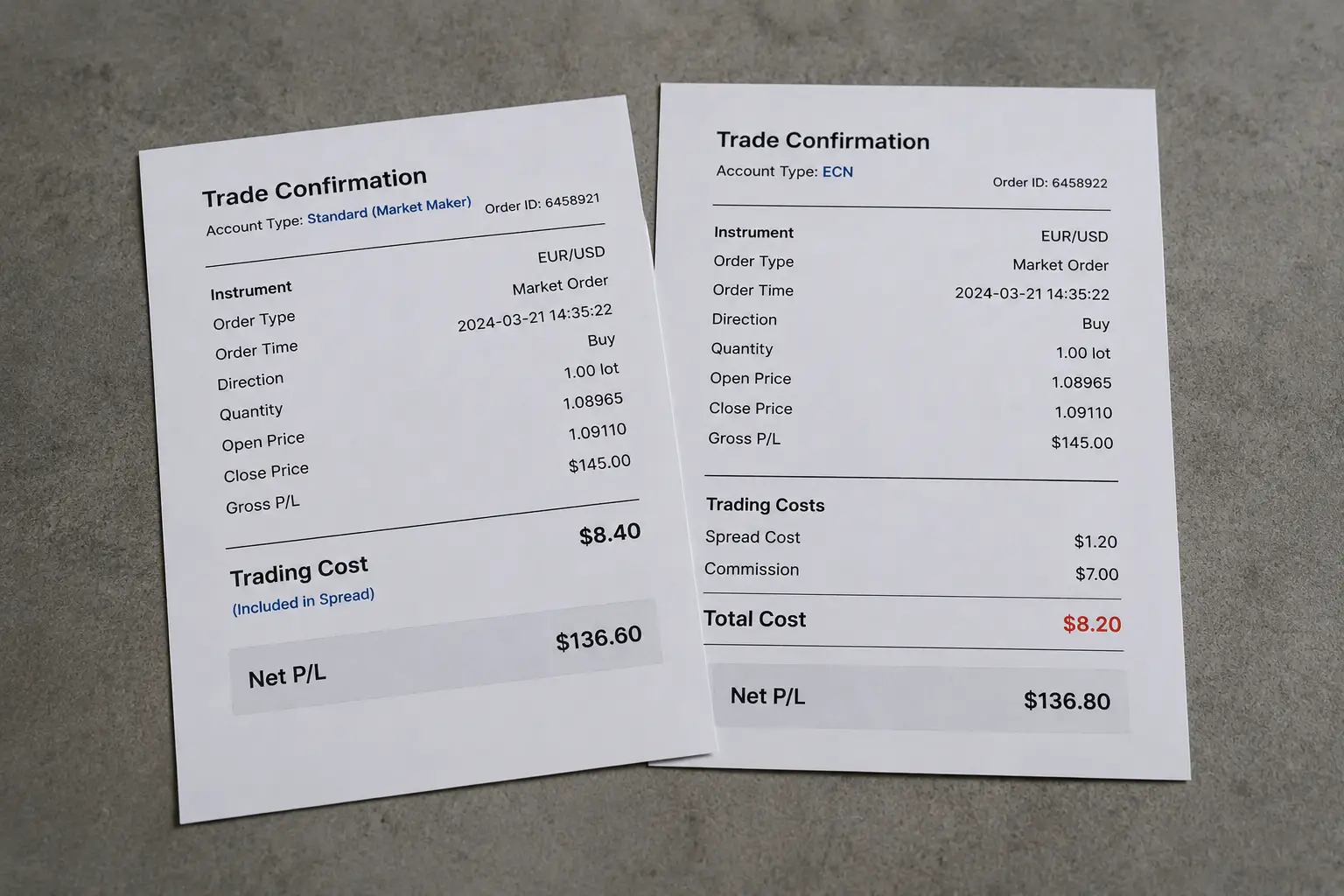
With a market-maker broker, the trading fee is included in the spread, so there is no separate commission charge. This structure is attractive to novice traders because it is relatively easy to understand.
Conversely, an ECN broker will charge separate commission fees for trading and offer tighter raw spreads. Initially, it may appear that ECN trades will cost substantially more than trades with market-making brokers; however, active traders often find that their overall trade costs with an ECN broker are lower than those charged by market-making brokers.
For example, scalpers and high-frequency traders can achieve substantial savings by using tight spreads offered by an ECN account, thereby reducing transaction costs.
Slippage and Execution Speed
Another area where there is a significant difference between a market-making broker and an ECN broker is execution quality. In general, ECN brokers provide faster execution than market-making brokers because orders are usually routed directly to liquidity providers. Execution speed is especially important for scalpers and other traders who frequently enter and exit positions quickly.
On the other hand, market-making brokers generally provide stable execution under normal market conditions. However, in volatile market conditions, there may be occasional delays or requotes in execution, depending on the specific execution systems employed by the individual broker.
Many modern brokers use highly efficient execution systems. As a result, the differences between market makers and ECN brokers may not be as clear as in previous years.
With the distinctions in trading costs and execution quality outlined, the next consideration is which model best suits various trading styles.
The decision between using a market maker vs. an ECN broker is entirely based upon an individual trader’s personal characteristics, trading strategy, and experience level.
For new traders and other sophisticated traders (scalpers and algorithmic traders), market-maker brokers are generally preferred, as they offer simple trading conditions. Therefore, many beginner traders find that the simplicity, stability of spreads, and ease of pricing make them a good choice.
For traders who are scalpers and/or use algorithmic trading strategies, ECNs offer them advantages, such as lower trading costs due to tighter spreads and quicker trade execution, as seen when reviewing Best ECN Forex Brokers in 2026.
Longer-term traders may not notice any significant difference between the two execution models, since they place trades much less frequently and the spread would have less impact on their overall profitability.
Understanding your own trading style will help you decide which broker execution model is best for you.
Related Articles: Forex Broker Comparison Hub – 2026 Edition
Regulation & Broker Transparency
Regardless of whether an execution model is considered “good or bad,” the most important factor in selecting a broker is the regulatory environment in which they operate.
An appropriately regulated broker must meet regulatory standards on pricing transparency, client funds protection, and fair execution, as outlined in How Regulators Protect Forex Traders. Meeting these regulations will provide the trader with a reliable and safe trading environment.
Regulatory authorities in major financial markets require brokers to disclose the execution models they use and the associated trading costs.
By choosing a properly regulated broker, you can substantially reduce the risks you face when trading online.
Technology & Market Evolution
Over the past ten years, there have been great strides in the technology used in the trading industry, and improvements in liquidity aggregation have enabled brokers to better serve their clients with competitive pricing and rapid trade execution.
Many brokers today operate hybrid models, combining elements of the market-maker and ECN execution models by dynamically routing customers’ orders based on current market conditions.
As technology continues to advance in the trading industry, the differences between execution models may become less important to many traders.
Understanding both execution models is key to making informed trading decisions and selecting the broker type that best supports your trading goals.
Conclusion
Ultimately, the choice between Market Maker and ECN brokers depends on how trades are executed and how costs are structured. Market makers provide internal liquidity with stable spreads and simple pricing, while ECNs connect traders directly to liquidity providers, offering tighter spreads and greater transparency.
Each model has its advantages. Market makers suit beginners with consistent conditions, while ECNs are often preferred by scalpers and active traders seeking better pricing and faster execution.
In the end, the right choice depends on your trading style, strategy, and experience. Understanding these differences helps traders select the broker that best fits their goals, especially when using Your Trusted Broker Resource.