

In recent years, proprietary trading firms (or prop firms) have dramatically changed the trading landscape. Only a few years ago, traders had to use substantial capital to participate meaningfully in the market. With prop firms, talented traders now have access to large amounts of funded accounts and do not have to use their own money.
The growth of these firms has also enabled thousands of aspiring traders worldwide to enter the market. Instead of depositing thousands of dollars in a broker to trade, traders will now have access to up to $10,000,000 of capital with only their passing of the prop firm evaluation.
However, if you work as a trader with a prop firm, you will quickly realize that succeeding with that prop firm will not be as easy as passing the evaluation. While many traders pass the challenge phase, most fail to maintain consistent performance post-evaluation, which highlights Why Traders Fail Prop Firm Challenges. Additionally, many traders misunderstand the rules, risk limits, or profit structures.
This Prop Firm Mastery Guide for 2026 will provide details on everything that traders need to be aware of when it comes to prop firms, including how prop firms operate, how evaluations are set up, the rules that will help show you how to make a profit, and the strategies used by traders to stay funded long term.
What is a Prop Trading Firm?
Proprietary trading firms, also known as Prop Trading Companies, provide traders with capital to trade financial markets in the prop firm's name. In return for using the firm's capital to trade, the trader will share a predetermined percentage of the profits generated by that trading with the prop firm, which is a core concept behind How Prop Firms Make Money.
While the concept as a whole is classic, prop trading firms have now entered the mainstream due to the increase in popularity of remote prop trading. This has enabled retail traders to trade at remote prop firms online.
Another common model for prop trading firms is the evaluation model. Almost all retail prop trading firms require that traders first prove their trading ability by passing a challenge, which may require demonstrating risk management and profit-generation skills.
Upon successful completion of the challenge, the prop trading company will allocate a capital account to that trader and permit them to retain a portion of the profits as previously authorized. Typically, a trader retains between 70% to 90% of the profits they generate.
Related Articles: Best Prop Firms for Beginners
How the Prop Firm Evaluation Process Works
Most proprietary trading firms use multi-stage evaluations to measure traders’ discipline, risk control, and profit performance.
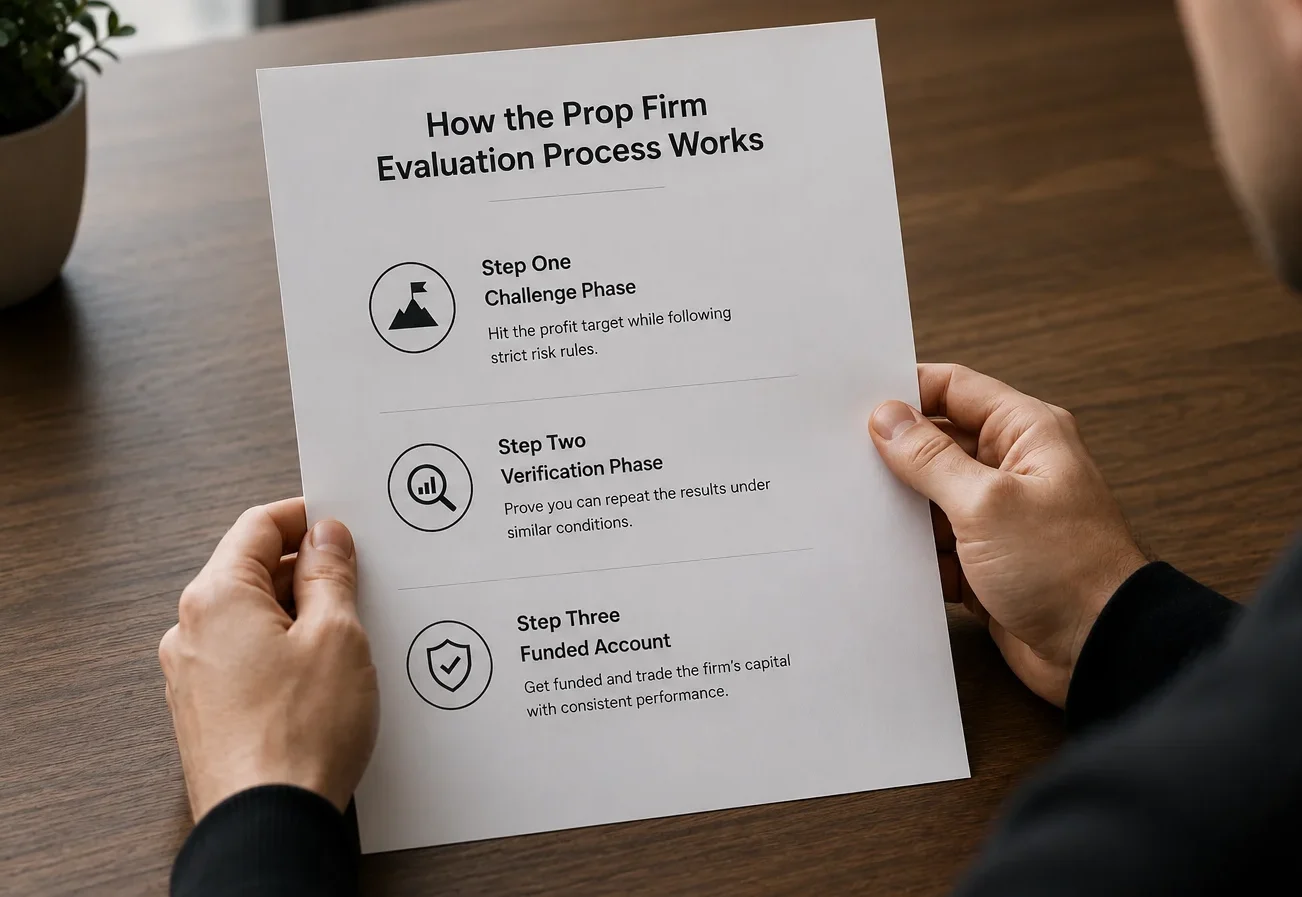
Step One – Challenge Phase
In this phase, a trader is tasked with reaching a predetermined level of profit while adhering to stricter risk management standards, such as maximum daily losses, overall drawdowns, minimum number of trading days, and profit targets (typically 8-10%), as clarified in Daily Drawdown vs Maximum Drawdown Explained.
This step checks whether traders make consistent profits with low risk.
Step Two – Verification Phase
If a trader successfully completes the challenge phase, they proceed to the verification phase, where they must demonstrate to the company, under very similar conditions, that they can repeat their results. Typically, the profit target will be lower than that in the challenge phase, and the risk management parameters will be the same.
During verification, the firm will decide if the trader’s results were due to chance or to their strategy and aggressiveness.
Step Three – Funded Account
Once both phases of the evaluation are completed satisfactorily, the trader is provided with a funded account to continue executing trades using the firm’s money while following pre-established payout schedules (typically bi-weekly to monthly).
Key Rules Traders Must Understand
One of the most common reasons traders fail prop firm challenges is misunderstanding the rules.
These firms operate under strict risk frameworks designed to protect capital.
Below are some of the most important rules traders must follow.
Rule | Description | Typical Limit |
Maximum Daily Loss | Maximum loss allowed in a single trading day | 4%–5% |
Maximum Drawdown | Total account loss allowed before failure | 8%–12% |
Profit Target | Minimum profit required to pass evaluation | 8%–10% |
Minimum Trading Days | Required number of active trading days | 5–10 days |
Position Restrictions | Limits on news trading, holding overnight, or weekend trades | Depends on firm |
Understanding these conditions before starting the challenge is critical for long-term success.
Related Articles: Best Instant Funding Prop Firms
Why Prop Firms Have Become Popular
The Prop Trading Firm Boom: Prop Firm Growth and What It Means for Traders Today
There have been several growth factors associated with the increasing number of proprietary trading firms:
The removal of the capital barrier to trading. Traders no longer need large deposits to gain significant market exposure.
The ability of proprietary trading firms to quickly scale trading accounts for traders. Some proprietary trading firms have scaling programs, which allow traders who demonstrate consistent performance to increase their capital allocation.
The fact that profits are shared between the proprietary trading firm and the trader creates an incentive structure for both parties. The trader wins when successful, and the firm wins when the trader is successful.
For disciplined traders, proprietary trading firms offer a pathway to trading professionally without assuming the administrative or capital-raising responsibilities of managing other people’s money.
Common Trader Mistakes in Proprietary Trading Challenges
While proprietary trading firms may seem very attractive on the surface, the percentage of traders who have been successful with them is extremely low.
There are several key mistakes that participants in unsuccessful proprietary trading firms continue to make.
Overrisking
Too many traders try to reach their profit target as quickly as possible, leading them to overrisk each trade. This leads participants to violate their daily loss rule long before reaching the profit target. For successful traders, the normal risk per trade is 0.5% to 1%.
Overtrading
Another common mistake is overtrading. Many traders believe that taking more trades increases their chances of reaching the profit target. However, disciplined traders only take trades they believe have a high probability of success.
Violation of Rules
Even profitable traders can lose out due to noncompliance with the proprietary trading firm's rules. Some of the most common examples are:
• Opening trades during a restricted news period.
• Holding trades overnight when prohibited.
• Hitting daily loss limits.
For proprietary traders looking to succeed in the challenges, it is critical to carefully review the terms and conditions of the proprietary trading firm before participating.
Best Strategies for Passing Prop Firm Challenges
Trading strategies for professional traders and retail transactions are very different from what most retail traders or amateurs think.
The objective of professional prop traders is to deliver consistent, risk-managed performance rather than to maximize profit.
To achieve this, many effective trading strategies focus on helping professional prop traders create consistent performance through proper risk management.
Trade Fewer High Quality Setups
Experienced traders trade only when the market conditions are good. Furthermore, this portion of their trading will increase their chances of winning and decrease the likelihood of making decisions based on emotion.
Consistency Over Speed
Most prop firms do not require their traders to complete their evaluation quickly. This allows them to spread the completion of their evaluation over multiple days, helping build their discipline and eliminate any built-up pressure.
Professional proprietary traders view the evaluation process primarily as an assessment of risk management capabilities, rather than as a race to completion.
The Prop Trading Industry in 2026
The proprietary trading industry is evolving rapidly. The following three trends are currently influencing and shaping its future:
Increased competition is driving prop firms to improve their offerings for retail traders. As a result of this trend, prop firms are introducing better trading conditions, higher payout percentages, and more flexible rules for trader evaluations. These changes reflect an industry-wide shift to meet the needs and preferences of retail traders.
The development of technology in the prop trading industry has accelerated the evolution of risk management systems, resulting in more effective monitoring of trader performance and more precise identification of rule violations through advanced analysis, thereby shaping industry standards.
There is increased regulatory scrutiny of the prop trading industry as many firms expand globally. This trend may lead to additional oversight or licensing requirements that could affect how these firms operate in different regions.
Despite all these changes, the prop trading industry continues to offer retail traders one of the greatest opportunities to access large amounts of trading capital.
Conclusion
Proprietary trading firms continue to play an increasingly important role in the modern trading landscape. As noted by The Broker Reference, they offer qualified traders access to substantial trading capital without requiring them to risk their own funds.
However, succeeding within a prop trading firm requires more than just profitability. Traders must consistently demonstrate discipline, strong risk management, and the ability to follow strict evaluation rules set by the firm.
A clear understanding of how prop firms operate—from the evaluation stage through to managing a funded account—can significantly improve a trader’s chances of long-term success.
For those who approach the process with a professional mindset, prop trading firms present a powerful opportunity to transition into full-time trading. Traders who focus on disciplined execution, patience, and consistency are far more likely to stay funded and build a sustainable career in the financial markets.